My husband had always been controlling about money.
But that morning, he crossed a line I never thought he would cross.
It started with something that should have been simple.
His sister, Melissa, had asked to use my credit card.
She said she needed it for several expenses and promised she would pay me back.
I refused.
The card was in my name, the account was mine, and after years of covering household expenses, I had finally started keeping my finances separate.
My husband became furious.
“You’re really going to embarrass my sister like that?”
“I said no.”
He slammed his cup onto the table.
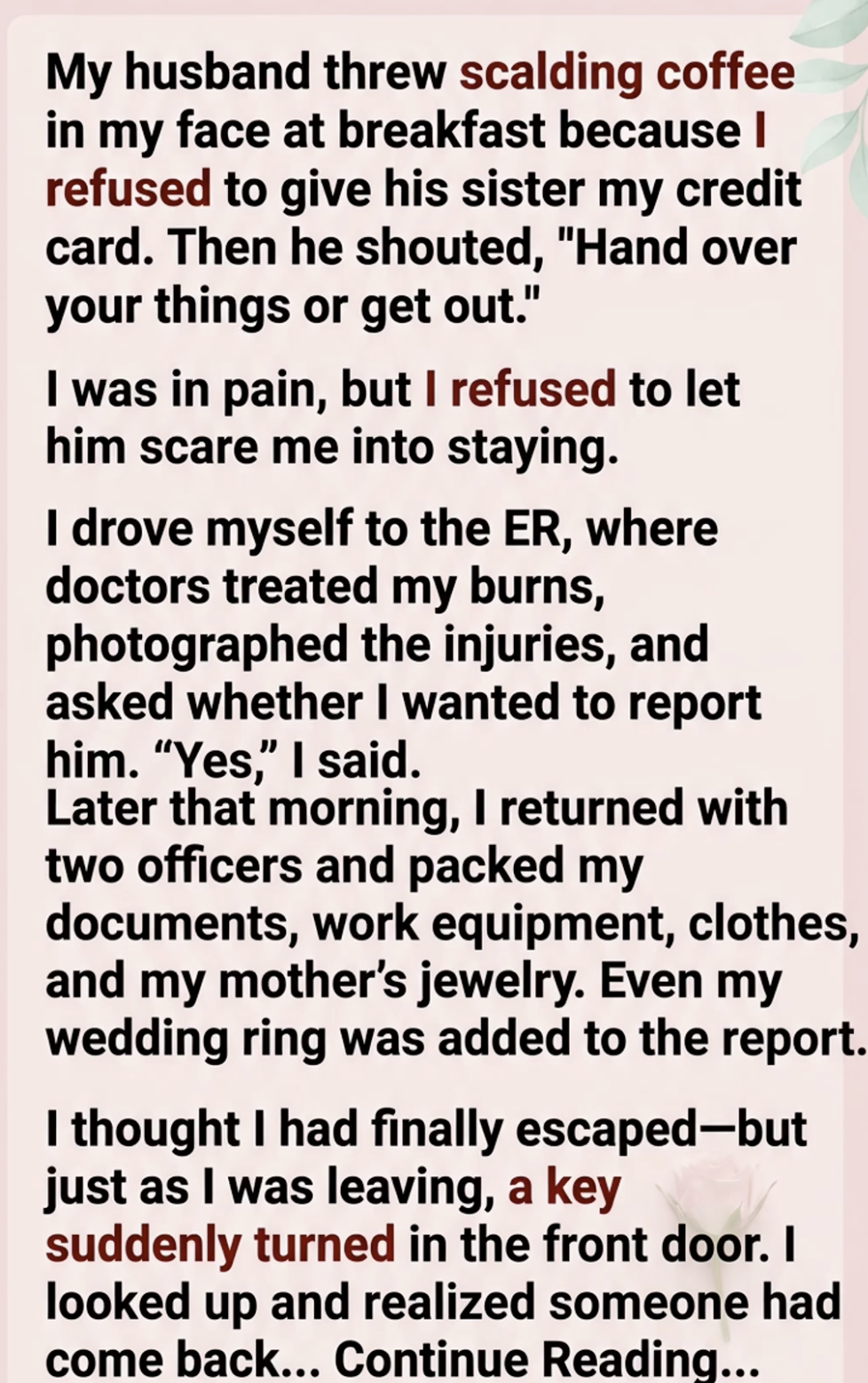
Then, before I could move, he threw the scalding coffee toward me.
Pain shot across my face and neck.
I screamed and stumbled backward.
He didn’t apologize.
Instead, he pointed toward the hallway.
“Hand over your things or get out.”
Something inside me went completely quiet.
I didn’t argue.
I didn’t beg.
I picked up my phone and left.
I drove myself to the emergency room, where doctors treated the burns and documented my injuries.
A nurse asked me a question I’ll never forget.
“Do you want to report what happened?”
I looked at the photographs they had taken.
Then I thought about all the times I had told myself his behavior wasn’t serious enough to leave.
“Yes,” I said.
The report was filed.
Later that morning, I returned to the house with two officers so I could safely collect essential belongings.
I packed my identification, financial documents, work equipment, medication, clothing, and my mother’s jewelry.
The officers also documented the condition of my injuries and the items I was taking.
Even my wedding ring was listed because I wanted a clear record of everything involved.
I thought that was the end.
I was wrong.
I had just picked up the last box when I heard a sound behind me.
A key turned in the front door.
I froze.
One of the officers immediately moved toward the entryway.
The door opened.
My husband’s sister, Melissa, stepped inside.
She stopped when she saw the officers.
Then she looked at me.
“What are you doing here?”
I stared at her.
“This is my home too.”
She looked nervous.
Then something slipped from her hand.
A small envelope.
It landed on the floor.
I bent down to pick it up.
Melissa tried to grab it first.
One of the officers stopped her.
“Leave it there.”
I looked at the envelope.
My name was written across the front.
Inside was a copy of a credit-card application.
My credit information was printed across the pages.
But I had never applied for it.
At the bottom was a signature that looked similar to mine.
Almost.
But not quite.
I looked at Melissa.
“What is this?”
She said nothing.
The officer examined the document and asked her where she got it.
She eventually admitted that my husband had given her access to some of my financial information.
He had been trying to arrange another line of credit using my information.
The credit card she had asked for that morning wasn’t the only thing she wanted.
They had been planning to use my credit to cover debts I hadn’t agreed to take on.
Suddenly, the argument over one credit card made sense.
My husband wasn’t simply angry because I had refused to help his sister.
He was angry because I had stopped cooperating with a financial plan I didn’t even know existed.
The officers documented the paperwork and added it to the report.
Melissa eventually left with an attorney.
My husband didn’t return that day.
And for the first time in years, I wasn’t waiting for him to come home.
I stayed with a friend that night.
Over the following weeks, I worked with my bank to secure my accounts, changed my passwords, placed additional protections on my credit, and gave investigators every document I had.
My husband tried contacting me repeatedly.
At first, his messages were angry.
Then they became apologetic.
Then they became promises.
“I’ll change.”
“I lost control.”
“Come home and we’ll fix this.”
I didn’t respond.
Not because I hated him.
Because I finally understood that apologies couldn’t erase what had happened.
The investigation eventually confirmed that financial documents had been accessed without my permission.
The matter involving the attempted use of my identity was handled separately from the domestic violence case, and both became part of the legal record.
Months later, I stood in a new apartment surrounded by boxes.
The place wasn’t large.
It wasn’t luxurious.
But every key belonged to me.
Every account was mine.
Every decision was mine.
I kept my mother’s jewelry in a small safe beside my documents.
My wedding ring was there too.
I hadn’t decided what I would eventually do with it.
One evening, I looked at it for a long time.
For years, I had thought that leaving meant losing my marriage.
Eventually I realized something different.
Leaving meant I had stopped losing myself.
I couldn’t change what happened that morning.
But I could decide what happened next.
And when the door finally closed behind me for the last time, I didn’t feel like I was running away.
I felt like I was finally going home.