At dinner, my husband suddenly reached across the table and grabbed my purse.
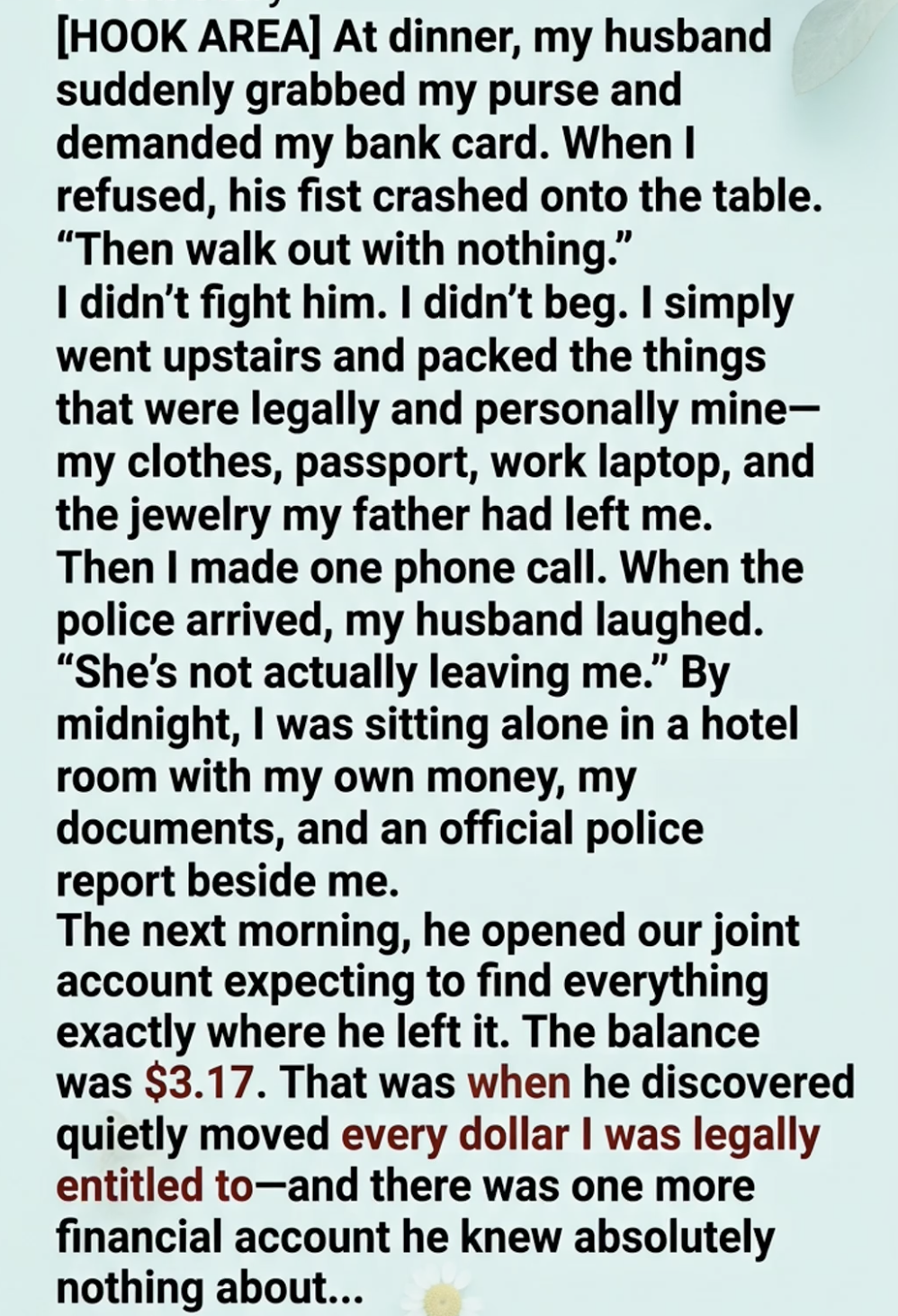
“Give me your bank card.”
I pulled it back.
“No.”
His expression changed instantly.
His fist slammed onto the table hard enough to make the glasses jump.
“Then walk out with nothing.”
I didn’t argue.
I didn’t cry.
I simply looked at him and realized that the man sitting across from me wasn’t asking for my card because he needed help.
He wanted control.
I quietly stood up.
“Fine.”
He laughed.
“Where are you going?”
“Upstairs.”
I went to the bedroom and packed only what was legally and personally mine.
My clothes.
My passport.
My work laptop.
My medication.
The jewelry my father had left me.
I left his belongings exactly where they were.
Then I made one phone call.
When the police arrived, my husband laughed.
“She isn’t actually leaving me.”
One officer looked at him.
“She has asked us to be here while she collects her belongings.”
My husband shook his head.
“This is ridiculous.”
I said nothing.
I collected my bags and walked out.
By midnight, I was sitting alone in a hotel room.
My own money was in my account.
My documents were beside me.
And an official police report was on the table.
I barely slept.
The next morning, my phone started filling with messages.
My husband wanted to know where I was.
Then he wanted to know why I had “taken everything.”
I hadn’t.
I had taken only what belonged to me.
But he didn’t know that yet.
At around nine in the morning, he opened our joint checking account.
I knew because the account was connected to an alert system I had set up months earlier.
The balance was $3.17.
He called immediately.
“You emptied the account!”
“No.”
“You took all the money!”
“I transferred the money that belonged to me.”
“That was our money!”
“Then we can let the bank and the attorneys determine exactly what belonged to whom.”
There was a long silence.
Then he asked,
“How much did you move?”
“I documented everything.”
He became furious.
But I had been preparing for that conversation long before the dinner argument.
For months, I had been paying most of the household expenses while my husband repeatedly moved money from our joint account into accounts I knew very little about.
I had asked him several times where the money was going.
He always said the same thing.
“It’s family business.”
So I had started keeping records.
Statements.
Transfers.
Bills.
Deposits.
Shared expenses.
I wasn’t hiding money.
I was documenting it.
Before leaving, I had spoken with my attorney and my bank.
The transfers were made according to the ownership of the funds and the financial records available to me.
Nothing was taken secretly from his personal accounts.
Nothing belonging solely to him was touched.
But there was another account.
One my husband didn’t know about.
Years earlier, my father had established an investment account in my name.
It contained money from a family trust and investments he had left to me.
My husband had never had access to it.
I had never used it to hide marital income.
It was simply an asset that belonged to me independently.
And that was the account that gave me the freedom to leave.
My husband discovered its existence three days later.
His attorney apparently mentioned it during a discussion about our finances.
He called me that evening.
“You have another account?”
“Yes.”
“How much is in it?”
“That isn’t something I need to discuss with you directly.”
He became quiet.
Then he said,
“I thought we shared everything.”
I remembered the dinner table.
His fist.
My purse.
The words:
“Walk out with nothing.”
“No,” I said.
“You wanted control over everything.”
“That isn’t true.”
“It is.”
For the first time, I wasn’t afraid of his anger.
I had my documents.
I had legal advice.
I had access to my own money.
And I had a record of what had happened.
The divorce process was difficult.
There were arguments about property, accounts, expenses, and debts.
But because I had kept careful records, the financial discussions eventually became about facts instead of accusations.
The joint account was reviewed.
The transfers were reviewed.
Our separate assets were identified.
The money in my father’s account remained separate property.
And the money that belonged jointly was divided according to the applicable agreements and law.
My husband eventually had to accept that I hadn’t robbed him.
I had simply stopped allowing him to control my access to money.
Months later, I moved into a small apartment.
It wasn’t fancy.
But when I woke up in the morning, I didn’t have to ask anyone before buying groceries.
I didn’t have to explain where my paycheck went.
I didn’t have to hand over my bank card to prove my loyalty.
And I didn’t have to live with the fear that one angry argument could leave me financially stranded.
One evening, I found the old purse from that dinner sitting in my closet.
I remembered how my husband had grabbed it.
At the time, I thought he was trying to take my bank card.
Now I understood something deeper.
He wasn’t really reaching for a piece of plastic.
He was reaching for control over my life.
And when I refused to hand it over, I didn’t lose my marriage.
I finally gained something I had been slowly giving away for years.
My independence.