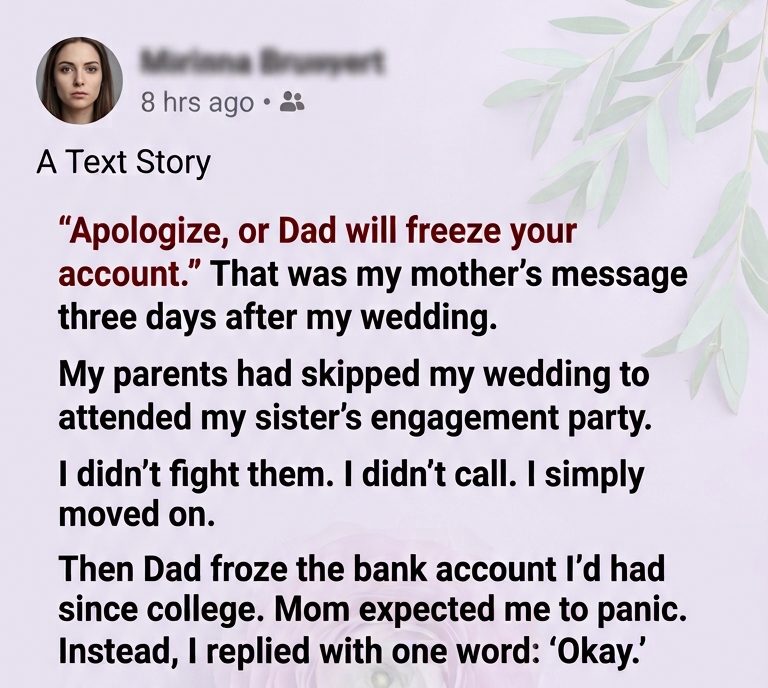
“Apologize, or Dad will freeze your account.”
That was my mother’s message three days after my wedding.
I read it while sitting beside my husband, Daniel, in the small apartment we had rented together. Outside, rain tapped against the windows. My wedding dress was still hanging in the bedroom, and the flowers Daniel had bought me were beginning to wilt on the kitchen table.
I read the message twice.
Then I put my phone down.
My parents had skipped my wedding to attend my younger sister’s engagement party. They hadn’t even bothered to call me that morning. My mother had sent a brief text saying they were “needed elsewhere,” as though I were inviting them to a casual dinner instead of watching their eldest daughter get married.
I had spent weeks hoping they would change their minds.
They never did.
My sister, Vanessa, had gotten engaged to a wealthy real estate agent named Blake. My parents had spent months planning the engagement celebration, which apparently mattered more to them than my wedding.
I didn’t argue. I didn’t beg them to come.
I married Daniel without them.
And for three days, I thought their absence was the end of it.
Then my father froze my bank account.
It was the account I had opened when I was eighteen. My father had helped me set it up, and because he had been listed as a joint account holder, he still had authority over it.
I had kept the account for years out of convenience. My paycheck no longer went there, but I used it to pay several family expenses.
My parents knew that.
They also knew I had been helping them financially for nearly six years.
My mother expected me to panic when she sent that message.
Instead, I replied with one word.
“Okay.”
She called immediately.
I let it ring.
Then she sent another message.
“Don’t be childish. Your father is upset, and you owe us an apology. We sacrificed everything for you.”
I stared at those words for a long time.
Then I opened my banking app.
The account balance was $312.
That was all.
Six months earlier, Daniel and I had quietly moved almost all our savings into a new account at another bank. We had been saving for a home, and after my father made several comments about how much money I had “sitting around,” we decided it was time to separate our finances completely.
My parents had no access to the new account.
They didn’t even know it existed.
My father had frozen an account containing less money than he spent on a weekend dinner.
He thought he had taken away my security.
He had forgotten something far more important.
For years, I had been helping pay his bills.
The mortgage.
The car insurance.
The property taxes.
And part of Vanessa’s private student loan.
My parents had become so accustomed to my payments that they no longer thanked me. They simply expected the money to arrive.
Every month.
Without fail.
And I had kept paying because I believed family was supposed to help family.
I was about to learn what my parents believed.
The first call came the following Monday.
It was my father.
“Your mother tells me you’re refusing to apologize.”
“I’m not refusing anything,” I said. “I’m just not discussing it.”
“You owe your mother some respect.”
“I didn’t ask either of you to choose between my wedding and Vanessa’s engagement party.”
“That’s not what happened.”
“Then what happened?”
He paused.
“Your sister needed us.”
“And I didn’t?”
“You’re married now. You have Daniel. Vanessa is still getting started in life.”
I almost laughed.
Vanessa was twenty-nine. She had a new luxury car, a private apartment, and a fiancé who had recently bought a house.
I was thirty-two, had worked since college, and had spent years quietly helping my parents keep their own house.
But in my father’s mind, Vanessa was always the one who needed saving.
I was the one who could be relied upon.
“You froze my account,” I said.
“Because you need to learn that actions have consequences.”
“I understand.”
“Then apologize.”
“No.”
The silence that followed was so complete I could hear the faint hum of his television.
Finally, he said, “You’ll regret this.”
He hung up.
I looked at Daniel.
“He thinks he has leverage,” I said.
Daniel reached across the table and took my hand.
“Then stop giving him any.”
That night, we reviewed every recurring payment connected to my parents.
There were more than I remembered.
I paid $1,180 toward their mortgage each month. I covered their car insurance, which cost another $246. I paid a portion of their annual property taxes through monthly transfers. I also sent $450 every month toward Vanessa’s private student loan.
The total was more than $2,000 a month.
Over the years, I had contributed tens of thousands of dollars.
I had never demanded repayment.
I had never asked them to put my name on the house.
I had never even asked them to acknowledge what I was doing.
But when they needed to punish me, they reached for the one account they thought they controlled.
Daniel leaned over my shoulder as I opened the mortgage payment portal.
“Are you sure?” he asked.
I stared at the scheduled payment.
For years, I had treated helping my parents as a permanent obligation. I had never considered what would happen if I stopped.
“I’m sure,” I said.
I canceled the automatic transfers that were in my name.
Then I contacted the insurance company and removed my payment method from their policy, making sure the account holder would be notified directly.
I also contacted the student loan servicer to confirm that I was not a co-borrower or guarantor. I had only been making voluntary payments.
That distinction mattered.
I wasn’t abandoning a legal responsibility.
I was ending a financial arrangement my family had come to take for granted.
The next morning, I sent my mother a short message.
“I’ve stopped the payments I was making on your behalf. Please make arrangements for the upcoming bills.”
She responded within minutes.
“What does that mean?”
“It means I won’t be paying them anymore.”
“You can’t do this to us!”
“I can. And I am.”
Then I turned off my phone.
By Wednesday, my mother had called fourteen times.
My father called nine.
Vanessa sent a message accusing me of trying to ruin her future.
I didn’t respond to any of them.
On Thursday morning, my mother appeared at our apartment.
She was standing outside the door when Daniel opened it.
“Where is she?” she demanded.
“I’m here,” I said, stepping into view.
My mother looked past me into the apartment.
“Do you have any idea what you’ve done?”
“I stopped making payments.”
“Your father’s mortgage is due!”
“Then he’ll need to pay it.”
“We don’t have that kind of money sitting around!”
I felt something shift inside me.
For years, I had assumed my parents were struggling because of bad luck, rising costs, and the ordinary difficulties of life.
But they had never explained their finances to me.
They had simply told me what they needed.
And I had paid.
“Why can’t you afford your own mortgage?” I asked.
My mother’s face tightened.
“Don’t question us.”
“I’ve been paying it for years. I think I’m allowed to ask.”
“You offered to help!”
“Yes. I did. And I’m allowed to stop.”
She lowered her voice.
“Your father is furious. He says you’re making him look like a fool.”
I almost smiled.
“He froze my account because I got married without apologizing for something I didn’t do. I think he managed that all by himself.”
Her expression changed.
“You’ve become just like Daniel.”
I didn’t know what that was supposed to mean.
Then she said something that made me go still.
“You have no idea what we’ve done for you.”
I looked directly at her.
“Then tell me.”
She opened her mouth.
Closed it.
And walked away.
That was when I began to suspect there was something beneath the anger.
Something my parents had never wanted me to see.
Two weeks later, the mortgage company called me.
At first, I assumed it was a mistake.
“Am I listed as an authorized contact?” I asked.
The representative explained that my phone number had been included on the account because I had previously made recurring payments. She couldn’t disclose the full account details, but she could tell me that the account holder had contacted them about a payment shortfall.
I thanked her and ended the call.
Then I searched my email for old payment confirmations.
I found years of them.
Most were ordinary receipts. But one, from nearly four years earlier, caught my attention.
It was a confirmation for a $9,600 transfer to my parents.
The note attached to the payment read:
Temporary assistance for property expenses. To be repaid after the refinance.
I had forgotten about it.
I opened the email thread.
My father had written that the money would cover closing costs and several overdue expenses while he refinanced the house. He promised to repay me within a year.
A year had become four.
I searched for the original bank statement and found another transfer, this one for $14,200.
Then another for $7,500.
The amounts were large enough that I remembered why I had sent them. My parents had said the house was at risk. My father had promised the situation was temporary.
I added the transfers together.
More than $31,000.
And those were separate from the monthly payments.
I called Daniel into the room.
He read the emails slowly.
“Did they ever repay any of this?” he asked.
“No.”
“Did they tell you what happened with the refinance?”
I shook my head.
My father had said the bank needed additional paperwork. Later, he said the process had been delayed. Eventually, the subject had disappeared from our conversations.
I had assumed the loan had been settled.
Now I wasn’t sure.
I called my father.
He answered on the fourth ring.
“What now?”
“I found the emails about the money I lent you for the refinance.”
He said nothing.
“You promised to repay me.”
“That was years ago.”
“Yes. It was.”
“We had expenses.”
“I understand. But I need to know what happened to the money.”
He sighed.
“Your mother is right. Daniel has changed you.”
“Dad, where did the money go?”
“Into the house.”
“Then why did you need more money every month for the mortgage?”
“Because life is expensive.”
“Did you refinance?”
Another silence.
Then he said, “You don’t understand how these things work.”
“Help me understand.”
He ended the call.
I sat there staring at my phone.
For the first time, I wondered whether my parents had been telling me the truth at all.
The answer came from an unexpected source.
My aunt Linda called me the following evening.
She was my mother’s younger sister, and she had attended my wedding. She had been one of the few relatives who showed up without making excuses.
“I heard there’s trouble,” she said carefully.
“I suppose there is.”
“I don’t want to get involved in your parents’ business, but I think you should know something.”
My stomach tightened.
“What?”
“Your father has been talking about selling the house.”
I blinked.
“What?”
“He asked me last year whether I knew anyone who might buy it. He said the mortgage was becoming difficult to manage.”
I tried to make sense of that.
“Why would he sell it? He told me the refinance was finished.”
Linda hesitated.
“I don’t think it ever went through.”
I thanked her and ended the call.
Then I sat with Daniel and went through everything we knew.
The monthly payments. The loans. The unexplained transfers. The promises that had never been fulfilled.
We decided not to make accusations based on fragments.
Instead, I gathered every record I had and requested copies of the documents relating to the money I had transferred. I also consulted a lawyer to understand what evidence I would need if I wanted to pursue repayment.
The lawyer explained that the old transfers might be treated differently depending on the written agreements, dates, and applicable law. The emails were useful, but they weren’t a guarantee of recovery.
That was fine.
I wasn’t looking for revenge.
I wanted the truth.
And I wanted to stop being treated like an unlimited source of money.
Three weeks after the wedding, my parents invited me to dinner.
The invitation came from my mother.
“Your father wants to settle this as a family.”
I agreed to meet them at a restaurant.
Daniel came with me.
Vanessa was already seated when we arrived, scrolling through her phone. My father sat at the head of the table, looking as though he were preparing to negotiate a business deal.
My mother began.
“We all said things we regret.”
I waited.
“Your father was upset about the wedding,” she continued. “You should have understood how important Vanessa’s engagement was.”
“I understood that you chose not to attend my wedding.”
“That’s not fair.”
“Then let’s talk about something else.”
I placed a folder on the table.
Inside were copies of the transfer confirmations, the emails, and a summary of the monthly payments I had made.
My father looked at the folder but didn’t touch it.
“What is this?”
“A record of the money I’ve given you.”
“We’re not discussing money tonight.”
“You invited me to settle things as a family. This is part of it.”
Vanessa finally looked up.
“Are you seriously keeping track of every dollar you’ve ever given us?”
“No. I’m keeping track of the money you said you would repay.”
My father pushed the folder away.
“We raised you. We paid for your education. We gave you everything.”
“You helped me through college, and I’m grateful. But I also worked, paid my own expenses, and helped you for years afterward.”
“After everything we sacrificed—”
“Dad, I’m not asking you to repay the cost of raising me. I’m asking what happened to the money you promised to return.”
My mother’s eyes filled with tears.
“You’re humiliating us.”
“I’m asking a question.”
My father finally opened the folder.
He read the first page.
Then the second.
His expression changed when he reached the old email about the refinance.
“You kept this?”
“Yes.”
He looked at my mother.
She looked down at the table.
That small exchange told me more than either of them had said.
“Where did the money go?” I asked again.
My father closed the folder.
“We had other debts.”
“What debts?”
He rubbed his forehead.
“Credit cards. Personal loans. Things you don’t need to know about.”
“Then why did you tell me the money was for the house?”
“We were trying to protect you from worrying.”
I stared at him.
“You asked me for money because the house was in trouble. I sent it because I believed you. If you had told me the truth, I could have made my own decision.”
My mother began to cry.
Vanessa looked between us.
“What does this have to do with me?”
I turned toward her.
“Did you know I was paying part of your student loan?”
“Of course.”
“Did you know Mom and Dad had been borrowing money from me?”
Her expression hardened.
“They said you wanted to help.”
“I did want to help. But did you know they told me the money would be repaid?”
She said nothing.
Then my father spoke.
“Enough. You’ve made your point.”
“No,” I said. “I haven’t.”
I took a breath.
“You froze my bank account because I didn’t apologize for getting married without you. You thought I depended on that account. But I don’t. And I won’t be paying your bills anymore.”
My mother wiped her eyes.
“So you’re abandoning us?”
“No. I’m ending the financial arrangement. Those are not the same thing.”
My father stood.
“If you walk away from this family, don’t expect us to welcome you back.”
I looked at him for a long moment.
“I hope you change your mind about that.”
Then Daniel and I left.
The months that followed were difficult.
My parents struggled to cover their expenses. They sold my father’s second car and canceled several subscriptions. Eventually, they listed their house for sale and moved into a smaller property they could afford.
The sale did not solve every problem.
After reviewing their finances, my parents admitted they had accumulated years of credit-card debt and personal loans. Some of the money I had given them had gone toward those debts, while other amounts had covered everyday expenses.
They had not been honest with me about the extent of their financial trouble.
They had also continued spending as though their income had never changed.
The house had become the center of a financial burden they could no longer maintain.
I did not rescue them.
For the first time, they had to make decisions based on their own income and expenses.
My father eventually agreed to discuss repayment of the money he had promised to return. With legal guidance, we documented what he acknowledged owing and established a repayment plan based on what he could reasonably afford.
It wasn’t everything I had hoped for.
But it was a start.
Vanessa stopped speaking to me for nearly two months. When she finally called, she sounded different.
“I thought you were doing fine,” she said.
“I was.”
“I didn’t know you were giving them that much.”
“You never asked.”
She was quiet.
Then she admitted that our parents had told her I was happy to help and that the payments were temporary. She had never questioned it because she had never been expected to.
“I’m sorry,” she said.
It was the first apology I received.
It wasn’t dramatic. It didn’t erase years of resentment.
But it was real.
My mother took longer.
She eventually sent me a letter. In it, she admitted that she had treated my reliability as an obligation and my independence as permission to ask for more. She apologized for missing the wedding and for threatening me afterward.
My father’s apology came in a short phone call.
“I handled things badly,” he said.
“Yes, you did.”
“I should never have frozen that account.”
“No, you shouldn’t have.”
He waited for me to soften the answer.
I didn’t.
But I told him I was willing to rebuild our relationship if we could do it without threats, guilt, or money being used as leverage.
He agreed.
Whether he fully understood what that meant remained to be seen.
A year after my wedding, Daniel and I bought a modest house of our own.
We celebrated with a quiet dinner, just the two of us.
My parents were invited to visit the following weekend.
My mother brought a homemade pie. My father helped Daniel carry a bookshelf into the living room. Neither of them mentioned money.
For the first time in years, we spent an afternoon together without a bill waiting at the end of it.
Before they left, my father stood beside my car.
“I’m glad you’re doing well,” he said.
“Thank you.”
He hesitated.
“Your mother still thinks you should have apologized after the wedding.”
I looked at him.
“Then she still doesn’t understand what happened.”
He nodded slowly.
“I suppose she doesn’t.”
It wasn’t a perfect ending.
My parents were still learning to respect the boundaries I had established. I was still learning that loving someone did not mean making their problems my responsibility.
But I no longer confused financial support with family loyalty.
And I no longer kept an account open simply because my father wanted access to it.
That old account remained frozen for a while, holding its $312.
Eventually, I closed it.
The money was transferred to me after the bank completed its review, and I put it toward our new home.
Sometimes I think about the message my mother sent three days after my wedding.
“Apologize, or Dad will freeze your account.”
They believed that account was my safety net.
They never understood that the real safety net had been my willingness to keep paying their bills.
And when I finally stopped, the truth came out.
I hadn’t abandoned my family.
I had simply stopped financing the illusion that everything was fine.