The first thing I noticed was the cold.
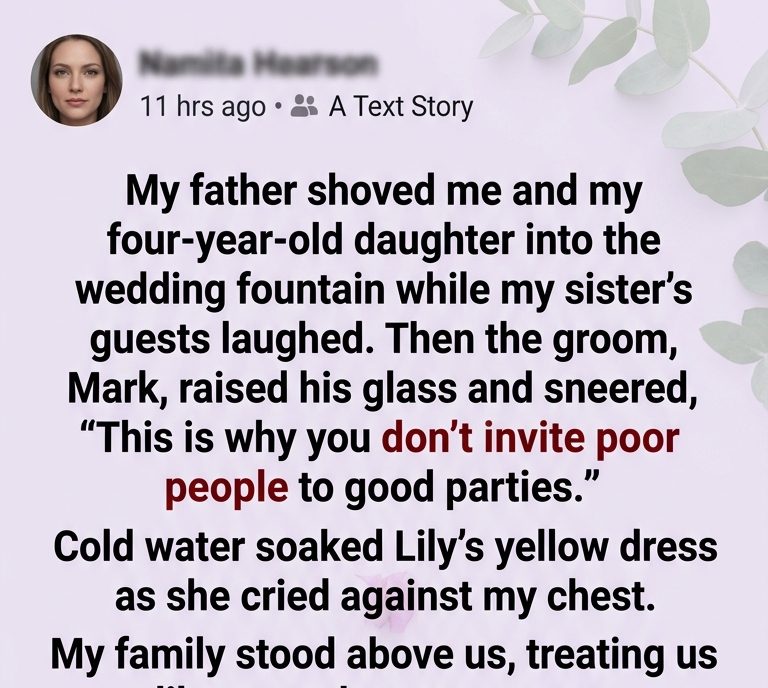
It rushed through my dress and wrapped around my legs as I fell backward into the wedding fountain, clutching my four-year-old daughter against my chest.
Then came the laughter.
Dozens of guests stood around the stone fountain, holding champagne glasses and wearing their finest clothes. Some covered their mouths. Others openly laughed.
My daughter, Lily, began to cry.
“Mommy! Mommy, I’m cold!”
“I’ve got you, sweetheart.”
I struggled to stand in the shallow water, keeping one arm around her while using the other to push wet hair away from her face.
Her yellow dress, the one she had insisted on wearing because it made her feel like a princess, clung to her small body.
My father stood above us.
He had shoved me.
Not accidentally. Not because he had stumbled.
He had looked directly at me, placed both hands against my shoulders, and pushed.
“You should have learned to behave yourself,” he said.
I stared at him in disbelief.
A few feet away, my younger sister, Vanessa, stood beside her new husband, Mark. Her white wedding dress glittered beneath the garden lights.
Mark raised his champagne glass.
“This,” he announced, loud enough for the nearest tables to hear, “is why you don’t invite poor people to good parties.”
The laughter grew louder.
I looked around for someone to help us.
My mother stood beside the wedding cake, her lips pressed into a thin line. She looked uncomfortable, but she did not move.
My aunt Patricia shook her head.
“Honestly, Eleanor, you always know how to ruin a special occasion.”
Eleanor.
That was my name.
And somehow, even after being pushed into a fountain with my four-year-old daughter, I was still the person they blamed.
I tightened my arms around Lily.
“Don’t look at them, sweetheart,” I whispered. “Look at Mommy.”
She buried her face against my neck.
I lifted her out of the water and stepped onto the stone path. My shoes slipped, and I nearly fell again.
Nobody offered a hand.
Then Mark laughed once more.
“Maybe someone should call a cab. I’m sure they can’t afford to stay for the reception.”
I turned toward him.
“You should be careful what you say.”
His smile widened.
“Or what?”
I looked at the people surrounding him.
For years, I had imagined this family might change.
I had imagined that if I worked hard enough, stayed patient enough, and refused to compete with my sister, they might eventually see me as more than the daughter who had disappointed them.
But standing there with my soaked child in my arms, I finally understood something.
They had not mistaken my patience for weakness.
They had mistaken it for permission.
I reached into my handbag and pulled out my phone.
My hands were shaking, but my voice was steady.
“Daniel,” I said when he answered. “We’re at the west fountain.”
There was a brief silence.
Then my husband asked, “Are you and Lily safe?”
“I have her.”
“Stay where you are. I’m coming.”
I ended the call.
My father crossed his arms.
“Who was that?”
“My husband.”
He scoffed.
“Your husband? The man you’ve been hiding from us?”
I said nothing.
For three years, I had kept Daniel away from my family.
They knew I was married. They knew I had a daughter. They knew I lived in a comfortable home and worked part-time as a consultant.
But they did not know Daniel’s full name.
They did not know what he did.
And they had never visited our house.
I had told them he traveled frequently and preferred privacy. That was true, but it was not the whole truth.
The real reason was simpler.
I wanted to know whether they could treat me with kindness without knowing what my husband was worth.
I wanted to believe that, somewhere beneath their obsession with money and status, they still loved me.
Now, with Lily trembling in my arms, I knew the answer.
My father glanced toward the western entrance.
“Fine. Let him come. Maybe he can explain why you thought you belonged here.”
I looked at him.
“I was invited.”
“By your mother,” he snapped. “She should have known better.”
Then the west gates began to open.
A man in a dark suit stepped through, accompanied by two members of the venue’s security team.
He moved quickly across the garden.
Mark turned toward the entrance.
At first, he looked irritated.
Then he recognized the man.
His champagne glass stopped halfway to his mouth.
The color drained from his face.
“Daniel?” he whispered.
My husband stopped beside me.
He took one look at Lily’s wet dress, then at my soaked hair and trembling hands.
His expression changed.
Not into rage.
Something colder.
He removed his jacket and wrapped it around our daughter.
“Hey, little bird,” he said gently. “Let’s get you warm.”
Lily reached for him.
“Daddy, Grandpa pushed Mommy.”
Daniel closed his eyes for a brief moment.
Then he looked at my father.
“Is that true?”
My father opened his mouth.
But Mark spoke first.
“Mr. Whitmore, I can explain.”
Daniel turned toward him.
“Then explain.”
And for the first time that evening, nobody laughed.
1. The Daughter Who Was Never Good Enough
My family had always measured love in strange ways.
My father, Richard Lawson, believed success was something you could display.
The size of your house mattered.
The car you drove mattered.
The people who returned your calls mattered most of all.
My mother, Helen, rarely disagreed with him. She preferred to smooth over arguments, especially when they involved my younger sister, Vanessa.
Vanessa was the daughter who could do no wrong.
When she won a school award, my parents framed the certificate.
When I graduated near the top of my class, my father asked why I had not earned the highest mark.
When Vanessa married her first boyfriend at twenty-three, my parents paid for an elaborate engagement party.
When I announced that I was moving to another city for work, my father told me I was abandoning the family.
I spent most of my childhood trying to earn approval that always seemed to be reserved for someone else.
I was not poor growing up.
My parents lived in a large house, and we never lacked necessities.
But they taught us that money was proof of worth, and that people with less money should be grateful for whatever attention they received.
When my first marriage ended, my father called me a failure.
When I returned to work after having Lily, he complained that I was putting my child in someone else’s care.
When I started rebuilding my life, he told relatives that I was struggling.
I eventually stopped correcting him.
The truth was that I had built a peaceful life.
I had a small but successful consulting business, a daughter who made me laugh every day, and a husband who treated me with a kindness I had never known before.
Daniel Whitmore was not the kind of man who announced his achievements.
He remembered how I took my tea.
He never raised his voice when we disagreed.
When Lily had nightmares, he sat beside her bed until she fell asleep.
And when I told him about my family, he listened without insisting that I cut them off.
“People can surprise you,” he once said.
I wanted to believe him.
So when Vanessa announced her wedding, I agreed to attend.
Daniel offered to come with me.
I hesitated.
“I want to go alone first,” I told him.
“Why?”
“Because I need to know whether they can treat me like family without knowing anything about you.”
He looked at me for a long moment.
“You don’t have to prove your worth to them.”
“I know.”
“Do you?”
I smiled sadly.
“I’m trying to.”
Daniel finally agreed, but he made me promise to call him if anything felt wrong.
I promised.
I never imagined that I would need him to rescue us from a fountain.
2. The Wedding Invitation
Vanessa’s wedding invitation arrived six weeks before the ceremony.
It was thick ivory cardstock with gold lettering.
The venue was an estate outside the city, complete with landscaped gardens, a private ballroom, and a fountain imported from Italy.
My mother called the same evening.
“Your sister wants you there early,” she said. “There will be photographs.”
“I’ll come with Lily.”
“Of course. But please make sure she behaves.”
I paused.
“She’s four, Mom.”
“I know how old she is. I’m simply saying this is an important day.”
I looked at the invitation on my kitchen counter.
“Will Daniel be welcome?”
My mother hesitated.
“Vanessa’s guest list is already complicated.”
“He’s my husband.”
“I understand that, Eleanor. But your father thinks it would be better if you came with Lily.”
There it was.
The familiar message.
You can come, but do not bring anything that makes us uncomfortable.
I should have declined.
Instead, I told myself that the wedding was one day. I could be polite, keep my distance from my father, and leave early if necessary.
I chose a simple blue dress.
For Lily, I bought a yellow one with tiny embroidered flowers.
When she saw it, she spun around in the living room.
“I’m going to look like sunshine!”
I kissed her forehead.
“You already do.”
On the morning of the wedding, Daniel helped Lily put on her shoes.
“Listen to Mommy today,” he told her.
“I always listen.”
He raised an eyebrow.
“Usually.”
She giggled.
Then he turned to me.
“If anything happens, call me.”
“I will.”
He kissed me.
“And Eleanor?”
“Yes?”
“You don’t have to stay just because they expect you to.”
I held his hand.
“I know.”
But I still believed I could get through the day without a scene.
That was my mistake.
Not attending the wedding.
Not trying to make peace.
My mistake was believing that if I behaved perfectly, other people would treat me decently.
3. The Reception
The ceremony itself was beautiful.
Vanessa walked down the aisle in a fitted white gown, her veil trailing behind her.
Mark looked handsome in a dark suit.
My mother cried.
My father stood proudly beside the aisle.
For a few minutes, I allowed myself to enjoy the occasion.
Lily sat beside me, swinging her feet and whispering questions about the flowers.
Then came the reception.
The tables were arranged beneath white canopies. Crystal glasses caught the afternoon sun, and servers carried trays of champagne and small plates of food.
I was seated near the edge of the garden.
My name card had been placed at a table with distant relatives and people I barely knew.
Lily and I were not included in the family photographs.
When I asked my mother about it, she said the photographer had already finished.
I accepted the explanation.
Later, while I was helping Lily eat a piece of cake, Vanessa approached.
“Could you keep her away from the dance floor?” she asked.
“She’s sitting with me.”
“I know, but she keeps looking at the decorations. I don’t want her touching anything.”
“She hasn’t touched anything.”
Vanessa sighed.
“Eleanor, please don’t make this difficult.”
I stared at my sister.
“I’m not.”
She walked away before I could say anything else.
A little later, I saw my father speaking with Mark near the fountain.
They were laughing.
When I approached to ask where the restroom was, my father glanced at my dress.
“You could have dressed better.”
“I’m wearing what I have.”
He gave a dismissive snort.
“Some things never change.”
I turned to leave.
Then he called after me.
“Eleanor.”
I stopped.
“You should be grateful you were invited.”
I faced him.
“I am grateful to attend my sister’s wedding. But I’m not grateful for being insulted.”
His face darkened.
“You always have to make yourself the victim.”
“I’m not making myself anything.”
Mark joined us, holding a glass of champagne.
“What’s going on?”
“Nothing,” my father said. “Your sister-in-law is upset again.”
Mark looked me up and down.
“Maybe this isn’t the right place for family drama.”
I took Lily’s hand.
“We’re leaving.”
My father stepped into my path.
“Don’t walk away while I’m talking to you.”
“Move, Dad.”
He stared at me.
Then he grabbed my shoulder.
I pulled back.
“Don’t touch me.”
His hands shoved forward.
My heel slipped on the wet stone.
I fell backward into the fountain.
Lily fell with me.
The water was shallow, but the impact knocked the breath from my chest. I twisted instinctively, trying to keep her head above the surface.
She screamed.
I held her close and pushed myself upright.
That was when the laughter started.
And that was when I called Daniel.
4. The Name That Changed the Room
Daniel stood beside me, his jacket wrapped around Lily.
He did not shout.
He did not threaten anyone.
He simply looked at Mark.
“Why did you call me Mr. Whitmore?”
Mark swallowed.
“I didn’t realize you were—”
“Were what?”
Mark glanced toward my father.
Richard had gone pale.
My mother stood motionless beside the cake table.
Vanessa looked from Daniel to her husband.
“Mark? What’s happening?”
Mark forced a laugh.
“This is a misunderstanding.”
Daniel’s eyes remained on him.
“Then you should have no trouble explaining it.”
Mark straightened his jacket.
“I work with your company’s investment group. We met at the Northbridge acquisition meeting last year.”
Daniel nodded.
“I remember.”
Mark looked relieved.
Then Daniel added, “You were the adviser who presented the financial projections for Lawson Development.”
My father’s expression changed.
Lawson Development was his company.
For years, he had spoken about it as though it were a business empire. In reality, it was a regional property development firm that had struggled with debt after several projects ran over budget.
My father had spent the past year seeking new investors.
I knew some of this because my mother occasionally complained about his stress.
But I had never discussed it with Daniel.
Not because I was hiding anything.
Because Daniel had never asked me to use my family connections to help him.
And because I did not want my marriage to become another bargaining chip in my father’s world.
Mark stared at Daniel.
“You’re the managing partner?”
“One of them.”
My father stepped forward.
“Daniel, I’m Richard Lawson. I don’t think we’ve been properly introduced.”
Daniel looked at him.
“No. We haven’t.”
My father extended his hand.
Daniel did not take it.
Instead, he adjusted the jacket around Lily.
“Your granddaughter is shaking,” he said. “My wife is injured. I’m taking them somewhere warm.”
My father’s hand fell.
“Now, hold on. This is a family matter.”
Daniel’s voice remained calm.
“You pushed my wife into a fountain while she was holding your four-year-old granddaughter.”
“It was an accident,” my father said quickly.
I looked at him.
“You shoved me.”
He turned toward me.
“Eleanor, don’t exaggerate.”
Daniel glanced at the security guard standing nearby.
“Please preserve any available camera footage and identify the witnesses. We may need it.”
The guard nodded.
Mark’s face had become almost gray.
“Mr. Whitmore, I’m sure we can resolve this privately.”
Daniel finally looked directly at him.
“Privately?”
“Yes. There’s no reason to involve anyone else.”
Daniel’s expression hardened.
“You were happy to involve everyone when you raised your glass and mocked my wife.”
Mark had no answer.
Then Daniel turned to me.
“Are you ready to go?”
I nodded.
He took Lily from my arms and carried her toward the entrance.
I followed.
Behind us, the wedding reception had fallen silent.
But I did not look back.
5. What My Husband Had Never Told Them
Daniel drove us to a nearby hotel.
He had already arranged for a room, warm clothes, and a doctor to check Lily and me.
Lily was frightened but physically unharmed. I had bruised my hip and scraped my palm, but nothing was broken.
When the doctor left, Daniel sat beside me on the bed.
“I should have come with you,” he said.
“No.”
He looked at me.
“I knew they could be cruel. I didn’t know they would do this.”
I reached for his hand.
“You gave me the chance to make my own decision.”
“I wish you hadn’t needed to.”
We sat quietly for a while.
Then I asked the question that had been bothering me.
“Why did Mark recognize you so quickly?”
Daniel hesitated.
“I told you I work in private investment.”
“You did.”
“I’m a managing partner at Whitmore Capital. We invest in property, infrastructure, and a few other sectors. Mark worked on a proposal connected to one of our potential investments.”
“Was Lawson Development part of that?”
“Yes.”
I looked at him.
“Are you investing in my father’s company?”
“Not currently.”
“Were you planning to?”
“We were evaluating a proposal. That process is separate from our marriage.”
I nodded slowly.
That was exactly why I had never wanted my family to know his name.
I did not want my father calling Daniel with requests.
I did not want Vanessa asking for favors.
I did not want Mark treating me differently because my husband could influence a business decision.
I had wanted to know whether they could love me without a financial incentive.
Now I had my answer.
Daniel brushed a strand of wet hair away from my face.
“I’m sorry they made you feel you had to hide me.”
“I wasn’t hiding you because I was ashamed of you.”
“I know.”
“I was hiding the money.”
He smiled faintly.
“I know that too.”
For the first time that evening, I laughed.
Then my expression grew serious.
“Will this affect the investment?”
Daniel considered his answer.
“It may affect how we evaluate the people involved, but we won’t make a decision out of anger. The investment team will review the proposal on its merits. Any concerns about Mark’s conduct or the reliability of the information he provided will be handled through the proper process.”
“And my father?”
“If his company is financially sound and the terms make sense, it can be considered. If it isn’t, it shouldn’t receive an investment simply because he is your father.”
I nodded.
That was the man I had married.
He would not punish my family to satisfy his anger.
But he would not protect them from the consequences of their own decisions, either.
6. The Wedding That Ended Early
The following morning, Vanessa called.
I nearly ignored it.
Then I answered.
“What do you want?”
She sounded exhausted.
“Eleanor, what happened yesterday was awful.”
“Yes.”
“Dad says it was an accident.”
“It wasn’t.”
She exhaled sharply.
“I don’t know what to believe.”
I closed my eyes.
“You watched him push me.”
“I was standing across the fountain.”
“You watched me fall. You heard Lily crying. And you heard Mark make fun of us.”
“I know.”
“Then why are you calling?”
She was quiet.
Finally, she said, “Mark is terrified.”
I almost laughed.
“Is he?”
“He says Daniel could ruin his career.”
“Daniel hasn’t threatened his career.”
“But he could.”
“That’s not my problem, Vanessa.”
She began crying.
“I just wanted one perfect day.”
I felt a familiar ache.
For years, I had been expected to absorb everyone else’s pain so that my sister could remain happy.
But this time, I did not step into that role.
“You had your perfect day,” I said. “You had the wedding you wanted. What happened afterward was a choice your husband and our father made.”
“Please don’t turn this into something bigger.”
“I didn’t push myself into the fountain.”
She hung up.
Later, I learned that the wedding reception had ended early.
Several guests had left after witnessing the incident. The venue had preserved its security footage, and the wedding planner had documented what happened.
My father initially insisted that I had lost my balance.
But the footage showed him placing both hands on my shoulders and pushing.
There was no ambiguity.
The recording also captured Mark raising his glass and making his remark.
My father called me that evening.
“You’ve made me look like a criminal.”
“You pushed me.”
“I barely touched you.”
“I was holding your granddaughter.”
“You’re blowing this out of proportion.”
I looked at Lily, who was coloring at the kitchen table.
“Dad, I’m not discussing this with you.”
“You owe me some respect.”
“No,” I said quietly. “Respect is something we show each other.”
I ended the call.
That was the first time I had ever hung up on my father.
It would not be the last.
7. The Business Behind the Wedding
Two weeks later, Daniel received a formal report from his investment team.
The proposed investment in Lawson Development had been under review for several months.
The company had promising properties, but it also carried significant debt. Several projected sales had not materialized, and one major project depended on approvals that had not yet been secured.
The investment team had already identified those risks before the wedding.
The incident did not create the financial problems.
It did, however, prompt a closer review of Mark’s role in the proposal.
Mark had presented himself as an independent adviser, but the review found that his firm had a financial relationship with Lawson Development that had not been clearly disclosed in the materials provided to the investment team.
That did not automatically establish fraud or misconduct.
But it was a material issue.
The investment team requested clarification and supporting documentation.
Mark’s firm struggled to provide a consistent explanation.
The proposal was placed on hold.
Eventually, Whitmore Capital declined to proceed with the investment, citing the company’s financial risks and unresolved disclosure concerns.
Daniel did not make the decision.
The investment committee did.
And the decision was based on the records, not on what had happened at the wedding.
My father called me the day he received the news.
“You did this,” he said.
“No, Dad.”
“Your husband pulled the investment.”
“The committee declined the proposal.”
“Because of you.”
“Because the financial information did not satisfy their requirements.”
“You’re my daughter!”
I stood at the kitchen window.
For a moment, I wanted to explain everything. I wanted to tell him that Daniel had not retaliated, that the company had been reviewed fairly, and that I had not even known the details of the proposal.
But I realized he would not hear me.
He had already decided that I was responsible.
“You should speak with your advisers,” I said.
“You’re going to let your husband destroy this family?”
I took a slow breath.
“Your business is your responsibility. My marriage is mine.”
Then I ended the call.
8. The Apology That Came Too Late
Three months passed.
I did not attend family gatherings.
My mother sent messages asking when I would come home.
I told her I needed time.
She eventually visited my house.
She arrived with a box of Lily’s favorite cookies and a small stuffed rabbit.
Lily ran to greet her.
“Grandma!”
My mother hugged her tightly.
Then she turned toward me.
“Can we talk?”
I led her into the living room while Lily played nearby.
My mother looked older than she had at the wedding.
“Your father says you won’t speak to him.”
“I’ve spoken to him. He refuses to accept what happened.”
“He was upset.”
“So was I.”
She looked down at her hands.
“I should have helped you.”
“Yes.”
Her eyes filled with tears.
“I froze. I didn’t know what to do.”
“You could have helped Lily out of the water.”
She began to cry.
I did not comfort her immediately.
For years, I had rushed to soothe my mother whenever she became upset, even when she was upset because I had finally defended myself.
This time, I let the silence remain.
Eventually, she wiped her face.
“I’m sorry.”
I believed she meant it.
But an apology was not the same as repair.
“Mom, I need you to understand something. I will not bring Lily into a situation where someone might hurt her and then tell her it was her fault.”
“I understand.”
“And I won’t pretend the wedding was a misunderstanding.”
She nodded.
“I understand.”
“Do you?”
She looked at me.
“Yes.”
I wanted to believe her.
But I did not immediately restore the relationship to what it had been.
My mother began visiting once a month.
At first, I stayed in the room with her and Lily.
Later, when she consistently respected my boundaries, I allowed them to spend short periods together without me.
Trust returned slowly.
It was not something she could demand because she was my mother.
It was something she had to rebuild.
My father never apologized.
He sent one message, six months after the wedding.
I hope you’re happy with what you’ve done to this family.
I read it once.
Then I deleted it.
9. Mark’s Last Request
Almost a year after the wedding, Mark contacted Daniel directly.
He asked for a meeting.
Daniel declined to discuss the investment decision, explaining that the matter had already been handled through the company’s established process.
Mark then contacted me.
His message was short.
Eleanor, I owe you an apology. I was cruel to you at the wedding. I’m ashamed of what I said. Could we talk?
I showed it to Daniel.
“What do you think?” I asked.
“That depends on what you want.”
“I don’t know.”
“You don’t have to answer.”
I left the message unanswered for several days.
Eventually, I agreed to meet Mark in a public café.
I did not bring Lily.
Mark arrived alone.
He looked thinner and less confident than I remembered.
“I’m sorry,” he said as soon as we sat down.
I waited.
“I was trying to impress people. Your father had been talking about how you were embarrassing the family, and I joined in. I thought everyone would laugh.”
“They did.”
“I know.”
“You watched me fall into the fountain with my daughter.”
His eyes lowered.
“I know.”
“And you raised your glass.”
“I know.”
I studied him.
“Why are you apologizing now?”
He swallowed.
“Because I was wrong. And because I don’t want to be the kind of man who treats someone that way.”
I believed he felt regret.
But I also knew that regret did not erase consequences.
“I appreciate the apology,” I said. “But I’m not going to pretend we’re close.”
“I understand.”
“And you should never speak about Lily that way again.”
“I won’t.”
I stood.
The conversation was over.
When I returned home, Daniel asked how it had gone.
“He apologized.”
“And?”
“I accepted the apology. I didn’t promise him anything else.”
Daniel smiled.
“That sounds fair.”
It was.
I could acknowledge someone’s remorse without giving them access to my life.
10. The Family I Chose
Two years after the wedding, Lily turned six.
We held her birthday party in our backyard.
There were balloons, paper decorations, a chocolate cake, and a dozen children running across the grass.
My mother came.
She brought a gift and helped Lily decorate cupcakes.
She did not mention my father.
She did not ask me to forgive him.
She simply spent the afternoon with her granddaughter.
At one point, Lily ran over to me with frosting on her cheek.
“Mommy, look! Grandma made a purple cupcake!”
My mother laughed.
“It was supposed to be pink.”
“It’s better purple,” Lily declared.
I smiled.
For the first time in a long while, I felt that something in our family had changed.
Not because everything had been forgiven.
Not because the past had disappeared.
But because I had stopped pretending that keeping the peace was more important than protecting my child.
That evening, after the guests left, Daniel helped me gather the decorations.
I found a small yellow ribbon caught in the grass.
It reminded me of the dress Lily had worn to the wedding.
For a moment, I saw the fountain again.
The cold water.
The laughter.
My father’s hands.
Mark’s raised glass.
Then I looked through the kitchen window.
Lily was asleep on the sofa, her birthday crown tilted over one ear.
Daniel was washing the cake plates.
The house was warm.
Safe.
Quiet.
I placed the ribbon in a drawer and closed it.
I no longer needed to prove that I belonged to my family.
I had built a family of my own.
And I had learned that love was not measured by the size of someone’s bank account, the influence of their spouse, or the number of people willing to laugh at another person’s humiliation.
Love was measured by what someone did when you were frightened, hurt, and unable to defend yourself.
My father had pushed me into a fountain.
My sister had looked away.
Her husband had laughed.
And my mother had frozen.
But my husband had come.
He had wrapped our daughter in his jacket, made sure we were safe, and refused to let anyone rewrite what had happened.
He did not need to threaten my family.
He did not need to destroy their business.
He did not need to prove that he was more powerful than my father.
He simply stood beside me and let the truth remain the truth.
That was the moment my life changed.
Not when Mark recognized his name.
Not when the investment was declined.
Not when my father finally realized that I had married a man he could not impress.
It changed when I stopped asking people who had humiliated me to decide whether I deserved respect.
I had deserved it all along.
And from that day forward, I made sure my daughter knew the same thing.
No amount of money can turn cruelty into class, and no family name can make humiliation acceptable.
Lily would grow up knowing that she never had to earn the right to be treated with kindness.
Neither did I.