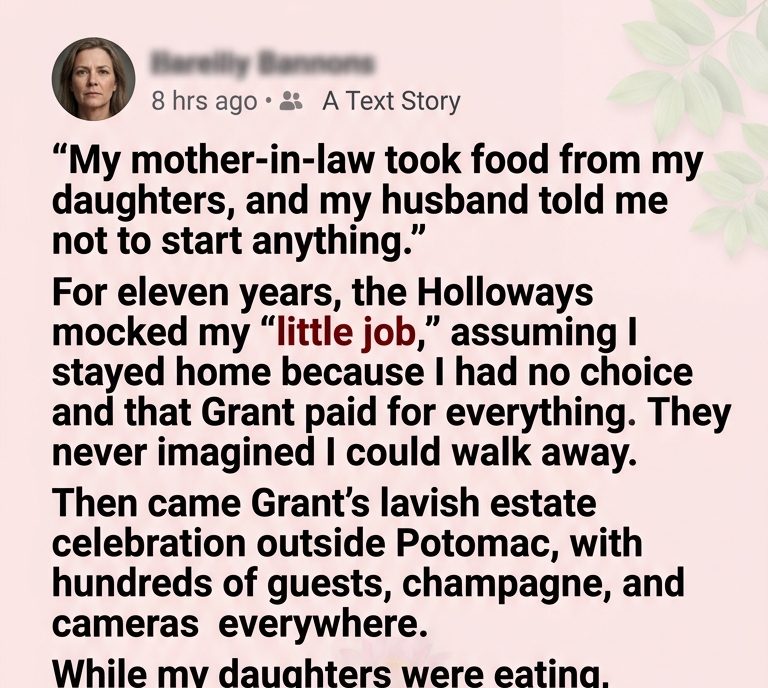
The first thing my mother-in-law took from my daughters was their dinner.
The second thing she took was my patience.
The third thing she lost was the illusion that I would tolerate anything to keep my marriage intact.
It happened at Grant Holloway’s estate celebration, a lavish affair held on the grounds of his family’s property outside Potomac, Maryland. Hundreds of guests filled the gardens. Champagne flowed beneath crystal chandeliers, a string quartet played beside the fountain, and photographers moved through the crowd capturing every carefully arranged smile.
Grant had spent weeks talking about the event.
“It needs to be perfect,” he told me repeatedly. “My father’s business partners will be there. So will the people who matter.”
Apparently, my daughters and I were not among them.
My girls, Sophie and Lily, were eight and ten. They had spent the afternoon getting ready, excited to wear their matching blue dresses. Sophie had even practiced saying hello to Grant’s business partners because her father promised she could meet some of them.
I had prepared myself for another evening of polite insults and forced smiles.
Constance Holloway, my mother-in-law, had never liked me. From the day Grant introduced us, she treated me as though I were a temporary inconvenience in her son’s life.
She disliked my clothes, my cooking, my background, and especially my work.
I owned a small bookkeeping and financial consulting company. I had started it at our kitchen table when Sophie was a baby, working during naps and after bedtime. Over the years, it grew into a successful business with a handful of employees and clients across several states.
But to the Holloways, it was still my “little job.”
Constance often introduced me by saying, “This is Grant’s wife. She keeps herself busy with numbers.”
Grant never corrected her.
For eleven years, I convinced myself that his silence was harmless. He was uncomfortable confronting his mother, I told myself. He wanted to keep the peace.
I kept the peace, too.
I swallowed the comments about my business. I smiled when Constance criticized my parenting. I stayed quiet when Grant’s relatives joked that I had married well.
And whenever they suggested that my husband paid for everything, I let them believe it.
The truth was that I had never needed Grant’s money.
But I had loved him.
For a long time, I thought that was enough.
That evening, I learned how wrong I was.
The dinner tables were arranged across the lawn, beneath white canopies decorated with flowers. Servers carried trays of roasted chicken, vegetables, and fresh bread.
Sophie and Lily sat beside me at a table near the edge of the garden.
Grant had disappeared into a group of guests shortly after we arrived. He was wearing a tailored black suit, laughing loudly as he shook hands with men whose names I had heard around our house for years.
Every few minutes, I caught sight of him glancing toward us.
He never came over.
My daughters were hungry. They had eaten very little at lunch because they were excited about the party, and by the time the food arrived, Sophie was practically bouncing in her chair.
“Mom, this chicken is really good,” she whispered.
“Then eat up,” I told her.
Lily carefully cut her chicken into small pieces. She had always been the quieter of the two, the child who noticed every change in someone’s expression.
That was why I saw her face change before I heard Constance speak.
My mother-in-law approached our table in a silver evening gown, carrying a glass of champagne.
She looked at the plates in front of my daughters.
Then she looked at me.
“Have they finished?”
I glanced at the girls.
“No. They’re still eating.”
Constance’s mouth tightened.
“There are important guests here tonight. The children don’t need to sit around eating all evening.”
Sophie lowered her fork.
“We’re almost done, Grandma.”
Constance ignored her.
She reached down, took Sophie’s plate, and handed it to a passing server.
Then she lifted Lily’s plate.
Lily instinctively reached for it.
“But I’m not finished.”
Constance pulled it away.
“You’ve had enough.”
For a moment, I could not believe what I was seeing.
My daughters sat frozen, their forks still in their hands.
Sophie looked at me with wide eyes. Lily’s lower lip trembled, but she tried desperately not to cry.
I stood.
“Constance, give them their food back.”
She turned toward me, looking genuinely offended.
“Excuse me?”
“They’re children. They’re hungry. They haven’t finished eating.”
A few guests at the neighboring table stopped talking.
Constance lowered her voice, but there was nothing gentle about it.
“This is my family’s celebration. I will not have you making a spectacle over two plates of food.”
I looked at Grant.
He was standing several yards away, speaking with a man in a navy suit. He had clearly heard the commotion.
Our eyes met.
I waited for him to come over.
I waited for him to tell his mother that she had crossed a line.
Instead, he walked toward us with an irritated expression.
“What’s going on?”
“Your mother took the girls’ dinner,” I said. “They were still eating.”
Grant looked at the empty places in front of our daughters.
Then he looked at his mother.
“Mom, come on.”
For one hopeful second, I thought he was going to fix it.
But Constance simply lifted her chin.
“They’ve had enough. Children need to learn that the world doesn’t revolve around them.”
Grant sighed.
Then he turned to me.
“Don’t start anything, Claire.”
The words landed harder than I expected.
Not because he had failed to defend me.
Because he had failed to defend his own children.
Sophie stared at her lap. Lily had tears gathering in her eyes.
I looked at my husband, the man I had loved for eleven years.
“Are you serious?”
“Claire, please. There are hundreds of people here. This is not the time.”
“And when is the time, Grant?”
He leaned closer.
“Just let it go.”
Behind him, his mother smiled faintly, as if she had won a contest.
Something inside me went quiet.
I no longer felt the familiar urge to explain myself. I did not want to argue, embarrass him, or convince his family to treat my daughters with basic kindness.
I simply reached for Sophie’s hand.
Then I took Lily’s.
“Come on, girls.”
Grant frowned.
“Where are you going?”
“Home.”
He gave a short, disbelieving laugh.
“You’re seriously leaving over this?”
I looked at him.
“No. I’m leaving because of what you just taught our daughters.”
Then I walked away.
I did not shout. I did not throw a glass. I did not threaten divorce in front of his guests.
I took my children to the car and drove away.
Behind us, the music continued.
The girls were quiet for the first few minutes.
Then Sophie asked, “Mom, did we do something wrong?”
I tightened my hands around the steering wheel.
“No, sweetheart.”
“Then why did Grandma take our food?”
I glanced at her in the rearview mirror.
“Because sometimes adults behave badly, even when they should know better.”
Lily wiped her cheeks with the back of her hand.
“Dad didn’t say anything.”
That hurt more than anything Constance had done.
“I know.”
“Does he not love us?”
I pulled into a quiet parking area and turned toward them.
“Your father’s choices are not a measure of how lovable you are. Never believe that.”
I hugged them both until their breathing settled.
Then I drove to a restaurant near our home and ordered them whatever they wanted.
Sophie chose a cheeseburger and fries. Lily ordered pasta and a chocolate milkshake.
They ate slowly, talking about school and a science project, and gradually the evening became ordinary again.
But for me, something had changed.
At home, after the girls were asleep, I sat alone at the kitchen table.
My phone showed seven missed calls from Grant.
His first message read:
Where are you?
The second:
You made me look ridiculous in front of everyone.
The third:
Come home. We can discuss this tomorrow.
I stared at the screen.
Not one message asked whether the girls were okay.
Not one asked whether they had eaten.
I put the phone facedown.
Then I opened my laptop.
For years, I had kept my business finances separate from Grant’s. My company had its own accounts, its own contracts, and its own records. The money I earned had helped me build a financial cushion that I rarely discussed with anyone.
There was also the house.
Three years before I married Grant, I had purchased a modest but beautiful property in Bethesda. It had four bedrooms, a deep front porch, and a backyard large enough for children to play.
I bought it with money I had saved before our relationship became serious, supplemented by a small mortgage that I paid down over time.
When Grant and I married, we agreed to live in the larger house his family had helped him acquire. It was closer to his business, and he insisted that it made sense.
My Bethesda property became a rental.
Over the years, I renovated it, paid off the remaining mortgage, and eventually stopped renting it out. I had kept it furnished and maintained, partly as an investment and partly because I liked knowing I had somewhere to go if life ever took an unexpected turn.
Grant knew I owned a property.
He did not know how much it was worth, how little debt remained on it, or how carefully I had protected my financial independence.
He had never asked.
He assumed my business was a hobby.
He assumed the money in our household came from him.
And I had allowed those assumptions to survive because correcting them always seemed to create more trouble than it was worth.
That night, I began making calls.
First, I contacted my attorney, Rachel Bennett.
She had helped me structure my business years earlier and had prepared the documents for my property purchase.
When she answered, I told her what had happened.
She listened without interrupting.
Then she asked, “Are you safe?”
“Yes.”
“Are the girls safe?”
“Yes.”
“Then let’s take this one step at a time. Do you want to separate from Grant, or do you want to understand your options first?”
I looked toward the hallway where my daughters were sleeping.
“I want to understand my options. And I want to make sure he cannot use money to force us back into that house.”
“Good,” she said. “Tomorrow, bring me every financial document you have. We’ll review the ownership records, your marital finances, and the practical steps involved in separating.”
After we hung up, I called my property manager.
I asked him to arrange for the Bethesda house to be cleaned and prepared for me and the girls.
Then I called my sister, who lived nearby, and asked if she could help with the children the next morning.
By two o’clock, I had made more decisions for my future than I had made in the previous two years.
At 2:17 a.m., Grant sent one final message.
You’re being childish. Be home when I wake up.
I did not reply.
The next morning, Grant woke up in the estate’s guest suite.
He had stayed overnight after drinking with his business partners. He was probably expecting to find me at home, preparing breakfast and waiting for him to explain why I had embarrassed him.
Instead, he found an empty bedroom.
My clothes were gone.
The girls’ school bags were gone.
The bathroom shelves were cleared of our things.
On the kitchen counter, I had left a short note.
The girls and I are safe. I will contact you about arrangements for seeing them. Please communicate through my attorney until we have agreed on next steps.
Grant called immediately.
I let it go to voicemail.
He called again.
Then he called my sister.
She told him the girls were with me and that he needed to respect my request to communicate through counsel.
That was when he became angry.
By midmorning, he had convinced himself that I was making a dramatic gesture and would soon come to my senses.
He drove to the house where we had lived together.
A staff member told him I had taken the girls elsewhere.
He called my phone again.
Then he remembered the property I owned in Bethesda.
He had visited it once, years earlier, when we were dating. He remembered the broad front porch and the white columns.
He drove there, convinced he would find me waiting for him.
Instead, he found my car in the driveway.
He rang the doorbell.
I opened the door.
For a moment, he simply stared at me.
Behind me, Sophie was sitting at the dining table drawing a picture. Lily was on the living-room rug, building a tower from wooden blocks.
Grant looked past me.
“What is this?”
“My house.”
He gave a short laugh.
“Claire, don’t be ridiculous. I know you own this place, but you can’t just disappear with my children because of a disagreement.”
“It wasn’t a disagreement.”
“Your mother-in-law took two plates. That’s what this is about?”
“No,” I said. “It’s about you watching your mother humiliate our daughters and telling me to stay quiet.”
He shook his head.
“You’re making this into something it isn’t.”
I stepped aside, but I did not invite him in.
“Do you want to speak to the girls?”
His expression softened immediately.
“Of course.”
I called them over.
Sophie came first, followed by Lily.
Grant crouched to their level.
“Hey, girls. Why don’t you come home with me? Your mom and I need to talk.”
Neither child moved.
Lily looked at me.
Sophie asked, “Will Grandma be there?”
Grant hesitated.
“Well, yes. She lives nearby.”
“Will she take our food again?” Sophie asked.
He looked startled.
“No, of course not.”
“Will you tell her to stop if she does?”
Grant glanced at me, then back at Sophie.
“Let’s not talk about that now.”
Sophie took a step backward.
“I don’t want to go.”
Lily reached for her sister’s hand.
“Me neither.”
Grant stood.
His face had changed.
He looked at me as if I had coached them, as if their fear had somehow been manufactured for my benefit.
“What have you been telling them?”
“The truth.”
“You’re turning them against me.”
“No, Grant. They watched what happened. They heard what you said.”
He rubbed his forehead.
“I’m not doing this on the porch.”
“Then you should leave.”
He stared at me.
For the first time since I had known him, he seemed unable to understand the situation.
He had arrived expecting to collect his wife and children, deliver a lecture, and return to his normal life.
Instead, he was standing outside a house he had never thought of as mine, while his daughters refused to leave with him.
Then his eyes moved toward the hallway.
He noticed the framed photographs on the wall, the children’s shoes beside the stairs, and the neatly arranged boxes near the dining room.
“What have you done?”
“I moved.”
“Without asking me?”
“I’m not required to ask your permission to live in a house I own.”
His face went pale.
“Claire, you cannot possibly be serious.”
“I am.”
He stepped closer.
“You’re my wife.”
“And I’m a person, Grant.”
He opened his mouth, then closed it.
I continued before he could interrupt.
“I built a business while raising our daughters. I bought this house before we were married. I have supported myself for years. You never bothered to learn any of that because it was easier to believe I needed you.”
“That’s not fair.”
“Isn’t it?”
He looked around again.
“How much is this place worth?”
I almost laughed.
That was his first question.
Not whether the girls had slept well. Not whether I had been frightened. Not whether he had failed them.
The value of the house.
“That is not relevant to this conversation.”
“It’s very relevant. We’re married.”
“My attorney will explain what is relevant.”
The color drained from his face.
“Your attorney?”
“Yes.”
He looked at the girls again.
Then he lowered his voice.
“Claire, let’s not destroy eleven years over one bad evening.”
I felt the familiar ache of remembering the good years. The road trips. The nights we had stayed up talking. The day Sophie was born, when Grant cried as he held her. The day Lily took her first steps toward him.
I had not imagined those moments.
But good memories did not erase the present.
“We’re not here because of one evening,” I said. “We’re here because of eleven years of you asking me to accept disrespect so you wouldn’t have to confront your family.”
He shook his head.
“I can fix this.”
“Then start by understanding why it happened.”
He looked at me for a long time.
Finally, he said, “I need to think.”
“You should.”
He walked back to his car.
Before getting in, he turned.
“You’ll regret this.”
I watched him drive away.
Then I closed the door.
My hands were shaking.
But for the first time in years, I did not feel trapped.
The next few weeks were difficult.
Grant alternated between anger, apologies, and attempts to persuade me that I was overreacting.
At first, he sent long messages about how much he loved me.
Then he complained that I was damaging his reputation.
Then he offered to arrange a private lunch with Constance so she could “clear the air.”
I declined.
When he asked whether the girls could spend time with him, I agreed to reasonable arrangements through our attorneys, provided the plans were clear and the girls felt comfortable.
I did not want to punish them by cutting off their father.
I wanted them to have a relationship with him that did not require them to accept humiliation.
Our attorneys began reviewing the practical issues involved in separating. We gathered financial records, identified shared obligations, and worked through the questions that needed to be resolved.
Grant had always spoken as if every important asset belonged to him.
The documents told a more complicated story.
My business was established before our marriage. My Bethesda property had been purchased before we married and remained titled in my name. The estate where we had lived was connected to Grant’s family and was not an asset I had any intention of claiming.
Our marital finances still needed to be examined carefully, and neither of us could simply declare every account or purchase untouchable. Our attorneys would have to determine what the law and our agreements required.
But one thing was clear.
I was not financially helpless.
That discovery unsettled Grant more than my departure had.
He had built his understanding of our marriage around the belief that I depended on him.
Now he was discovering that I had been standing on my own feet all along.
A few days after we separated, Constance called me.
I almost let it go to voicemail.
But I answered.
“Claire,” she began, “I understand you’re upset.”
I closed my eyes.
“Upset?”
“I’m sure the situation at the party could have been handled differently.”
“You took food away from two hungry children.”
“They had already eaten.”
“They were still eating.”
She sighed.
“I don’t think we need to argue over details.”
“Those details are my daughters.”
Silence.
Then she said, “Grant is devastated. You need to think about the consequences of breaking up a family.”
I looked through the kitchen window at Sophie and Lily playing in the backyard.
“Constance, I did think about the consequences. I thought about them when your son watched our daughters being humiliated and told me to be quiet.”
“He was trying to keep the peace.”
“Whose peace?”
She had no answer.
I continued.
“You have spent eleven years treating me as if I should be grateful to be included in your family. You have mocked my work, dismissed my opinions, and expected me to smile through it. I tolerated that because I loved Grant. But my daughters will not grow up believing they have to accept cruelty to earn a place at a table.”
“You’re being dramatic.”
“No. I’m being clear.”
I ended the call.
My hands trembled afterward, but I did not call her back.
A month later, Grant asked to meet me at a café.
I agreed because I wanted us to discuss the children without lawyers sitting between every sentence.
He looked tired when he arrived.
For once, he was not wearing a tailored suit. His shirt was wrinkled, and he had dark circles beneath his eyes.
“I miss them,” he said.
“I know.”
“I miss you, too.”
I stirred my coffee.
“I miss the person I thought we were.”
He looked down.
“I spoke to my mother.”
“And?”
“I told her she cannot treat the girls like that again.”
I waited.
“She says she was trying to teach them manners.”
“Then she has misunderstood what manners are.”
“I know.”
It was the first time he had said those words without immediately defending himself.
He rubbed his hands together.
“I keep thinking about that night. I saw the girls’ faces. I knew they were upset, but I thought you would calm down and we’d talk about it later.”
“You were worried about the guests.”
“Yes.”
“You were worried about your mother being embarrassed.”
He nodded slowly.
“And I didn’t think about what it would do to them.”
I watched him carefully.
An apology did not erase the past. But I wanted to know whether he understood what he was apologizing for.
“Why did you tell me not to start anything?” I asked.
He looked away.
“Because I’ve spent my whole life trying to keep my mother happy. If she’s upset, she makes everyone miserable. I learned to give in before things got worse.”
“That explains your behavior. It doesn’t excuse it.”
“I know.”
“Your daughters are learning from you. They’re learning what a husband does when someone mistreats his wife. They’re learning what a father does when someone hurts his children.”
His eyes filled with tears.
“I know.”
For a moment, I saw the man I had married.
But I also saw the years I had spent waiting for him to become that man when his mother was watching.
“I want to fix our marriage,” he said.
“I can’t promise you that.”
“Is there anything I can do?”
“Yes. Be a father to your daughters without making them responsible for your relationship with me. Respect the boundaries we’ve set. And stop treating an apology as a way to make everything go back to normal.”
He nodded.
We finished our coffee.
When we left, he asked whether he could take the girls to the park that weekend.
I told him I would discuss it with them and confirm the arrangements.
It was not reconciliation.
It was a beginning.
The girls adjusted to the new house faster than I expected.
They chose their bedrooms, helped me plant flowers in the backyard, and began inviting friends over after school.
Sophie taped drawings to the refrigerator. Lily arranged her books on the living-room shelves and insisted that every one of them needed a proper place.
At night, we read together in the big bedroom until they fell asleep.
The house was quieter than the estate, but it felt warmer.
No one monitored how much food the girls ate.
No one corrected their laughter.
No one made them feel as though they were taking up space that belonged to someone more important.
My business continued to grow. I hired another accountant and moved my office into a small commercial space nearby. For the first time, I stopped scheduling every important meeting around Grant’s preferences.
I had spent years making my life smaller so our marriage would feel comfortable to him.
Now I was discovering how much room there was when I stopped doing that.
Grant began attending the girls’ school events. At first, he seemed uncertain about how to behave without his mother’s approval. But he kept showing up.
He apologized to Sophie for not standing up for her.
He apologized to Lily for letting her leave a family celebration feeling ashamed.
He did not ask them to forgive him immediately.
That mattered.
Constance took longer.
She sent the girls gifts, which I allowed them to accept. She asked to visit, and I told her that any visit would need to happen with clear expectations about how the children were treated.
She complained to Grant.
This time, he did not ask me to give in.
He told her that if she wanted a relationship with her granddaughters, she needed to respect their mother and treat them kindly.
It was the first boundary he had ever set with her that did not come with a request for me to soften it.
I noticed.
I did not mistake it for a complete transformation.
But I noticed.
Six months after the celebration, Grant came to the Bethesda house for a meeting with our attorneys’ approval to discuss the remaining practical arrangements.
He stood on the porch for a moment before entering.
“I never realized how much you did here,” he said.
I looked around the living room.
There were toys under the coffee table, school papers on the counter, and a half-finished puzzle on the dining table.
“It’s just a house.”
“No,” he said quietly. “It’s a home.”
I did not respond.
He looked toward the backyard, where the girls were playing.
“Are they happy?”
“Yes.”
He nodded.
“I’m glad.”
For a moment, neither of us spoke.
Then he said, “I used to think you stayed because you needed me.”
I met his eyes.
“I stayed because I loved you.”
He swallowed.
“I understand that now.”
“I hope you do.”
He looked at the framed family photograph on the mantel. It had been taken years earlier, before the small humiliations accumulated into something I could no longer ignore.
“We had good years,” he said.
“Yes. We did.”
“Do you ever think we could have saved it?”
I considered the question honestly.
“I think we could have saved it if you had stood beside me when it mattered. Not once. Not after I left. When it mattered.”
He lowered his head.
“I’m sorry.”
“I believe you’re sorry.”
He looked up.
“But being sorry and being ready to change are different things.”
He nodded.
“I know.”
Our separation continued through the legal process. There were difficult conversations and decisions, and not every detail was resolved neatly. We worked through parenting arrangements, finances, and the future with the help of our attorneys.
I did not get everything I wanted.
Neither did Grant.
But I no longer confused compromise with surrender.
And I no longer believed that keeping a family together was worth teaching my daughters to accept disrespect.
A year after the night at the estate, Sophie and Lily celebrated their birthdays in our backyard.
We invited their friends, my sister, a few neighbors, and Grant.
Constance was not invited.
The girls had chosen a simple party with homemade decorations, a chocolate cake, and a table full of food.
At one point, I watched Grant helping Lily arrange cupcakes on a tray while Sophie showed him how to tie balloons to the fence.
He looked comfortable with them.
Not perfect. Not transformed into a different man overnight.
But present.
When it was time to eat, Sophie took a plate and filled it with chicken, fruit, and two cupcakes.
Lily followed her.
Grant glanced at their plates.
Then he smiled.
“Looks like you two have a good appetite.”
Sophie grinned.
“We’re hungry!”
“Then eat,” he said. “There’s plenty.”
I stood a few feet away, listening.
It was such a small thing.
A father telling his children they were allowed to eat until they were satisfied.
But I knew how much it mattered.
Later, after the guests had left, I sat on the porch with a cup of tea.
The evening air smelled of cut grass and birthday candles. Through the open window, I could hear the girls laughing as they got ready for bed.
My phone buzzed.
A message from Constance.
I hope one day you will let me explain what happened. I miss the girls.
I read it twice.
Then I typed:
You can have a relationship with them when you are ready to acknowledge what happened and treat them with respect. I will not force them to be around anyone who makes them feel small.
I sent the message.
Then I put my phone away.
I did not know whether Constance would ever understand.
I did not know whether Grant and I would ever find a way back to each other.
But those questions no longer controlled my life.
For eleven years, I had mistaken silence for patience and sacrifice for love. I had believed that if I kept everyone comfortable, eventually they would recognize what I brought to the family.
I was wrong.
My daughters did not need me to win an argument at a party.
They needed me to show them that love did not require them to accept humiliation.
They needed a mother who would stand up, take their hands, and walk away when the people around them forgot their worth.
That night, when Constance took their plates, she thought she was reminding my daughters of their place.
She had no idea that I was finally remembering mine.
And when Grant arrived at the house he never knew I owned, he discovered something far more important than my money or property.
He discovered that the woman he had mistaken for dependent had been choosing to stay.
And that choice was no longer his to take for granted.
5 Strong Title Options
- My Mother-in-Law Took Dinner From My Daughters, and My Husband Told Me to Stay Quiet—The Next Morning, He Discovered the House I Had Kept Secret
- For Eleven Years, My Husband’s Family Called My Business a Joke—Until I Walked Out of Their Lavish Party With My Hungry Children
- My Mother-in-Law Humiliated My Daughters in Front of Hundreds of Guests, but My Husband’s Biggest Shock Came the Next Morning
- My Husband Thought I Had Nothing Without Him—Then He Found Me Living in the House I Had Owned Long Before Our Marriage
- “Don’t Start Anything,” My Husband Whispered as His Mother Took Our Daughters’ Food—So I Left, and Everything Changed