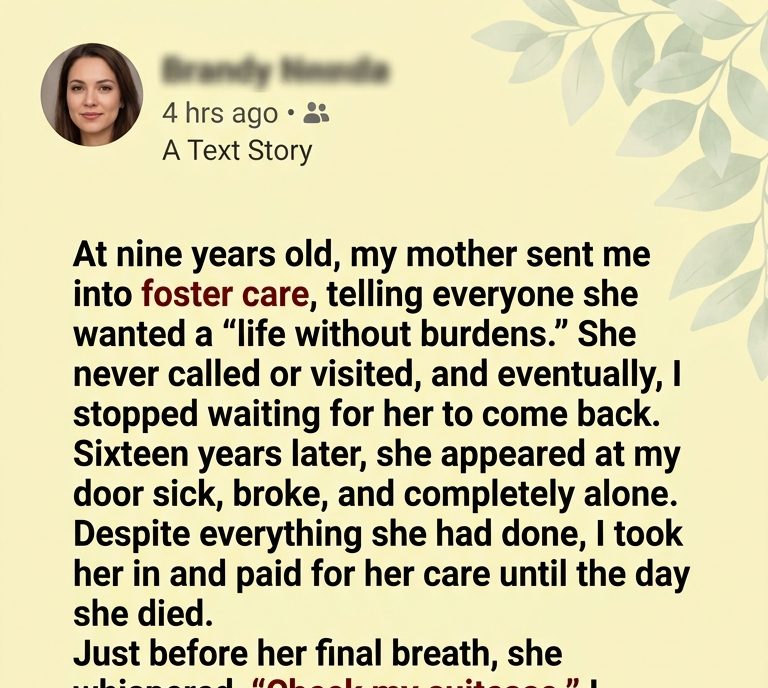
The first time my mother called me a burden, I was nine years old.
She said it while standing beside a social worker in our small apartment, her arms folded tightly across her chest.
“I want a life without burdens,” she explained.
I remember staring at the red suitcase beside the front door. It was the only luggage I owned, and one of its wheels had broken months earlier. My mother had packed it herself, folding my clothes into neat stacks as if she were preparing me for a holiday.
I had thought we were going somewhere together.
Instead, a woman named Mrs. Harris took my hand and led me downstairs.
“Your mother needs some time to get things sorted out,” she told me gently.
I looked back.
My mother was already closing the door.
“Mom?”
She didn’t turn around.
That was the last time I saw our apartment from the inside.
I spent the next seven years moving between foster homes, learning how to unpack quickly and never ask how long I would be staying. Some families were kind. Others treated me like an obligation they had agreed to fulfill.
Every birthday, I wondered whether my mother remembered.
Every Christmas, I hoped she might send a card.
At first, I wrote letters to her through the social services office. I told her about school, my new friends, and the books I liked. I never asked why she had sent me away. I was afraid the answer would be that she didn’t love me.
Eventually, the letters stopped.
Not because I had stopped caring.
Because I had finally understood that nobody was going to make her answer.
At sixteen, I was placed with a couple named Margaret and David Collins. They had two grown children, a quiet house, and a habit of leaving the kitchen light on when they knew I would be home late.
They never promised they would replace my parents.
They simply treated me as if I belonged.
When I turned eighteen, I stayed in touch with them even after aging out of the system. Margaret helped me apply for college scholarships. David taught me how to change a tire and read a lease.
I studied accounting, worked part-time at a grocery store, and eventually found a steady job at a small financial services company.
By twenty-five, I had a modest apartment, a reliable car, and enough savings to feel safe for the first time in my life.
I rarely thought about my mother anymore.
Then, on a rainy Tuesday evening, someone knocked on my door.
I opened it and found a thin woman standing in the hallway.
Her coat was too large. Her hair had turned almost entirely gray, and she leaned heavily on the wall as if standing required more strength than she possessed.
For several seconds, I didn’t recognize her.
Then she said my name.
Not the name I used as an adult.
The childhood nickname she had given me when I was little.
“Lily?”
My stomach tightened.
“Mom?”
She nodded.
Her eyes filled with tears.
“I didn’t know where else to go.”
I stood frozen in the doorway.
Sixteen years.
Sixteen years without a birthday card, a phone call, or a single question about whether I was alive.
And now she was standing in front of me, sick and alone, asking for a place to stay.
I should have asked her to leave.
I should have demanded answers.
Instead, I noticed that her hands were trembling.
“Are you okay?” I asked.
She shook her head.
“I’m not well, sweetheart.”
That word hurt more than I expected.
Sweetheart.
She had not called me that in sixteen years.
I let her inside.
My mother’s name was Elaine. She was fifty-eight, though illness had made her look much older. She told me she had been living in a rented room outside Denver, but her landlord had asked her to leave after she fell behind on payments.
She had no savings, no job, and no family willing to help.
When I asked about her health, she admitted she had been diagnosed with an advanced illness several months earlier. She had missed appointments because she couldn’t afford transportation and had stopped taking some medications when the money ran out.
I took her to an urgent care clinic the next morning.
They sent us directly to the hospital.
The doctors confirmed that she was seriously ill and needed ongoing treatment. There were options for managing her condition, but her prognosis was poor.
I sat beside her hospital bed while a doctor explained the next steps.
My mother stared at the blanket.
“I’m sorry,” she whispered.
I didn’t know what she meant.
For abandoning me?
For showing up only when she needed help?
For waiting until her life had collapsed before remembering she had a daughter?
I couldn’t ask all those questions in a hospital room.
So I said nothing.
After several days, she was discharged with a care plan. I brought her to my apartment and set up the spare room. I bought a comfortable bed, arranged her medications, and helped schedule appointments.
Margaret offered to bring meals.
David helped me install a handrail in the bathroom.
My mother thanked them both, but I could see that she was uncomfortable receiving kindness from people who had done more for me than she ever had.
The first few weeks were difficult.
Elaine slept much of the day. When she was awake, she watched television or stared out the window. Sometimes she tried to talk about the past, but the conversation always stopped before reaching the years when I had needed her most.
One evening, while I was sorting her prescriptions, she asked, “Did you have a good childhood?”
I looked at her.
“What do you think?”
She lowered her eyes.
“I suppose I deserve that.”
I wanted to tell her that I had survived. That I had found people who cared about me. That I had built a life despite the years she had taken away.
But I also wanted to tell her about the nine-year-old girl who had cried herself to sleep, believing her mother had chosen freedom over her.
Instead, I said, “It wasn’t easy.”
She nodded.
“I know.”
“No,” I replied. “You don’t.”
She didn’t argue.
As the months passed, I became her primary caregiver. I took time off work for appointments, managed insurance paperwork, and learned how to help her when she was too weak to stand on her own.
The medical bills were frightening.
I used part of my savings to cover what insurance did not. When she needed additional support, I arranged for a home-care aide a few afternoons each week.
I never told her how much it cost.
I also never pretended that caring for her erased what she had done.
Some nights, after helping her settle into bed, I sat alone in my kitchen and wondered why I was doing it.
Was it love?
Was it guilt?
Was I still that nine-year-old girl hoping that if she were good enough, her mother might finally choose her?
The answer changed from day to day.
But I knew one thing.
I was choosing to help her now.
That choice belonged to me.
One afternoon, while I was brushing her hair, she caught my wrist.
“You shouldn’t have to do all this.”
“I know.”
“You could have left me somewhere.”
“Yes.”
She studied my face.
“Why didn’t you?”
I thought about the question for a long time.
“Because I know what it feels like when everyone decides you’re someone else’s problem.”
Her eyes filled with tears.
She turned toward the window.
“I don’t deserve you.”
I set the brush down.
“Maybe not. But I’m not doing this because you earned it.”
She looked back at me.
“Then why?”
“Because I don’t want to become someone I don’t recognize just because you hurt me.”
For the first time, she began to cry openly.
I held her hand, but I did not tell her everything was forgiven.
It wasn’t.
By the fifth month, her condition had worsened. She became weaker and needed help with nearly everything. The doctors explained that treatment was no longer likely to reverse the disease. Our focus shifted toward comfort and keeping her at home if that remained possible.
I arranged for hospice care.
A nurse named Patricia visited regularly, checking my mother’s symptoms and teaching me how to make her more comfortable.
One evening, Elaine asked me to bring her old suitcase from the closet.
It was the same red suitcase she had packed for me when I was nine.
I had kept it all these years, though I had no clear reason why. The broken wheel had been replaced long ago, and the fabric was worn at the corners.
“Why do you want this?” I asked.
“I want to see it.”
I placed it beside her bed.
She ran her fingers over the handle.
“You carried this when you left.”
“I didn’t leave. You sent me away.”
Her hand stopped.
“Yes,” she whispered. “I did.”
She asked me to open it.
Inside were a few old dresses, a scarf, and some papers. Nothing seemed unusual. I folded everything back into place and closed the lid.
My mother watched me.
“Lily, there’s something I need you to know.”
I sat beside her.
“What is it?”
Her lips parted, but no words came.
She looked exhausted.
“Not yet,” she whispered.
I felt a familiar frustration rise inside me.
“Mom, I can’t keep waiting for you to tell me things.”
“I know.”
“Why did you send me away?”
She closed her eyes.
“I’m sorry.”
“That’s not an answer.”
“No,” she murmured. “It isn’t.”
She fell asleep before we could speak again.
I almost brought it up the next day, but she was in pain, and the nurse had warned me that her energy was fading. I decided to wait until she felt stronger.
There was no stronger day.
Two weeks later, I was sitting beside her bed when she began breathing irregularly. The hospice nurse had warned me that this could happen. I called her, and she arrived quickly.
My mother opened her eyes once.
“Lily?”
“I’m here.”
Her fingers were cold in mine.
“Check my suitcase.”
I leaned closer.
“What?”
“The suitcase,” she whispered. “Please.”
“I will. I promise.”
She tried to say something else, but her breath caught.
Then, a few minutes later, she was gone.
I stayed beside her for a long time.
I cried, though I couldn’t have explained exactly what I was grieving. I mourned the mother I had lost that day, but also the mother I had never really had. I mourned the childhood I could not recover and the conversations we had postponed until there was no time left.
After the funeral, I searched the suitcase.
I emptied every pocket, checked beneath the lining, and examined the old clothes. I found a few receipts, a faded hospital bracelet, and a small photograph of a house I didn’t recognize.
Nothing that explained her words.
I put everything back and stored the suitcase in the closet.
For two weeks, I tried not to think about it.
Then one Saturday morning, I decided to clean it properly.
I carried it into the living room, opened it, and began wiping the inside with a damp cloth. When I reached the bottom, I noticed something odd.
The lining was uneven.
One corner had a line of tiny stitches that didn’t match the rest.
I pressed against it.
Something crackled underneath.
My hands began to tremble.
I found a pair of scissors and carefully cut through the thread.
Inside the lining was a small envelope, yellowed with age.
My childhood name was written across the front in my mother’s handwriting.
Lily.
I sat on the floor.
For several minutes, I couldn’t bring myself to open it.
Then I slid a finger beneath the flap.
Inside was an old photograph and a folded letter.
The photograph showed my mother standing beside a man I had never seen before. She was much younger, perhaps in her early twenties, and she was holding a baby wrapped in a pale blanket.
The baby was me.
The man’s arm rested around her shoulders. He was smiling at the camera, but his eyes looked tired.
On the back, someone had written a date from the year I was born.
I unfolded the letter.
The first line stopped me cold.
I’m sorry I lied about why I gave you away.
I read it again.
Then I began.
My darling Lily,
If you are reading this, I have finally run out of time to keep pretending that the truth would only hurt you.
When you were nine, I told everyone I wanted a life without burdens. I let you believe you were the burden.
That was the cruelest thing I ever did.
I pressed the letter against my chest.
For sixteen years, I had carried the belief that my mother had simply grown tired of me.
Now, in her handwriting, she was telling me that the story had been different.
I continued reading.
Your father, Daniel, was not the man I told people he was.
He died when you were three years old. I told you he had left us because I could not bear to explain what happened.
The truth is that Daniel had been sick for a long time. He had a serious heart condition, and he knew he might not live to see you grow up.
Before he died, he asked me to promise that I would make sure you had a safe and stable life.
I promised him I would.
I stopped.
My father had been a blank space in my childhood. I had a few vague memories of a man lifting me onto his shoulders, but my mother had always said he left when I was too young to remember him properly.
The letter continued.
After Daniel died, I struggled. I was young, frightened, and in debt. I worked two jobs and still fell behind. I was ashamed of how little I could give you.
Then I met a man named Robert.
He offered to help me financially. At first, he seemed kind. He said he could give us a better life.
But when I became pregnant with his child, everything changed.
My hands tightened around the paper.
Robert did not want you in our home. He said you reminded me of Daniel and that I would never be able to start over while you were there.
I should have told him to leave.
Instead, I was afraid of losing the only financial security I had.
I convinced myself that sending you into foster care would be temporary. I told myself I would get you back once I had enough money and a stable home.
I signed the papers. I told the social worker I could not care for you.
Then I let Robert convince me that contacting you would make everything more difficult.
I put the letter down.
My heart was pounding.
The explanation did not make what she had done acceptable. It did not make the years of silence disappear.
But it gave the abandonment a shape I had never known.
I picked up the letter again.
I thought I could build a new life and return for you later.
I was wrong.
Robert became controlling. He monitored my calls and questioned every person I spoke to. When I tried to contact the social services office, he threatened to leave me with nothing.
I was afraid. I was ashamed. And each year I waited made it harder to face you.
That is not an excuse.
You deserved a mother who fought for you. I chose the easier path, and you paid for it.
Tears blurred the page.
I wanted to hate her for every word.
I wanted to understand her.
Both feelings sat inside me, tangled together.
Then I reached the final paragraphs.
The man in the photograph is Daniel’s older brother, Michael.
Before Daniel died, he asked Michael to look after you if anything happened to him. Michael offered to take you when I could no longer care for you, but I refused. I was afraid that if you went to him, I would lose you forever.
Years later, after Robert and I separated, I tried to find Michael. I learned that he had moved away. I wrote to an old address, but the letter came back.
I never stopped knowing that I had failed you.
There is one more thing.
Daniel left money in a trust for you. I was named to manage it while you were a child. I used some of it to pay debts and living expenses when we were struggling. I told myself I would replace it.
I never did.
The account was eventually closed, and I have no right to pretend that what remains is yours. I have enclosed the documents I kept, along with Michael’s last known address. I don’t know whether he is still there.
I am not asking you to forgive me.
I am asking you to know that you were never a burden to your father.
You were the best thing that ever happened to him.
I wish I had been brave enough to tell you.
Love,
Mom
I sat on the floor until the sunlight shifted across the room.
The letter answered some questions and opened others.
Who was Robert? What had happened to him? Why had my mother never tried harder to find me? And what had happened to the trust my father had left?
The envelope contained several folded papers, including an old trust document and a letter addressed to my mother from a law office. The papers were faded, but the names and dates were still legible.
I knew enough about accounting to understand that I needed professional help before drawing conclusions.
The following Monday, I contacted an attorney who specialized in estates and trusts.
She reviewed the documents carefully.
“The paperwork suggests there was a trust established for you,” she explained. “But these records alone don’t tell us what happened to the funds. We would need to trace the account and determine whether any claims remain possible.”
“Can we find out?”
“We can try.”
She requested archived records, contacted the financial institution listed in the documents, and searched public records for the attorney who had originally handled the trust.
The process took several months.
During that time, I found Michael.
The address in the letter was outdated, but the attorney located a forwarding record connected to a small town in Oregon. With help from a local directory and a few phone calls, I found a number for a man named Michael Reeves.
I called him on a Sunday afternoon.
A man answered.
“Hello?”
“Is this Michael Reeves?”
“Yes.”
“My name is Lily. My mother was Elaine. My father was Daniel.”
There was a long silence.
Then he said, very quietly, “Oh, sweetheart.”
I began to cry.
Michael told me he had spent years wondering what had happened to me. After Daniel died, he had offered to take me in, but Elaine had refused. He had tried to remain involved, but she stopped answering his calls.
When he learned that I had entered foster care, he contacted the social services office. He was told that my placement was confidential and that he would need to follow the proper process to seek contact.
He began that process.
Before it was completed, Elaine moved, and he lost track of her.
“I should have kept trying,” he said.
“You didn’t know where I was.”
“I knew you were out there.”
His words hurt, but not in the same way my mother’s silence had.
We spoke for nearly two hours.
He told me about my father: how Daniel played guitar badly but enthusiastically, how he made pancakes shaped like animals, and how he used to carry a little notebook where he wrote down things he wanted to teach me when I grew older.
“He loved you,” Michael said. “He talked about you constantly.”
I asked whether he had any photographs.
“I have a box full.”
A month later, I flew to Oregon.
Michael was waiting outside the airport, holding a small cardboard sign with my name on it.
He looked older than the man in the photograph, of course, but I recognized the shape of his smile.
When he hugged me, I felt something inside me loosen.
Not because he could replace the family I had lost.
Because he was a living connection to a part of my life that had been kept from me.
At his home, he showed me the photographs.
My father holding me as a baby.
My father sitting beside my crib.
My father asleep on the couch with me curled against his chest.
There were pictures of birthdays, a small garden, and a birthday cake with crooked candles.
In one photograph, Daniel was sitting on the floor, helping me stack wooden blocks. I was laughing so hard that my eyes were nearly closed.
I stared at that picture for a long time.
“I don’t remember this,” I whispered.
Michael sat beside me.
“You were happy.”
I touched the edge of the photograph.
For years, I had believed my childhood began with rejection.
Now I knew there had been love before the loss.
It did not erase what came afterward.
But it mattered.
Back in Colorado, the attorney eventually uncovered more information about the trust. The account had been closed years earlier, and the remaining records were incomplete. Some funds had been used for expenses authorized under the original arrangement; other withdrawals were less clearly documented.
There was no simple way to recover the money, and the attorney warned me that any claim would depend on evidence, applicable deadlines, and the terms of the trust.
I chose not to pursue a lengthy legal battle based on incomplete records.
The money mattered less to me than the truth.
I kept copies of the documents, along with the photograph and letter, in a safe place.
For a long time, I wondered whether I should have done more for my mother.
Whether taking her in had been a mistake.
Whether the letter changed the meaning of what I had done.
Eventually, I understood that it didn’t have to.
I had cared for her because I chose to. I had paid for her treatment because I could not bear to leave a sick person without help. I had stayed beside her at the end because I wanted to, even though I had every reason to walk away.
Her confession did not make her abandonment acceptable.
Her suffering did not erase mine.
And my kindness did not mean she had been entitled to it.
A year after her death, I visited Margaret and David.
I brought the photograph of my father and showed it to them.
Margaret studied it carefully.
“You have his eyes,” she said.
I had never noticed that before.
David asked whether finding the letter had helped.
I thought about it.
“It gave me answers,” I said. “But it didn’t give me back my childhood.”
He nodded.
“Sometimes answers don’t fix things. They just help us understand what we’re carrying.”
That night, I placed the photograph in a frame beside a picture of Margaret and David at my college graduation.
My family had never been one simple story.
There was the father I barely remembered, the mother who abandoned me, the uncle who had tried to find me, and the foster parents who had given me a home when I needed one.
There were people who had failed me and people who had chosen to show up.
For years, I had believed that being abandoned meant I was unwanted.
Now I understood that my mother’s decision had been about her fear, her choices, and her failures—not my worth.
I still wished she had fought for me.
I still wished she had called.
I still wished she had told me the truth while there was time for us to talk about it.
But I no longer needed her explanation to decide what kind of person I would become.
I kept the red suitcase, too.
Not because I wanted to preserve the day she sent me away.
Because inside its broken lining, I had found a truth that belonged to me.
I had been loved.
I had been hurt.
I had survived.
And none of those things canceled out the others.