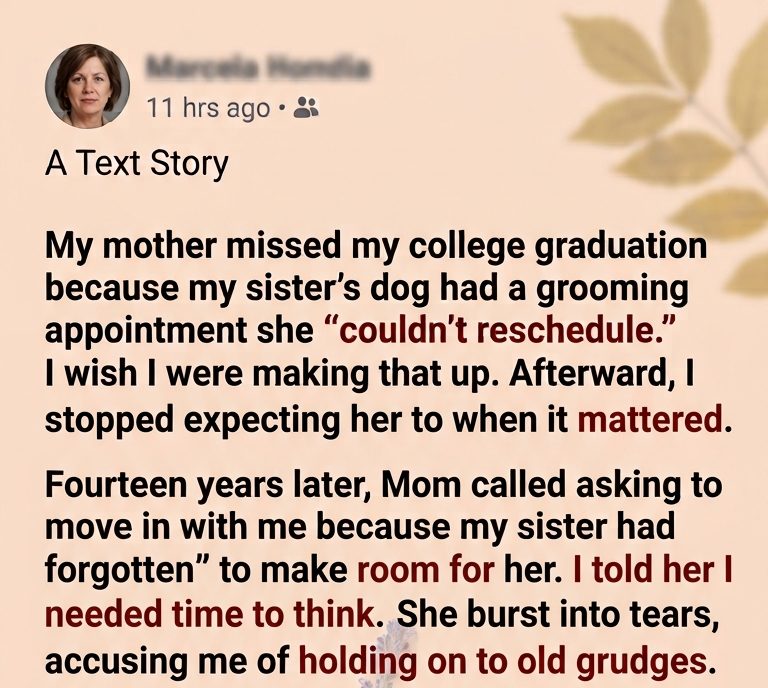
My mother missed my college graduation because my sister’s dog had a grooming appointment she “couldn’t reschedule.”
I wish I were making that up.
I was twenty-two years old, standing in the middle of a crowded university auditorium, wearing a black gown that felt two sizes too large and holding a diploma I had worked years to earn. Families filled the seats around me. Mothers waved flowers. Fathers leaned into the aisles with cameras. Grandparents clapped so loudly that graduates turned to smile at them.
I kept looking toward the entrance, hoping to see my mother.
She had promised she would be there.
For weeks, she had told everyone how proud she was of me. She had even bought a new dress for the occasion. The night before graduation, she called to confirm the time and asked whether I had reserved enough seats.
Then, forty minutes before the ceremony, my phone lit up.
“Sweetheart, I’m so sorry,” she said. “Your sister’s dog has an appointment, and she really needs me to take him. The groomer is booked for weeks.”
I stood outside the auditorium, staring at the message I had just received.
“You’re missing my graduation for a dog’s haircut?”
“Don’t say it like that,” she replied sharply. “It’s not just a haircut. Bella has been having skin problems, and your sister is overwhelmed. You know how difficult things have been for her.”
I did know.
My older sister, Lauren, had always been the one everyone worried about.
When she struggled in school, my mother hired tutors. When she dropped out of college, Mom said she was still finding herself. When she quit her first job, Mom paid her rent. When she married a man who treated her badly, Mom helped her move out.
I rarely asked for anything.
I worked evenings at a grocery store, took out student loans, and spent weekends studying in the library. When I was exhausted, I reminded myself that graduation would be worth it.
I had imagined my mother sitting in the audience, crying as she watched me cross the stage.
Instead, she was driving my sister’s dog to the groomer.
“I have to go,” Mom said. “Lauren is waiting.”
Then she hung up.
I walked into the auditorium alone.
When my name was called, I crossed the stage, shook the dean’s hand, and accepted my diploma. I smiled for the photographer because that was what everyone else was doing.
Afterward, I took a few pictures with classmates. I watched their families surround them with flowers and hugs.
I told myself I was fine.
But that evening, when my mother finally called, I couldn’t pretend anymore.
“You missed something that mattered to me,” I said.
“I said I was sorry.”
“You didn’t even try to come.”
“Your sister needed help.”
“And I didn’t?”
She sighed.
“Please don’t turn this into a competition. I love you both equally.”
That sentence hurt more than I expected.
Because I had never wanted to compete with my sister. I had only wanted my mother to show up.
“I’m not asking you to choose between us,” I told her. “I’m asking you to keep your promises.”
She said I was being dramatic.
I stopped arguing.
Over the years, I learned to stop expecting her to attend important events. When I got my first professional job, I sent her a picture of my office. She responded with a thumbs-up.
When I bought my first house, she said she would visit, but she canceled twice because Lauren needed help with something.
When I got married, Mom arrived late because she had been helping my sister prepare for a weekend trip.
She made it to the reception, but she missed the ceremony.
I stopped saving her a front-row seat.
Eventually, I stopped asking whether she was coming at all.
I built a life that didn’t depend on her promises.
I married Daniel, a patient man who never made me feel guilty for wanting to be loved. We had a daughter named Sophie, who was curious, thoughtful, and far more observant than most adults realized.
I became a project manager at an architectural firm. Daniel worked in accounting. We paid our bills, saved what we could, and bought a modest house with a small garden.
Our life wasn’t glamorous, but it was steady.
And for a long time, I believed I had finally made peace with my mother.
Then, fourteen years after my graduation, she called me on a Tuesday afternoon.
I was preparing dinner when her name appeared on my phone.
“Hello, Mom.”
“Oh, sweetheart,” she said, her voice trembling. “I really need your help.”
I put down the knife.
“What happened?”
“It’s Lauren. She sold the house.”
I waited.
Mom had been living with Lauren for nearly three years. After Lauren’s second divorce, she had moved into a larger home and invited Mom to stay with her. At the time, Mom had told me it was a temporary arrangement.
Apparently, it had become permanent.
“What do you mean she sold it?” I asked.
“She’s moving. She says she needs a fresh start, and she’s already found a smaller place.”
“Where are you going?”
“That’s the problem.” Mom paused. “There isn’t room for me.”
I leaned against the kitchen counter.
“Didn’t she know she was selling the house?”
“Of course she knew. But everything happened so quickly.”
“Mom, houses don’t usually get sold overnight.”
Her voice tightened.
“I’m not calling to be interrogated. I’m calling because I need somewhere to live.”
I glanced toward the kitchen table.
Sophie, who was eleven, sat there doing her homework. She had her headphones around her neck and was carefully writing something in her notebook.
“Have you looked at senior apartments?” I asked.
“I don’t want to live in some strange place with strangers.”
“What about renting a small apartment?”
“With what money? Lauren says the sale proceeds are hers. She says the house was in her name.”
“Was it?”
Mom went quiet.
“I helped her with the mortgage,” she finally said. “That should count for something.”
I rubbed my forehead.
“Do you have savings?”
“Not enough to live on.”
“Then we need to understand your finances before making any decisions.”
“I was hoping you would let me move in.”
The request landed between us.
My mother wanted to move into my home.
The same mother who had missed my graduation because of a dog’s grooming appointment.
The same mother who had repeatedly canceled visits, forgotten birthdays, and treated my milestones as optional.
I didn’t want to punish her.
But the thought of sharing my home with someone who had spent my entire life making me feel like an afterthought filled me with dread.
“I need time to think,” I said.
She began crying.
“I can’t believe you’re doing this to me. You’re my daughter.”
“I know.”
“I’m your mother. I took care of you when you were little.”
“And I’m not saying I won’t help.”
“You’re holding on to old grudges.”
I closed my eyes.
“This isn’t about one graduation, Mom.”
“Then what is it about?”
I could have listed everything.
The missed ceremonies. The canceled visits. The years of being told that my sister’s needs were more urgent. The way Mom always expected me to understand while rarely trying to understand me.
But I was tired.
“I need to talk to Daniel,” I said. “I’ll call you tomorrow.”
She sniffed loudly.
“Fine. I see how it is.”
Then she hung up.
For several seconds, I stood motionless in the kitchen.
Sophie looked up from her homework.
“Mom?”
“Yeah, honey?”
“Is that the grandma who didn’t come when you got your diploma?”
My hand tightened around the phone.
Sophie had heard the story before. I had told it once when she asked why Grandma wasn’t in our graduation photographs. I hadn’t expected her to remember it so clearly.
“Yes,” I said quietly.
Sophie looked back at her notebook.
“Oh.”
That was all she said.
But my mother was still on the line.
I had forgotten she hadn’t hung up properly.
“Mom?” I said.
Nothing.
Then I heard the faint click of the call ending.
I felt a strange mixture of shame and relief.
My daughter hadn’t insulted her grandmother. She had simply asked a question.
And the answer was true.
That evening, Daniel and I sat at the kitchen table after Sophie went to bed.
“I don’t want her to end up on the street,” I said.
“Neither do I,” Daniel replied.
“But I don’t know if I can live with her.”
“Then we need to separate helping her from letting her move in.”
I looked at him.
“What if she says we’re abandoning her?”
“She can say whatever she wants. That doesn’t mean we have to make a decision that changes our whole household without knowing what’s really happening.”
He was right.
We agreed that I would speak to Lauren the next morning.
Before I could call her, however, a message appeared on my phone.
It was from my sister.
You need to know what Mom signed before you agree to anything.
Beneath the message was a photograph of a document.
I opened it.
At first, I didn’t understand what I was looking at. The page was a signed agreement between my mother and my sister, dated nearly three years earlier.
I read it once.
Then again.
My mother had transferred her share of the proceeds from the sale of her previous home to Lauren.
The document stated that the money was a gift, not a loan. In return, Lauren had agreed to let Mom live with her for as long as she needed.
There was a signature at the bottom.
My mother’s.
I stared at it, trying to understand.
Mom had never told me she owned part of a house.
Years earlier, after my father died, she had sold the home they had shared. She told me she used the money to pay off debts and cover living expenses.
But according to the document, a substantial portion of that money had gone toward Lauren’s house.
I called my sister.
She answered immediately.
“Did you read it?”
“Yes. What exactly happened?”
Lauren exhaled.
“Mom sold her house after Dad died. You know that.”
“I know what she told me.”
“She gave me most of the money for a down payment. I was supposed to let her live with me. That was the agreement.”
“And now you’re selling the house.”
“Yes.”
“Why?”
“Because I can’t afford it anymore. The mortgage, the repairs, everything. I’m selling it and moving into a condo.”
I tried to keep my voice calm.
“Why didn’t you make arrangements for Mom?”
“I did.”
“What does that mean?”
“I offered to help her find an apartment. I even offered to cover the deposit. She refused.”
“Why?”
“Because she says she doesn’t want to spend her money on rent.”
I frowned.
“What money?”
Lauren hesitated.
“Mom still has money from the house sale.”
I sat up straighter.
“How much?”
“I don’t know the exact amount. But she has an investment account. She told me she wasn’t going to touch it because she wanted to leave it to us.”
The room seemed to grow colder.
“She told me she had almost nothing.”
“She told me the same thing when I asked her to help with the house expenses.”
I pressed my fingers against my temple.
“Then why is she saying you left her with nowhere to go?”
“Because she thinks you’ll let her move in. She said you have the bigger house and the better job.”
I felt a wave of anger, followed immediately by something more painful.
My mother had called me in distress, presenting herself as a woman with no money and no options.
But she had money.
She had an agreement with my sister.
And she had apparently decided that my home was the easiest solution.
“Why did you send me this document?” I asked.
“Because she’s telling people I threw her out. I didn’t. I gave her three months’ notice, and I offered to help her find somewhere affordable.”
Lauren’s voice softened.
“I know Mom favors me. I know she always has. But I can’t keep carrying the financial responsibility for her choices. And I don’t want her telling everyone you refused to help when she never gave you the full story.”
For the first time in years, my sister and I were having an honest conversation about our mother.
Neither of us was shouting.
Neither of us was trying to win.
We were simply comparing what she had told us.
And the stories didn’t match.
After we hung up, I sat at the table for a long time.
I remembered my father’s funeral, when Mom had cried into Lauren’s shoulder while I handled the paperwork.
I remembered helping Mom pack her old house, believing she was nearly broke.
I remembered sending her money when she said her car needed repairs.
I remembered the graduation.
A dog’s grooming appointment.
For years, I had thought the deepest wound was that my mother hadn’t shown up.
Now I wondered how many other times I had been given only the part of the story that made her choices easier to accept.
The next morning, I called her.
“Mom, I saw the agreement you signed with Lauren.”
Silence.
“Who sent you that?”
“Lauren.”
“She had no right.”
“It’s a document about your housing and finances. Why did you tell me you had nowhere to go?”
“I don’t have anywhere to go.”
“You have savings.”
“That money is for the future.”
“Your future is happening now.”
She sighed impatiently.
“You don’t understand. Lauren has always needed more help than you.”
There it was again.
The familiar explanation.
Lauren needed more.
Lauren had it harder.
Lauren deserved another chance.
And I was expected to understand.
“I’m not asking you to give me money,” I said. “I’m asking why you told me you had none.”
“I didn’t want to spend my savings.”
“Then say that. Don’t tell me you’re helpless when you have options.”
Her voice grew sharp.
“You have a spare bedroom.”
“Yes. But having a spare bedroom doesn’t mean I’m obligated to become your housing plan.”
“I’m your mother.”
“And I’m your daughter. That relationship should mean something to both of us.”
She said nothing.
I took a breath.
“I’m willing to help you find an apartment. Daniel and I can help you compare costs, and we can contribute to a reasonable moving expense if necessary. But you cannot move into our home.”
Her breathing changed.
“So you’re turning your back on me.”
“No. I’m offering help. I’m also setting a boundary.”
“You’re punishing me for the past.”
“I’m making a decision about the present.”
She hung up.
For the rest of the day, I felt guilty.
Not because I believed I had done something wrong, but because guilt had always been the price of saying no to my mother.
That evening, Lauren called again.
“She told me you refused to help her.”
“I did offer to help.”
“I know. She called me afterward and said you were making her pay for missing your graduation.”
I let out a tired laugh.
“Of course she did.”
Lauren was quiet for a moment.
“Do you think she really believes that’s why we’re saying no?”
“I think she believes that if she makes this about our feelings, she won’t have to talk about her decisions.”
My sister didn’t answer.
Then she said something I had never expected to hear.
“I’m sorry about your graduation.”
I closed my eyes.
“What?”
“I should have told her to go. I knew how important it was to you. I was twenty-five, and I could have taken the dog myself.”
I swallowed.
“I’m not angry with you for the dog.”
“I know. But I let her make everything about me. I was used to it.”
For years, I had imagined an apology from my mother.
I had never imagined one from Lauren.
It didn’t erase anything, but it changed the way I saw my sister. She wasn’t simply the favored child who had taken everything. She was also someone who had grown accustomed to being the center of our mother’s attention, and who had rarely questioned what that attention cost everyone else.
We agreed to help Mom find a small apartment.
Lauren would help her organize the move. I would review the rental options and help arrange transportation. We would not give her cash without understanding what it was for, and we would not argue about the past while trying to solve the immediate problem.
Mom resisted every suggestion.
The apartments were too small.
The neighborhoods were too far away.
The rent was too expensive.
The buildings were too unfamiliar.
Whenever we found a reasonable option, she returned to the same question.
“Why can’t I stay with you?”
I eventually stopped explaining.
“I’ve already answered that.”
After several weeks, she chose a one-bedroom apartment near a shopping center and a medical clinic. It was modest but clean, with a small balcony and enough room for her belongings.
Lauren paid for the moving truck.
Daniel and I helped assemble a bookshelf and carry boxes upstairs.
Mom barely spoke to me that day.
When we finished, she stood in the middle of her new living room and looked around.
“I suppose this will have to do.”
“It’s a nice place,” I said.
She glanced at me.
“You could have made this easier.”
I felt the old familiar ache, but it no longer controlled my response.
“I did make it easier. I helped you find a place, and I helped you move.”
She turned away.
I left shortly afterward.
For several months, our relationship remained strained.
Mom rarely called unless she needed something. When she did call, she sometimes mentioned how lonely she was or how much nicer it would have been to live with family.
I listened, but I didn’t offer to change the arrangement.
Then, one afternoon, Sophie came home from school carrying a handmade card.
“Can we visit Grandma this weekend?” she asked.
I looked at the card.
It had a drawing of a small house and three people standing outside.
“Why?”
“Because she’s my grandma,” Sophie said. “And she lives alone.”
I studied my daughter’s face.
She wasn’t asking because she had forgotten what happened. She was asking because she understood that people could disappoint you and still matter.
“Yes,” I said. “We can visit.”
We brought Mom flowers and a box of pastries.
At first, the visit was awkward. Mom complained about the elevator and the noise from the apartment upstairs. She asked Daniel about work and told Sophie she had grown taller.
Then Sophie handed her the card.
Mom opened it carefully.
Inside, Sophie had written:
Dear Grandma, I hope you like your new home. I’m glad we can visit you here.
My mother read it twice.
Her eyes filled with tears.
“Thank you, sweetheart.”
Sophie smiled and went to look at the books on the shelf.
Mom watched her for a moment before turning to me.
“She’s a good girl.”
“She is.”
“You’ve done well with her.”
I waited, unsure whether there was more.
Mom folded the card and placed it on the table.
“I suppose I wasn’t always fair to you.”
The words were so unexpected that I didn’t immediately respond.
She looked down at her hands.
“I thought you were strong enough not to need me as much. Lauren always seemed to need me. I told myself you were fine.”
I felt my throat tighten.
“I needed you too.”
“I know that now.”
I wanted to ask why it had taken fourteen years. I wanted to tell her that being capable had never meant I was immune to disappointment.
But I had learned that not every painful conversation needed to become an argument.
“I’m glad you understand,” I said.
She nodded.
It wasn’t a perfect apology. She didn’t mention the graduation specifically, and she didn’t suddenly become the mother I had spent years wishing for.
But it was the first time she had acknowledged the pattern without blaming me for noticing it.
Over the following months, we began building a different relationship.
I visited when I could. Lauren visited too. We divided responsibilities more fairly, and Mom gradually became more comfortable managing her own life.
She still sometimes tried to make me feel guilty.
The difference was that I no longer mistook guilt for obligation.
A year later, Sophie graduated from elementary school.
Mom called a week before the ceremony.
“What time should I be there?”
I paused.
“Ten o’clock. The ceremony starts at ten-thirty.”
“I’ll be there.”
I didn’t let myself believe her completely.
On graduation morning, Daniel and I arrived early with Sophie. We found our seats and watched the other families settle in.
At ten-fifteen, my phone buzzed.
It was a message from Mom.
I’m in the parking lot. Which entrance should I use?
I read it twice.
Then I showed Sophie.
“She’s here,” I said.
Sophie smiled.
“Good.”
My mother walked into the auditorium a few minutes later, carrying a small bouquet of flowers. She found us, waved, and took the empty seat beside Daniel.
When Sophie’s name was called, Mom stood and clapped.
Not because she had finally become a perfect mother.
Not because one afternoon could erase fourteen years of disappointment.
But because she had shown up.
After the ceremony, she hugged Sophie and gave her the flowers.
Then she turned to me.
“I’m proud of you,” she said.
I knew she meant Sophie.
But for a moment, I remembered the young woman I had been, standing outside a university auditorium with a diploma waiting for her and an empty seat where her mother should have been.
I looked at Mom.
“Thank you for coming.”
She nodded, and I let the moment be what it was.
Not a correction of the past.
Not proof that everything was forgiven.
Just one small, honest moment in a relationship that had finally begun to change.
On the drive home, Sophie sat in the back seat holding her flowers.
“Mom?”
“Yeah?”
“Do you still feel sad about your graduation?”
I watched the road ahead.
“Sometimes.”
“Even though Grandma came today?”
“Even though she came today.”
Sophie considered that.
“Can you be happy about today and still be sad about before?”
I smiled faintly.
“Yes, honey. You can.”
And that, I realized, was the truth I had spent years trying to understand.
Forgiveness didn’t mean pretending the past hadn’t happened. Love didn’t require opening every door, surrendering every boundary, or accepting every excuse.
Sometimes, it meant allowing someone a place in your life without giving them control over it.
Sometimes, it meant helping them find a home while protecting the one you had built.
And sometimes, the most important thing a parent could do was show up—not because they were owed another chance, but because the people they loved deserved to know that they mattered.