The knock came at 3:17 on a Thursday afternoon.
I was sitting on the floor beside an open suitcase, trying to decide which of my belongings I could fit into two bags, when I heard it.
For a moment, I thought it was a delivery.
Then I heard Mr. Alvarez’s familiar voice through the door.
“Emma? It’s me. Can I come in for a minute?”
I opened the door.
My building manager stood in the hallway holding a thick envelope. His expression was unusually serious, and he kept glancing toward the stairwell as if he hoped someone might appear and rescue him from the conversation.
“What’s wrong?” I asked.
He looked at the envelope.
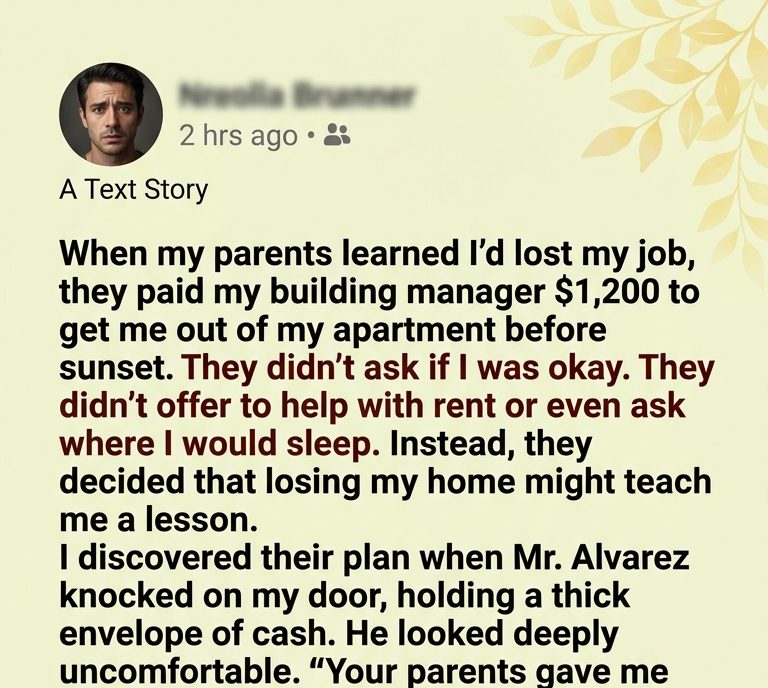
“Your parents came by this morning.”
My stomach tightened.
“My parents?”
He nodded and held out the envelope.
“They gave me twelve hundred dollars.”
I stared at him.
“For what?”
He took a breath.
“They want you out of the apartment before sunset.”
For several seconds, I couldn’t speak.
I was twenty-nine years old. I had worked in marketing for six years before my company eliminated my position during a round of layoffs. I had been unemployed for seven weeks, and although the experience had shaken me, I had never stopped looking for work.
My savings were limited, but I had enough to cover my rent for another month.
I had not asked my parents for money.
I had not asked them to rescue me.
I had simply told them the truth when my mother called the previous evening.
I had lost my job.
Apparently, that was enough to convince them I deserved to lose everything else.
“They paid you to evict me?” I finally asked.
Mr. Alvarez shifted uncomfortably.
“They said you needed a wake-up call. Your father told me that if you had to spend one night without a roof over your head, you might finally understand what it means to be responsible.”
I looked past him toward the hallway.
The building was quiet. A woman on the third floor was watering plants outside her door. Somewhere downstairs, a child was laughing.
The ordinary sounds of home continued around me while my world seemed to stop.
“What did you tell them?”
“I told them I couldn’t simply throw you out. They said they would pay me to handle it quickly.”
He lowered his voice.
“I shouldn’t have accepted the envelope before understanding what they expected. I’m sorry.”
Behind me, my suitcase remained open.
My laptop was on the kitchen table, displaying three unfinished job applications. A notebook lay beside it, filled with company names, interview dates, and reminders to follow up with recruiters.
I had spent the morning rewriting my résumé.
Now my parents had arranged for me to be homeless before dinner.
I looked at the envelope in Mr. Alvarez’s hands.
“Did they say anything else?”
He hesitated.
“Your father said you had become too comfortable. He said you needed to learn that nobody owes you anything.”
I almost laughed.
Nobody owed me anything.
That was precisely why I had been applying for jobs every day, refusing to spend recklessly, and trying to rebuild my life without asking anyone to carry me.
But my parents had never been interested in the details.
They were interested in appearances.
And in their eyes, losing a prestigious job was not a temporary setback. It was a public embarrassment.
I looked at Mr. Alvarez.
“Did you know who owns this building?”
He frowned.
“Of course. The management company handles the property.”
“No, I mean the actual owner.”
He shook his head.
“Why?”
I stepped away from the door and walked toward the desk in the corner of my living room.
There was a framed photograph on it of my grandmother, Evelyn Bennett, standing outside a brick apartment building on a snowy afternoon.
The building in the photograph was this building.
My grandmother had purchased it decades earlier, when the neighborhood was still filled with small shops and family-owned businesses. After she died, her property holdings had passed into a family trust.
My parents had always treated that trust as if it belonged to them.
They had assumed that because my father managed some of the family’s investments, he could make every decision.
But my grandmother had anticipated that possibility.
And she had made certain that her grandchildren would not be entirely dependent on their parents.
I turned back toward Mr. Alvarez.
“My grandmother left me a controlling interest in the company that owns this building.”
His face changed.
“What?”
“I don’t know exactly what my parents told you, but they don’t own my apartment. And they don’t have the authority to remove me.”
I looked at the envelope again.
“Keep the money. You’ll need it for the paperwork you’re about to help me review.”
Mr. Alvarez stared at me.
Then, slowly, he nodded.
For the first time that afternoon, I felt something other than fear.
My parents had made a terrible mistake.
They had confused my unemployment with helplessness.
And they had forgotten that the daughter they were trying to punish had a place in the very business they believed they controlled.
The Family Secret
My grandmother had never been wealthy in the way my parents liked to imagine wealth.
She didn’t own a private jet or spend winters in a mansion.
She owned buildings.
She bought modest apartment properties, repaired them, kept rents reasonable, and held onto them for decades. She believed that property was valuable not only because of the money it produced, but because it gave people somewhere to build their lives.
When I was a child, she often took me to visit her properties.
She knew the tenants by name. She remembered who worked nights, who had a new baby, and who needed a few extra days to pay rent.
My father, Richard, considered this sentimental nonsense.
He wanted to sell properties, invest the proceeds, and expand into larger developments.
My grandmother disagreed.
“You can make money without forgetting that people live inside the numbers,” she once told him.
He never liked being corrected.
After she died, her estate was divided through a series of trusts and holding companies. My father became responsible for overseeing certain investments, but he was not the sole owner of everything.
My grandmother had left me a controlling interest in Bennett Residential Holdings, the company that owned several apartment buildings, including the one where I lived.
She had also appointed independent trustees to protect the company’s assets and ensure that major decisions followed the governing documents.
I was twenty-two when the estate was settled.
At the time, I had little interest in property management. I wanted to build my own career, so I accepted a role on the company’s board but stayed out of day-to-day operations.
My father interpreted my distance as weakness.
He often spoke about the properties as though he owned them outright.
When I questioned a proposed sale, he dismissed me.
When I asked for financial reports, he said I was too inexperienced to understand them.
And when I moved into one of the apartments, he told me it would be a good way to learn to live within my means.
I had agreed because I liked the neighborhood and wanted to pay my own way.
I never imagined he would one day try to use that apartment as a weapon against me.
That evening, after Mr. Alvarez left, I called the attorney who had handled my grandmother’s estate.
Her name was Julia Chen.
She answered on the second ring.
“Emma? Is everything all right?”
I told her about the envelope, the demand to leave, and my parents’ explanation.
She was silent for a moment.
“Did your father put anything in writing?”
“Not that I know of. Mr. Alvarez has the envelope.”
“Good. Ask him to preserve it and any messages he received. Do not sign anything, and do not agree to surrender the apartment.”
“Can they evict me?”
“Your parents cannot evict you simply because they dislike your employment status. The landlord would need to follow the applicable legal process, and we need to review your lease and the ownership records. But if your parents have attempted to use the management company to pressure you, we need to address that immediately.”
I looked around my apartment.
The blue sofa. The small dining table. The framed photograph of my grandmother.
“I don’t want special treatment,” I said.
“Then don’t ask for it. Ask for the same lawful treatment any tenant deserves. And because you have an ownership interest in the company, make sure the company follows its own procedures. Your position gives you responsibilities as well as rights.”
That last sentence stayed with me.
I didn’t want to punish my parents by using the building as a personal weapon.
I wanted to stop them from using it as one.
Julia arranged a meeting for the next morning.
Before we hung up, she asked me one question.
“Emma, are you safe tonight?”
I looked at the open suitcase.
“Yes,” I said. “I think I am.”
For the first time that day, I meant it.
What My Parents Had Really Planned
The following morning, I met Julia at her office.
She had already obtained the building’s ownership records, the relevant trust documents, and a copy of the management agreement.
She spread the documents across a conference table.
“The building is owned by Bennett Residential Holdings,” she explained. “Your grandmother’s estate transferred the controlling voting interest to you, subject to the trust provisions. Your father has a management role in certain affiliated entities, but he does not have unilateral authority to terminate your tenancy.”
“So he lied to Mr. Alvarez?”
“Possibly. We should be precise. We need to establish what he actually represented and what Mr. Alvarez understood.”
She turned to another document.
“This is your lease. It’s current. Your rent is paid through the end of the month, and there is no outstanding violation.”
I exhaled.
“So they can’t make me leave today.”
“Not on the basis of what you’ve described.”
Julia then showed me an email chain between my father and the property management office.
My father had written that I was “financially unstable” and “no longer suitable for the building.”
He had instructed the manager to offer an immediate payment in exchange for my departure.
The email did not mention an unpaid rent balance, property damage, or any violation of my lease.
It described the arrangement as a “family intervention.”
I read the words twice.
My mother had been copied on the email.
She had replied:
She needs to understand that actions have consequences. Don’t let her talk her way out of it.
I placed the pages on the table.
My mother had always been the quieter one.
My father made the rules. She enforced them with disappointment, silence, and the occasional reminder that I was making life difficult for everyone.
I had spent years trying to earn her approval.
Now I understood that she had been willing to watch me lose my home to teach me a lesson.
Julia closed the folder.
“We should notify the company’s independent trustees and the management firm’s compliance officer. Your father should not be making unilateral decisions about a property in which he has a personal conflict.”
“Will he lose his position?”
“That is for the board and trustees to determine. Our job is to document what happened and ensure that any response is lawful and proportionate.”
I nodded.
I wanted my parents to face consequences.
But I did not want to become the kind of person who used power carelessly just because someone had hurt me.
The distinction mattered.
The Meeting
Three days later, the board convened an emergency meeting.
My father arrived in a charcoal suit, carrying a leather briefcase. My mother sat beside him, wearing the pearl earrings she reserved for formal occasions.
When they saw me at the table, my father stopped.
“What is she doing here?”
Julia answered before I could.
“Emma is a controlling shareholder and a director. She is entitled to attend this meeting.”
My father looked at the other board members.
“This is a private family matter.”
“No,” I said. “It became a company matter when you used company management to try to remove me from a property you do not personally own.”
His jaw tightened.
“You have no idea how much I have done for this family.”
“I know you tried to make me homeless.”
My mother looked down at her hands.
My father leaned forward.
“You lost your job, Emma. We were trying to help you understand the consequences of your choices.”
“I didn’t choose to be laid off.”
“You could have found another job by now.”
“I have been applying every day.”
“You should have taken anything available.”
“I have applied for jobs outside my field. I have interviewed. I have been doing everything I can.”
He waved a hand dismissively.
“Excuses.”
I felt the old instinct rise in me: to explain, to prove, to beg him to understand.
But I was no longer a teenager standing in his study, hoping he would tell me I had done well.
I was an adult sitting at a board meeting.
And the facts were on the table.
Julia summarized the lease, the management agreement, and the communications with Mr. Alvarez. The independent trustees asked my father to explain why he had attempted to arrange my departure without following the company’s established procedures.
He claimed he had been acting as a concerned parent.
One trustee asked him a simple question.
“If this were any other tenant, would you have offered the manager twelve hundred dollars to remove them before sunset?”
My father did not answer.
The board voted to suspend his property-management authority pending an independent review.
The management company was instructed not to take any action against me outside the ordinary legal process.
Mr. Alvarez was asked to provide a written account of what had happened. The company also agreed to review its procedures so that no employee would be pressured into carrying out an improper eviction.
My father stood abruptly.
“This is absurd. You’re humiliating me over a misunderstanding.”
I looked at him.
“You tried to take my home because I lost my job. You didn’t ask if I was okay. You didn’t ask whether I had enough money to eat. You didn’t even ask where I would sleep.”
My voice shook, but I continued.
“You wanted me to hit rock bottom. You just didn’t expect me to have somewhere to stand.”
He stared at me.
For the first time in my life, he had no immediate response.
The Offer
The next week, my mother came to my apartment alone.
I almost didn’t open the door.
When I did, she stood in the hallway holding a paper bag from the bakery I had loved as a child.
It was such a familiar gesture that it hurt.
“Can I come in?” she asked.
I stepped aside.
She placed the bag on the kitchen counter.
“I brought you something.”
“Thank you.”
We stood in silence.
Finally, she said, “Your father thinks you have overreacted.”
“I expected that.”
“He says he was trying to teach you independence.”
I looked at her.
“Did you believe that?”
She began to cry.
“I don’t know what I believed.”
“You signed off on it.”
“I know.”
“You knew I was trying to find work. You knew I was scared. And instead of asking how I was doing, you helped him arrange to throw me out.”
She wiped her cheeks.
“Your father has always believed that hardship makes people stronger.”
“Then why didn’t he let me handle my own hardship?”
She had no answer.
After a while, she sat down.
“When you were little, we worried that you would never learn to stand on your own. Your grandmother always stepped in. She paid for things. She gave you opportunities. Your father thought you would become dependent on other people.”
I looked at her carefully.
“My grandmother gave me a home to learn in. She didn’t try to take one away.”
My mother nodded slowly.
“I know.”
She reached into her purse and took out a check.
“Your father wants to offer you this. To help with expenses while you look for work.”
I did not take it.
“How much?”
“Five thousand dollars.”
I looked at the check.
It was more money than I had asked them for.
It was also less than the amount they had spent trying to force me out.
“Is there a condition?”
“No.”
“Does Dad expect me to apologize?”
She hesitated.
“He wants the family to move forward.”
“That isn’t the same as apologizing.”
She lowered the check.
“I know.”
I didn’t accept the money that day.
Instead, I told her that if they genuinely wanted to help, they could begin by acknowledging what they had done without turning it into a lesson about my character.
I also told her that I would not discuss my housing, finances, or employment with them for a while.
She nodded.
Before she left, she turned back toward me.
“Your grandmother would have been proud of you.”
I looked at the photograph on my desk.
“I wish she were here.”
“So do I.”
My mother left the bakery bag behind.
I ate one of the pastries that evening.
It tasted exactly as I remembered.
Rebuilding My Life
The job search continued.
There were rejections, unanswered emails, and interviews that seemed promising until they weren’t.
But I no longer felt that every setback meant I was failing as a person.
I found temporary contract work with a small nonprofit, helping them redesign their outreach campaigns. The pay was modest, but the work was meaningful, and it gave me recent experience to add to my résumé.
Three months later, I received an offer from a growing communications firm.
The salary was lower than my previous one, but the position had room for advancement. My manager valued my experience and didn’t treat the gap in my employment as a character flaw.
I accepted.
On my first day, I wore the navy blazer I had bought for interviews.
Before leaving, I stood in front of the mirror and took a deep breath.
I had a job again.
But more importantly, I had learned that my worth had never depended on one.
The independent review of the property company concluded that my father had exceeded his authority in attempting to arrange the removal. The board established clearer limits on his role and required additional oversight of tenant-related decisions.
Mr. Alvarez remained the building manager.
One afternoon, he stopped by to tell me that the company had updated its procedures.
“I’m sorry about what happened,” he said.
“You apologized already.”
“I still feel bad.”
“You were put in a difficult position. What matters is that you didn’t carry out the demand.”
He smiled faintly.
“I suppose I learned something too.”
I thanked him and returned to my work.
My parents and I did not suddenly become close.
My father sent a short email saying he regretted that the situation had “become so contentious.” It did not contain the words I was wrong.
I didn’t respond.
My mother called occasionally. Sometimes we spoke for ten minutes. Sometimes I let the call go to voicemail.
I wasn’t trying to punish her.
I was learning that forgiveness did not require immediate access to my life.
Six months after the incident, I received a letter from her.
It was handwritten.
She wrote that she had been afraid of disappointing my father. She had convinced herself that his harshness was a form of love because admitting otherwise would have forced her to confront years of choices.
She apologized for participating in the plan.
It was the first apology that did not contain an excuse.
I kept the letter.
I did not rush to tell her everything was fine.
But I called her the following Sunday.
We talked about ordinary things: the weather, her garden, the new job. It wasn’t reconciliation in the grand sense.
It was a beginning.
The Lesson They Never Expected
One evening, nearly a year after the day Mr. Alvarez knocked on my door, I sat at my kitchen table with my laptop open.
I was reviewing a proposal for a new campaign when I noticed the framed photograph of my grandmother beside the window.
She was standing outside this building, smiling at someone just beyond the camera.
I wondered what she would have said about everything that happened.
I could almost hear her voice.
People show you who they are when they think you have nothing to offer them.
My parents had believed that losing my job made me powerless.
They thought they could frighten me into obedience by threatening the one thing I had worked hardest to maintain: a stable home.
They had not understood that I had rights independent of my employment, my family name, or their approval.
And they had not understood that the building was never simply a family asset to be used whenever my father wanted to make a point.
It was a home.
It was a business with responsibilities.
And it was part of my grandmother’s legacy.
I still lived in the apartment. I still paid rent according to my lease. I still worked for my living.
Nothing about my grandmother’s inheritance meant I would never struggle.
It simply meant that my parents could not decide that struggle was something I deserved.
I closed the laptop and walked to the window.
Below, a young couple carried groceries through the entrance. A delivery driver held the door for an elderly man. Someone on the second floor had put a small plant on the windowsill.
Life continued.
I thought about the twelve hundred dollars in the envelope.
My parents had believed that money would buy a lesson.
Instead, it exposed the truth about the way they saw me.
They had wanted me to learn that nobody owed me anything.
I learned something else.
I could lose a job without losing my dignity. I could accept help without surrendering my independence. And I could love my parents without allowing them to control my life.
That was the lesson I kept.
And this time, I had chosen it for myself.