The first thing I noticed when I returned to Phoenix was the silence.
Not the ordinary quiet of an empty house, but the kind that settles over a place after something terrible has happened.
My daughter’s pink sneakers were missing from the hallway. Her schoolbag wasn’t beside the stairs. The little framed photograph of her and me at the beach had been taken off the living room shelf.
For one frightening moment, I thought Emma had left without telling me where she was going.
Then I saw her sitting on the front steps of our neighbor’s house, wearing yesterday’s clothes and holding her phone in both hands.
She was fourteen years old.
And she looked as though she had nowhere in the world to belong.
I hurried across the lawn.
“Emma!”
She jumped to her feet and ran toward me.
The moment I wrapped my arms around her, she began to cry.
“Mom, I’m sorry,” she whispered. “I didn’t know what else to do.”
“Sorry for what, sweetheart?”
“For making Grandma and Grandpa angry.”
I pulled back and looked directly into her eyes.
“You did nothing wrong. Tell me exactly what happened.”
Emma wiped her cheeks with her sleeve.
That morning, she had woken up early to finish a school assignment. My parents, Richard and Patricia, had been staying in my house while I attended a three-day work conference in Phoenix.
I had trusted them to look after Emma.
Instead, she found a folded sheet of paper outside her bedroom door.
The message was written in my father’s unmistakable handwriting.
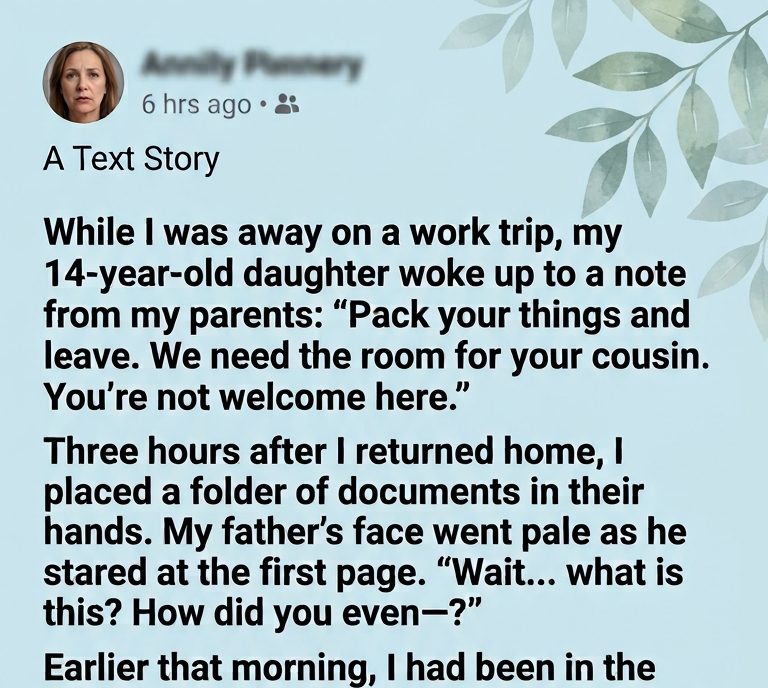
Pack your things and leave. We need the room for your cousin. You’re not welcome here.
Emma had read it several times, convinced she must have misunderstood.
She went downstairs and found my mother preparing breakfast.
“Grandma, what does this mean?” she asked, holding up the note.
My mother barely glanced at it.
“It means your cousin Tyler is coming to stay. He needs a proper bedroom.”
“But where am I supposed to go?”
“That’s not our problem,” my father replied from the dining table. “You’re old enough to understand that sometimes people have to make sacrifices.”
Emma reminded them that the house belonged to me.
My father slammed his newspaper down.
“Your mother isn’t here. Until she returns, we’re making the decisions.”
“But this is my home.”
“Not anymore,” my mother said coldly. “Your room belongs to Tyler now.”
Emma tried calling me.
I was presenting a proposal to a room full of clients when my phone began vibrating. After the third call, I stepped into the hallway.
“Mom… Grandma and Grandpa made me leave.”
I remember the feeling in my chest as if someone had reached inside and squeezed my heart.
“What do you mean, leave?”
“They said I couldn’t stay here anymore. Grandma told me to pack. Grandpa said if I didn’t go, he would call Aunt Melissa and tell her I was refusing to cooperate.”
“Where are you right now?”
“Mrs. Collins let me come over.”
Our neighbor, Eleanor Collins, had found Emma standing outside with a suitcase and her schoolbag. When she learned what had happened, she brought my daughter inside, made her breakfast, and called me.
I thanked her repeatedly.
Then I told Emma, “Stay with Mrs. Collins. Don’t go back into the house alone. I’m coming home.”
I ended the call, returned to the conference room, and asked a colleague to take over the remaining presentation.
My flight was booked within twenty minutes.
But while I waited at the airport, I made another call.
I called my attorney, Daniel Foster.
“Daniel, I need you to review the documents concerning my house. The original trust, the occupancy agreement, everything.”
There was a brief silence.
“Is something wrong?”
“My parents have thrown my daughter out of her bedroom while I’m away. They’re claiming they have the right to decide who lives in my house.”
“I’ll gather the documents,” he said. “And don’t let anyone pressure you into signing anything.”
I had no intention of doing that.
Because my parents had forgotten something important.
The house they were treating as their own had never actually belonged to them.
And the reason went back to my grandmother.
My grandmother, Evelyn Bennett, had been the person who made me feel safe when I was growing up.
She was a quiet woman with sharp eyes and a habit of keeping every important document in a labeled folder. She believed that family should help one another, but she also believed that generosity without boundaries could destroy relationships.
When I was thirty-one, she died after a short illness.
She left me a modest investment account, several personal belongings, and a house in a quiet neighborhood outside Phoenix.
The house had been purchased decades earlier, and my grandmother had spent years maintaining it. She wanted it to remain in the family, but she knew that simply leaving it to someone without clear arrangements could create conflict.
So she established a trust.
Under the terms of that trust, I became the beneficial owner of the property, with authority to manage it according to the trust documents. The title was held through the arrangement she had created, and the house was meant to provide stability for me and my daughter.
My parents had been allowed to live there under a written occupancy agreement.
They contributed a small monthly amount toward household expenses. In exchange, they could remain in the home as long as they followed the agreement’s conditions.
They were not the owners.
They could not transfer rooms, change the household arrangements, or decide that another family member had a greater right to live there.
My grandmother had anticipated that someone might confuse living in a home with owning it.
She had even included a letter explaining why she had made the arrangement.
I remembered the words clearly.
This house is meant to give my granddaughter and her child a secure place to live. Anyone who lives there should understand that security is a responsibility, not a weapon to use against another member of the family.
At the time, I had thought the letter was simply my grandmother being careful.
Now I understood why she had insisted on it.
By the time I arrived home, the sun was beginning to set.
Mrs. Collins had prepared dinner for Emma, but my daughter barely touched it. She stayed close to me, as though she feared I might disappear again.
I promised her I wasn’t going anywhere that evening.
Then I walked across the lawn and entered my house.
My parents were in the living room.
My father sat in his favorite armchair, watching television. My mother was arranging flowers on the coffee table.
Neither of them stood up.
“You’re home early,” my mother said.
“Where is Emma’s bedroom furniture?”
My father lowered the volume on the television.
“We moved some things around. Tyler will be arriving tomorrow.”
“Where is my daughter supposed to sleep?”
My mother sighed as though I were being unreasonable.
“She can use the guest room.”
“The guest room is full of boxes. You told her to leave the house.”
“She misunderstood,” my father said.
“No,” I replied. “She understood exactly what you told her.”
My mother folded her arms.
“Your sister has been struggling. Tyler needs a stable place to stay while she sorts things out. Emma is a teenager. She can adapt.”
“Then why didn’t you ask me?”
“Because you would have made it difficult.”
That answer told me everything.
They hadn’t made a mistake.
They had made a decision they knew I might reject, so they had waited until I was hundreds of miles away.
My father stood.
“You need to calm down. We’re your parents. We’ve done plenty for you over the years.”
“I appreciate what you’ve done for me. But that doesn’t give you the right to throw my daughter out.”
“This is family business,” he snapped.
“It is. And Emma is my family.”
My mother shook her head.
“You’re making this into something it isn’t.”
I looked around the living room. The furniture my grandmother had chosen was still there. The framed photographs, the old wooden clock, and the cabinet she had restored herself all remained in their places.
Everything looked familiar.
But the house no longer felt safe.
I reached into my bag and removed a thick folder.
“Then perhaps you should read this.”
I placed it on the coffee table.
My father looked irritated.
“What is this supposed to be?”
“Documents concerning the house.”
He opened the folder.
The first page was a copy of the trust’s property schedule. The next pages included the recorded title information, the occupancy agreement, and the section explaining who had authority over the property.
My father’s expression changed as he read.
His eyebrows drew together.
Then his face went pale.
“Wait… what is this?” he asked. “How did you even—?”
“I’ve always had these documents, Dad. You signed the occupancy agreement yourself.”
He turned to my mother.
She took the folder from him and began reading.
“This can’t be right,” she murmured.
“It is right.”
My father flipped through the pages more quickly.
“We’ve lived here for years.”
“Yes.”
“We’ve paid for things.”
“Yes. And the agreement explains what those payments cover.”
“So you’re saying we have no rights?”
“I’m saying you have the rights written in the agreement. You have permission to live here under specific conditions. You do not own the house, and you cannot decide that Emma has to leave.”
My father pushed the folder away.
“Your grandmother should never have put you in charge of something like this.”
“She trusted me to protect my daughter’s home.”
My mother looked up sharply.
“Are you threatening to throw us out?”
“No. I’m telling you that you cannot use this house to threaten Emma.”
For several seconds, nobody spoke.
Then my father pointed toward the folder.
“You planned this.”
I shook my head.
“No. You made your decision. I brought the documents because you were pretending your decision had no consequences.”
The next morning, my attorney arrived.
Daniel Foster had represented me in matters involving the trust for years. He carried a briefcase and a calm expression that made my father visibly uncomfortable.
We sat around the dining table.
Emma remained upstairs with Mrs. Collins, who had offered to keep her company while we talked.
Daniel placed a copy of the occupancy agreement in front of my parents.
“I’ve reviewed the documents,” he said. “The property is held under the arrangement established by Mrs. Bennett. Your daughter has the beneficial interest and the authority described in the trust. Your occupancy is governed by this agreement.”
My father crossed his arms.
“We’re not strangers. We’re her parents.”
“Of course,” Daniel replied. “But family relationships do not change the written terms of a property agreement.”
My mother stared at him.
“So what happens now?”
“That depends on what everyone wants to do,” Daniel said. “The immediate issue is straightforward. Emma is entitled to return to her home, and no one should attempt to remove her or her belongings.”
My father muttered something under his breath.
Daniel continued.
“If there are disagreements about the occupancy arrangement, those should be handled through the procedures in the agreement. No one should change the locks, remove possessions, or attempt to transfer occupancy to another person without proper authorization.”
My mother looked at me.
“You would really make this a legal matter against your own parents?”
“I didn’t make it a legal matter. You made it a legal matter when you decided that your granddaughter could be removed from her home without asking me.”
“We were trying to help Melissa,” she said.
“Then you should have helped her without hurting Emma.”
My father leaned forward.
“Tyler has nowhere else to go.”
“Then we can discuss how to help him. But Emma’s bedroom is not the price of that help.”
Daniel closed his folder.
“I recommend that everyone take some time before making further decisions. The agreement remains in effect, and any changes should be discussed with the person authorized to manage the property.”
My father didn’t respond.
For the first time since I had returned, he seemed to understand that he could not simply declare himself in charge.
Emma came downstairs later that afternoon.
She stood at the bottom of the staircase, looking uncertain.
“Can I go back to my room?”
I walked over and took her hand.
“Of course you can.”
She hesitated.
“Are Grandma and Grandpa going to be angry?”
“They might be upset. But that isn’t your responsibility.”
She looked toward the living room, where my parents sat in silence.
“Did I do something wrong?”
“No, sweetheart.”
I knelt so that we were eye to eye.
“You never have to earn the right to feel safe in your own home. You don’t have to give up your place just because someone else wants it.”
Her eyes filled with tears again.
“I thought you might be mad at me.”
“Never for asking me for help.”
I hugged her, and this time she held on tightly.
Then we went upstairs together.
Her bedroom had been partially emptied. Some of her books were stacked in the hallway, and her blankets had been placed in a cardboard box.
I helped her put everything back.
We restored the books to their shelves, arranged her pillows, and returned the framed photograph to her desk.
It was a small task.
But with every object we put back in place, I felt as though we were reclaiming something larger than a room.
We were restoring Emma’s sense of belonging.
My sister Melissa called that evening.
“You embarrassed Mom and Dad,” she said without greeting me.
“Did you know they were going to make Emma leave?”
“They told me Tyler could have the room. I assumed you’d agreed.”
“You assumed I had agreed to throw my daughter out of her bedroom?”
“Don’t twist my words.”
“I’m not. Did you know they had left her a note telling her she wasn’t welcome?”
Melissa went quiet.
Then she said, “Mom told me Emma could stay somewhere else for a few days.”
“Where?”
“I don’t know. With a friend, maybe.”
“She is fourteen, Melissa. She was alone with a suitcase when our neighbor found her.”
“I didn’t know it was that bad.”
“You didn’t ask.”
Melissa began to cry.
She explained that she had been struggling financially after a separation. Tyler had been having trouble at school, and she wanted him to spend some time with his grandparents.
I understood that she needed help.
I even felt sorry for her.
But understanding her circumstances did not mean I had to accept what she had done.
“I’m willing to talk about helping Tyler,” I told her. “I can help you look for temporary housing or work out a realistic plan. But Emma will not be pushed aside to make that happen.”
Melissa sniffed.
“So you’re choosing your daughter over your nephew.”
“I’m choosing not to sacrifice one child’s security to solve an adult’s problem.”
She ended the call without saying goodbye.
Over the next week, my parents and I met several times.
My father insisted that the occupancy agreement was unfair. He argued that years of living in the house should have given him more authority.
Daniel explained that the agreement did not grant him ownership simply because he had lived there for a long time. Any change would need to follow the terms of the trust and the applicable legal process.
My parents eventually agreed to stop interfering with Emma’s room and belongings.
They also agreed that Tyler would not move into the house without my consent.
That did not mean everything returned to normal.
My mother avoided me for days. My father spoke only when necessary.
I was willing to give them time, but I would not pretend nothing had happened.
We reviewed the occupancy agreement and clarified the household rules. I made sure my parents understood that they could continue living there under the existing arrangement, provided they honored its terms.
I did not threaten an immediate eviction.
I did not change the locks.
I did not use the house as revenge.
But I also made it clear that Emma would never again be treated as though she were a temporary guest in her own home.
Three weeks later, my mother knocked on Emma’s bedroom door.
I was in the kitchen when I heard her ask, “May I come in?”
Emma looked at me.
I nodded, leaving the choice to her.
“Okay,” Emma said.
My mother stepped inside.
She stood awkwardly near the doorway, holding a small paper bag.
“I brought you something,” she said.
Emma opened it. Inside was a new sketchbook and a set of colored pencils.
My mother took a breath.
“I’m sorry about what happened.”
Emma said nothing.
“I should never have told you to leave. Your grandfather and I should have spoken to your mother. We were trying to help Tyler, but we handled it terribly.”
“Why did you say I wasn’t welcome?” Emma asked.
My mother looked down.
“I was angry. That isn’t an excuse.”
Emma held the sketchbook against her chest.
“Did you really want me to leave?”
My mother’s eyes filled with tears.
“No, sweetheart. I didn’t think about how frightened you would be. I’m sorry.”
Emma didn’t rush to hug her.
She simply said, “Thank you for apologizing.”
My mother nodded and left the room.
It was not a perfect reconciliation.
But it was a beginning.
My father took longer.
He eventually admitted that he had assumed my grandmother’s arrangements were “just paperwork.” He had treated his years in the house as proof that he could make decisions for everyone who lived there.
“I thought I was doing what was best for the family,” he told me one afternoon.
“Then you need to remember that Emma is part of the family, too.”
He looked away.
“I know.”
I wanted to believe him.
But trust would have to be rebuilt through actions, not promises.
Months passed.
Tyler stayed with Melissa while she found a smaller apartment and worked through her finances. I helped her review her budget and locate community resources, but I did not offer my daughter’s room as a solution.
My parents continued living in the house under the agreement.
They no longer made decisions about Emma’s space without speaking to me. My mother began asking before entering her room, and my father stopped referring to the property as “our house.”
The changes were small, but they mattered.
Emma slowly returned to her old self.
She began inviting friends over again. She put new drawings on her walls and spent hours at her desk working on school projects.
One evening, I found her sitting on the floor beside the window, sketching the garden.
“Are you happy we came back?” I asked.
She looked up.
“Of course. This is home.”
I sat beside her.
“I’m sorry I wasn’t there that morning.”
She shook her head.
“You came back.”
Those three words stayed with me.
You came back.
I had spent years believing that being a good daughter meant keeping my parents comfortable, even when their choices hurt me. I had mistaken silence for peace and compliance for love.
My grandmother had understood something I was only beginning to learn.
A home is not just a building. It is the place where people should be able to trust that they belong.
And love does not give anyone permission to make another person feel disposable.
The folder of documents had protected my legal rights, but it had also forced my family to face a truth they had ignored for too long.
My parents could be grandparents.
They could be part of our lives.
They could even continue living in the house my grandmother had left behind.
But they could never again use that house to decide whether my daughter deserved a place in our family.
One night, as I tucked Emma into bed, she reached for my hand.
“Mom?”
“Yes?”
“Grandma said she wants to come to my school art show.”
“How do you feel about that?”
Emma thought for a moment.
“I think it’s okay. As long as she asks first.”
I smiled.
“That sounds fair.”
She turned off her bedside lamp.
And for the first time in weeks, I walked away from her room without worrying about what she might find outside the door the next morning.
The house was quiet again.
But this time, it was the peaceful kind of quiet.
The kind that comes when everyone finally understands that belonging should never have to be earned by surrendering your place to someone else.