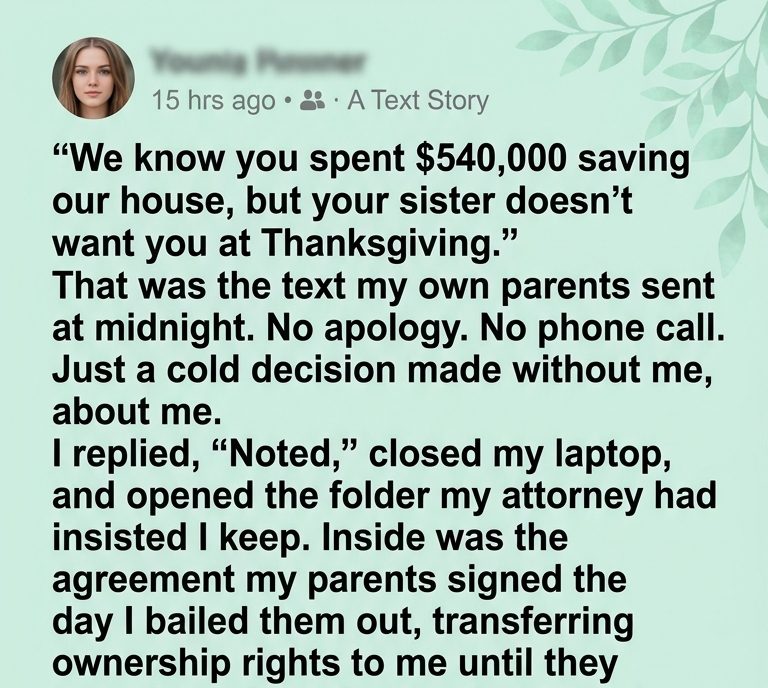
“We know you spent $540,000 saving our house, but your sister doesn’t want you at Thanksgiving.”
I read the message twice.
It had arrived at 12:07 a.m.
No greeting.
No explanation.
No apology.
Just one sentence from my parents, as if they were informing me that a meeting had been canceled.
For several minutes, I stared at the screen.
Then I typed one word.
“Noted.”
I closed my laptop.
And opened the folder my attorney had insisted I keep.
Inside was the agreement my parents had signed six months earlier.
The agreement that transferred ownership rights in their house to me until they repaid the $540,000 I had paid to prevent the property from being lost.
They had six months.
If they couldn’t repay me by the deadline, they would owe me rent under the agreement.
The deadline was Thanksgiving Day.
And suddenly, their message made sense.
They thought I would stay quiet.
They thought because I was their daughter, I would keep rescuing them even while they pushed me out.
They were about to discover that helping family and surrendering your rights were two very different things.
The House Everyone Thought Belonged To My Parents
My parents, Richard and Patricia, had lived in the same house for thirty-two years.
It was an older two-story property with a wide porch, a detached garage, and a maple tree my father had planted when my sister Lauren was born.
The house meant everything to them.
I understood that.
That’s why, when I discovered they were about to lose it, I stepped in.
It happened six months earlier.
My father had suffered a business setback.
My mother had accumulated medical and household expenses.
They had fallen behind on the mortgage and property taxes.
The notices had started arriving.
Then came the foreclosure warning.
My parents didn’t tell me.
I found out because a letter addressed to my father had accidentally been delivered to my apartment.
I called him immediately.
“Dad, what’s going on?”
“Nothing.”
“There’s a foreclosure notice.”
Silence.
Then he sighed.
“We were handling it.”
“You’re three months behind.”
“We’ll figure it out.”
They didn’t.
Two weeks later, I sat across from them at their kitchen table with a stack of financial documents between us.
My father looked exhausted.
My mother kept wiping her eyes.
“We’re going to lose the house,” she finally admitted.
“How much do you need?”
My father hesitated.
“Five hundred and forty thousand.”
I almost dropped my coffee.
“That much?”
The mortgage balance, tax arrears, penalties, and several other secured obligations had accumulated into an amount large enough that my parents couldn’t realistically cover it.
I could.
Not because I was wealthy beyond reason.
I had built a successful consulting business over several years and had savings and investments.
But $540,000 was still a massive amount.
I didn’t want to simply hand them the money.
So I called an attorney.
Her name was Margaret Ellis.
She explained that if I paid the debt without documentation, I could create an enormous family dispute later.
“If you want to help them save the house,” she told me, “make the arrangement formal.”
My parents agreed.
We signed an agreement.
I would pay the $540,000.
In exchange, my parents would transfer specified ownership rights in the property to me until the debt was repaid.
They had six months to buy those rights back.
If they repaid me in full, the arrangement would end.
If they didn’t, they would owe me rent under the agreement and remain in the house under clearly defined terms.
My father signed.
My mother signed.
And Lauren, my younger sister, signed as an acknowledged beneficiary of the arrangement because she had previously claimed an interest in the property.
Everyone knew what the agreement said.
At least, I thought they did.
The Family Rescue
The money transferred the next morning.
The foreclosure action was stopped.
The tax arrears were paid.
The mortgage was brought current.
The house was safe.
My parents cried when the transaction was completed.
My mother hugged me.
“You saved us.”
Dad squeezed my shoulder.
“I don’t know how we’ll ever repay you.”
“You have six months,” I reminded him.
He laughed nervously.
“We’ll figure it out.”
For the first few weeks, everything seemed fine.
Then Lauren started acting strangely.
She had always been the favorite.
She was charming, social, and successful in a very visible way.
She worked for a large company and regularly hosted dinners for colleagues.
My parents adored telling people about her.
When I helped with something, they called it “what family does.”
When Lauren did anything, they called it extraordinary.
I had learned to live with that.
What I hadn’t expected was for Lauren to resent the fact that I had saved the house.
She never thanked me.
Instead, she said things like:
“You know Mom and Dad would have figured it out.”
Or:
“You shouldn’t make a big deal about the money.”
I never did.
I didn’t mention the amount.
I didn’t remind anyone that I had emptied a significant portion of my investment account to save their home.
I simply waited.
Because I trusted the agreement.
And because I loved my parents.
Six Months Later
As Thanksgiving approached, Margaret sent me a reminder.
“Your contractual deadline is November 28,” she wrote.
Thanksgiving Day.
I smiled at the coincidence.
I assumed my parents would have the money ready.
They didn’t.
A week before Thanksgiving, I asked my father.
“Are you close to repaying the amount?”
He avoided my eyes.
“We’re working on it.”
“How close?”
“Not close enough.”
My stomach tightened.
“Dad, the deadline is next Thursday.”
“I know.”
“Then what are you planning to do?”
“We’ll talk after Thanksgiving.”
I stared at him.
“After?”
“We don’t want to discuss finances during the holiday.”
I didn’t argue.
“Okay.”
I left.
Three days later, I received a message from my mother.
Don’t bring up the house at Thanksgiving. Lauren has invited several colleagues and wants everything to be comfortable.
I read it.
Then I put my phone away.
I wasn’t going to cause a scene.
I wasn’t even sure I would attend.
Then came the midnight text.
“We know you spent $540,000 saving our house, but your sister doesn’t want you at Thanksgiving.”
That was the moment something inside me changed.
Not because I was excluded from dinner.
Because they had reduced everything I had done to a transaction they wanted to ignore.
I opened the folder.
There was the signed agreement.
There was the payment confirmation.
There was the property documentation.
And there was the clause about the deadline.
I called Margaret.
She answered on the second ring.
“I assume you’ve received the message.”
“How did you know?”
“Your mother emailed me yesterday asking whether the agreement could simply be ignored if everyone agreed.”
I sat back.
“And what did you tell her?”
“That contracts don’t disappear because a family wants a pleasant Thanksgiving.”
I laughed despite myself.
“What happens tomorrow?”
“If they don’t repay you, the agreement takes effect according to its terms.”
“Should I go there?”
“No.”
“Then what should I do?”
“Stay home. Let the paperwork speak.”
Thanksgiving Morning
My parents woke up expecting a normal holiday.
I know this because Lauren posted photographs.
The dining room had been decorated beautifully.
There were candles.
Flowers.
A huge turkey.
Lauren’s colleagues arrived in expensive coats and carrying bottles of wine.
My mother smiled for photographs.
My father stood beside her.
Everything looked perfect.
Except for one thing.
The deadline had arrived.
At 11:30 that morning, Margaret sent the formal notice.
My parents had not repaid the $540,000.
Under the agreement, the six-month buyback period had expired.
The ownership rights remained with me.
And rent provisions became effective.
I didn’t send anything myself.
Margaret handled it.
At 12:18 p.m., my father called.
I didn’t answer.
He called again.
Then again.
Finally, he left a voicemail.
“Please call me.”
I listened.
His voice sounded different.
Not angry.
Afraid.
Then came another message.
This one from my mother.
“Please don’t do this today.”
I stared at the phone.
I hadn’t done anything to them.
I had simply stopped pretending their obligations didn’t exist.
Then Margaret called.
“Your father has received the notice.”
“What did he say?”
“He wants to know whether there’s a way to extend the deadline.”
“Is there?”
“Only if you agree to it.”
I looked at the Christmas decorations already appearing in stores outside my window.
I thought about the midnight text.
About Lauren deciding I shouldn’t be at Thanksgiving.
About my parents choosing her comfort over basic respect for me.
“No,” I said.
Margaret was quiet.
“Are you sure?”
“Yes.”
“Then let the process continue.”
The Doorbell
At 2:03 p.m., someone rang my parents’ doorbell.
My father opened it.
And the color drained from his face.
It wasn’t a process server.
It wasn’t the police.
It wasn’t anyone dramatic.
It was Margaret.
And beside her stood a property manager carrying a folder.
My parents had no idea she was coming.
Margaret held out a document.
“Mr. and Mrs. Carter, I’m here to deliver the formal notice concerning the property agreement and the rent arrangement.”
My father looked past her.
“Where’s Emma?”
“She isn’t here.”
“Why?”
“Because she doesn’t need to be.”
My mother appeared behind him.
She looked terrified.
“This is Thanksgiving.”
Margaret nodded.
“I understand.”
“Can’t this wait?”
“The deadline was today.”
My father lowered his voice.
“We’re her parents.”
Margaret looked at him calmly.
“And she’s your daughter.”
Silence.
My father looked down.
The property manager explained the practical terms.
My parents were not being thrown onto the street.
The agreement didn’t allow that.
They could remain in the house under the occupancy provisions.
But now they had to pay rent.
And if they wanted the property rights transferred back, they needed to repay the outstanding amount according to a negotiated arrangement.
My father stared at the documents.
“What if we sell?”
“That requires Emma’s participation under the agreement,” Margaret said.
He closed his eyes.
The house he had assumed was still completely under his control was no longer his alone to decide about.
Then Lauren came into the hallway.
“What is happening?”
My mother looked at her.
“Your sister’s attorney is here.”
Lauren’s face changed.
“What?”
Margaret handed her a copy of the agreement.
Lauren read it.
Then she looked at my father.
“You signed this?”
“Yes.”
“And Mom?”
“Yes.”
Lauren’s voice rose.
“Then why did you tell me Emma couldn’t do anything?”
My father didn’t answer.
Because the truth was obvious.
They had hoped I wouldn’t enforce what they had signed.
The Conversation They Couldn’t Avoid
That evening, my parents came to my apartment.
I almost didn’t open the door.
But I did.
My father looked exhausted.
My mother was crying.
Lauren stood behind them.
Nobody spoke for several seconds.
Finally, my father said:
“We made a mistake.”
I nodded.
“You did.”
My mother wiped her eyes.
“We thought you’d understand.”
“I did understand.”
“Then why are you doing this?”
I looked at her.
“Because understanding doesn’t mean agreeing to be treated like I don’t matter.”
Lauren stepped forward.
“I never said you couldn’t come because I hate you.”
“You said you didn’t want me there.”
“I wanted the dinner to be about my colleagues.”
“So I was the problem?”
She looked down.
“I was embarrassed.”
“About what?”
She hesitated.
“About people knowing you had saved the house.”
I stared at her.
“You were embarrassed that I helped our parents?”
“No.”
She took a breath.
“I was afraid they’d think I hadn’t helped.”
There it was.
For the first time, she said it honestly.
She hadn’t wanted my contribution discussed because it made her feel inadequate.
So instead of confronting that feeling, she had pushed me out.
My mother whispered, “We should have handled this differently.”
“Yes.”
My father sat down.
“Can we buy the house back?”
I thought about it.
“Yes.”
His eyes lifted.
“How?”
“Exactly the way we agreed.”
He looked defeated.
“But we don’t have $540,000.”
“I know.”
“Then what do we do?”
“Work with Margaret.”
The House Became A Lesson
Over the next few months, my parents began paying rent under the agreement.
They also sold some investments.
My father downsized his business.
My mother sold a second vehicle.
They eventually raised enough to negotiate a repayment plan.
It wasn’t easy.
But it was fair.
I didn’t take the house from them.
I didn’t sell it.
I didn’t change the locks.
I didn’t humiliate them in front of their friends.
I simply enforced the agreement they had signed.
Lauren eventually apologized.
Not dramatically.
Not with tears.
She simply came to my apartment one evening.
“I was jealous,” she said.
“I know.”
“I hated that you were the one who saved them.”
“Why?”
“Because I wanted to be the daughter everyone thought was successful.”
I looked at her.
“You could have just been my sister.”
She cried then.
And for the first time in years, I hugged her.
But forgiveness didn’t erase boundaries.
That took longer.
The Next Thanksgiving
A year later, Thanksgiving came around again.
This time, my mother called me personally.
“Are you coming?”
I smiled.
“Am I invited?”
There was a long silence.
“Yes.”
“Do you actually want me there?”
“Yes.”
“Then I’ll come.”
When I arrived, my father opened the door.
He hugged me.
My mother was in the kitchen.
Lauren was setting the table.
There were no colleagues.
No secret guest list.
No midnight messages.
Just family.
After dinner, my father stood and raised his glass.
“I want to say something.”
Everyone became quiet.
He looked at me.
“Last year, we forgot something important.”
I waited.
“We thought because Emma loved us, she would always make things easy for us.”
His voice shook.
“She did make things easy for us once. She saved this house. But we confused her generosity with an obligation to keep sacrificing for us.”
My mother reached for my hand.
“We were wrong.”
Lauren nodded.
“So was I.”
I didn’t know what to say.
Then my father added:
“The house is still ours for now.”
Everyone laughed softly.
“But only because we finally learned to treat the person who helped us like family instead of an emergency fund.”
I laughed too.
And for the first time, the house felt different.
Not because the legal paperwork had changed.
Because the people inside it finally understood what the paperwork had been teaching us all along.
Love doesn’t mean unlimited access.
Family doesn’t mean one person carries everyone else.
And helping someone doesn’t give them permission to decide that your sacrifice has no value.
My parents eventually repaid the full amount.
The ownership rights were transferred back according to the agreement.
Margaret closed the file.
And I never again had to wonder whether my family valued me only when they needed something.
Because that Thanksgiving, I learned the real mistake my parents had made.
They thought my silence meant acceptance.
It didn’t.
My silence meant I was finally done explaining what I deserved.
And once I stopped explaining, the documents spoke for me.