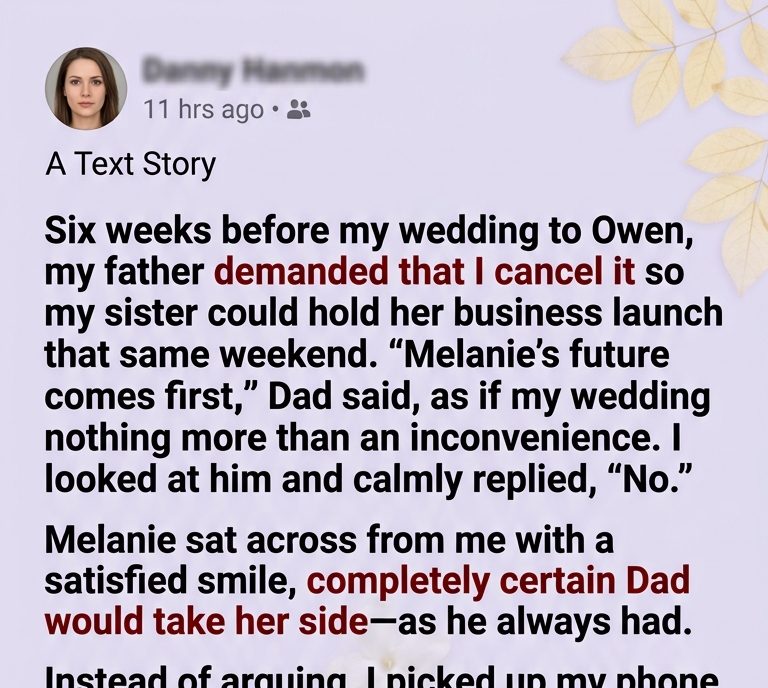
Six weeks before my wedding to Owen, my father demanded that I cancel it so my sister could hold her business launch that same weekend.
“Melanie’s future comes first,” Dad said, as if my wedding were nothing more than an inconvenience.
I looked at him and calmly replied, “No.”
Melanie sat across from me with a satisfied smile, completely certain Dad would take her side—as he always had.
Instead of arguing, I picked up my phone and started making changes.
I canceled every invitation I had sent to my parents, Melanie, my uncles, and my cousins.
Dad’s anger quickly turned to confusion.
Then his phone rang.
It was the estate manager.
His expression changed as he listened.
The wedding venue they had assumed belonged to someone else was actually my property, and I had just canceled every arrangement connected to their event.
But that wasn’t the worst part.
What the estate manager told Dad next made him realize that my wedding wasn’t the only thing they had just lost.
Continue reading….
The Weekend That Was Supposed to Be Mine
My name is Emma Carter, and for most of my life, I had learned not to expect much from my family.
Not because they were openly cruel.
That would have been easier.
Instead, they were experts at making favoritism sound reasonable.
Melanie needed help with college.
Melanie was struggling with her first job.
Melanie needed a car.
Melanie had an opportunity.
Melanie had a business idea.
Melanie was “under pressure.”
Whenever Melanie needed something, my parents somehow found the money, time, attention, and patience to give it to her.
Whenever I needed something, I was told I was capable of handling it myself.
I eventually stopped asking.
That was probably why I became independent.
At twenty-eight, I had built a small event-management company from nothing. It started with birthday parties and corporate dinners and eventually grew into private events and destination weddings.
I saved carefully.
I invested carefully.
And three years earlier, I had purchased a beautiful country estate about an hour outside the city.
It had originally been an old family property that had sat unused for years.
I renovated the main house, restored the gardens, converted the barn into an elegant event hall, and built a small guest cottage.
I named it Willow Ridge Estate.
It wasn’t enormous.
But it was beautiful.
And it was mine.
My parents knew I owned the business.
They didn’t know I owned Willow Ridge.
I had never told them.
Not because I wanted to deceive them.
I simply knew what would happen if they found out.
They would start asking for things.
And I had finally learned that some doors needed locks.
Six months before my wedding, Owen proposed.
He didn’t make some extravagant speech.
He simply took my hands and said, “Emma, I’ve never met anyone who works as hard as you do and still manages to care about everyone around her. I want to build a life with you.”
I cried.
Not because the proposal was perfect.
Because for the first time, someone had chosen me without making me feel like I was competing with somebody else.
We decided to marry at Willow Ridge.
It was personal.
It was beautiful.
And because I owned the property, we could design everything exactly the way we wanted.
My mother knew we were getting married there.
My father knew.
Melanie knew.
Nobody asked whose name was on the deed.
They assumed, like most people did, that I had rented it.
For once, I didn’t correct them.
Then Melanie announced her company launch.
It was supposed to happen in October.
There were several weekends available.
But she wanted the same weekend as my wedding.
At first, I thought it was an accident.
Then Dad called.
“Emma, we need to talk.”
I knew from his tone that it wasn’t a request.
He arrived at my apartment the following afternoon.
Melanie came with him.
She didn’t say hello.
She sat on my sofa, crossed her legs, and started scrolling through her phone.
Dad remained standing.
“You’re going to have to move the wedding.”
I stared at him.
“What?”
“Melanie’s launch is that Saturday.”
“I know.”
“And we need Willow Ridge.”
I laughed because I honestly thought he was joking.
“You mean the venue where I’m getting married?”
“Yes.”
“Dad, I’ve been planning this for over a year.”
“I understand.”
“No, I don’t think you do.”
He sighed.
“Emma, your wedding can happen another weekend.”
I looked at Melanie.
She finally put down her phone.
“It’s not just a launch,” she said. “Investors are coming. Clients are coming. Press is coming. If I move it, I lose momentum.”
“And if I move my wedding?”
She shrugged.
“You can reschedule.”
That sentence changed something inside me.
Not dramatically.
Quietly.
Like a door closing.
I looked back at Dad.
“You want me to cancel my wedding so Melanie can have a business event?”
“It’s one weekend.”
“No.”
His face hardened.
“What did you say?”
“No.”
Melanie smiled.
She actually smiled.
“I knew you’d make this difficult.”
Dad raised his voice.
“Emma, this isn’t about you.”
I picked up my phone.
“No,” I said. “It’s about me. That’s exactly the problem.”
Then I opened my wedding planning application.
I canceled the family invitations first.
Mom.
Dad.
Melanie.
My uncles.
My cousins.
One by one.
Dad watched.
“What are you doing?”
“Making changes.”
“You can’t just uninvite your family.”
“I just did.”
Melanie stood.
“You’re being ridiculous.”
I looked at her.
“You have your launch.”
She frowned.
“And you have your wedding.”
Dad slammed his hand against the back of a chair.
“You will not treat your sister like this!”
I didn’t answer.
His phone rang.
He pulled it from his pocket.
“Who is it?”
He glanced at the screen.
“Martin.”
Martin was the estate manager at Willow Ridge.
Dad answered.
“Martin, I’m in the middle of something.”
I couldn’t hear Martin’s words.
But I watched Dad’s face.
The anger disappeared.
Then the color drained from it.
“What do you mean?”
Silence.
“No. That can’t be right.”
Another pause.
“You’re telling me Emma owns the entire property?”
My sister stopped moving.
Dad slowly looked at me.
Martin continued speaking.
Dad’s expression became increasingly confused.
“Wait. The launch contract?”
He swallowed.
“What contract?”
I knew exactly what Martin was telling him.
Melanie had been communicating with Willow Ridge for weeks.
She had told everyone she had secured the estate for her launch.
She had apparently even arranged additional lighting, catering, security, and a stage.
All under the assumption that my family could use the property.
Dad ended the call.
Nobody spoke.
Finally, I said, “Anything else?”
Dad stared at me.
“You own Willow Ridge?”
“Yes.”
“You never told us.”
“You never asked.”
Melanie’s face had gone pale.
“You mean my launch is canceled?”
“I canceled every arrangement made under my ownership.”
“You can’t do that!”
“I can.”
Dad suddenly looked furious again.
“This is unbelievable.”
“No,” I said. “What’s unbelievable is that you thought you could take my wedding weekend from me because you believed Melanie’s business mattered more.”
Dad opened his mouth.
His phone rang again.
This time, he didn’t answer immediately.
The caller ID showed Martin.
Dad finally picked up.
“Yes?”
He listened.
Then his expression changed again.
“What?”
Melanie stepped closer.
“What is it?”
Dad looked at her.
“Martin says the estate’s corporate account has also been frozen.”
I frowned.
“What corporate account?”
Dad looked at me.
“Apparently Melanie’s company has been using Willow Ridge’s preferred-vendor account.”
I didn’t understand.
Martin explained it to Dad over the phone.
Months earlier, Melanie had contacted several vendors through the estate’s event network.
She had told them she was coordinating with Willow Ridge.
She had used the estate’s name to obtain preferred pricing.
In some cases, invoices had been delayed because vendors believed Willow Ridge was involved.
Martin had discovered the issue while reviewing the launch arrangements.
That was why he had called.
There was a significant amount of paperwork to unwind.
But there was something else.
Dad ended the call and sat down.
“What did he say?”
I asked.
He rubbed his forehead.
“Your sister’s company owes several vendors money.”
Melanie immediately protested.
“That isn’t true.”
Dad looked at her.
“Martin said there are unpaid invoices.”
“Those are pending.”
“Under Willow Ridge’s name.”
Melanie’s silence said enough.
I felt no satisfaction.
Only exhaustion.
I turned toward the window.
“Dad, I don’t want to fight with you.”
He looked up.
“Then why are you doing this?”
“Because I finally stopped fighting myself.”
He didn’t understand.
So I explained.
“For years, every time you chose Melanie, I told myself there must be a reason. When you helped her buy her first car, I told myself she needed it more. When you paid her rent, I told myself she was struggling. When you invested in her company, I told myself she had potential.”
I looked directly at him.
“But when you asked me to cancel my wedding for her, there was nothing left to explain.”
Melanie started crying.
But I didn’t move toward her.
She had cried before.
Usually, someone else ended up comforting her.
This time, I let the silence remain.
What Dad Had Never Known
The following morning, Martin came to my office.
He brought a folder.
“I thought you should see this.”
Inside were copies of contracts Melanie had arranged.
Some were legitimate agreements with vendors.
Others were emails where she had implied that Willow Ridge was sponsoring or hosting her launch.
There was no evidence she had intended to steal anything.
But she had been careless.
And she had allowed vendors to believe she had authorization she did not have.
Martin had already contacted them.
The estate would not be responsible for her company’s debts.
I signed the necessary notices.
Then Martin placed another document on the desk.
“This is the part your father was asking about.”
I read it.
It concerned a family investment account.
Years earlier, my grandfather had established a small investment fund for his grandchildren.
My father had managed it after my grandfather died.
I had always assumed my portion had been distributed years ago.
It hadn’t.
My share had remained invested.
And according to the records, Dad had used the family account as collateral for a business loan connected to Melanie’s company.
My signature wasn’t on the documents.
Neither was my consent.
I stared at Martin.
“Are you sure?”
He nodded.
“I’ve already asked the attorney to review it.”
The attorney confirmed what the documents showed.
Dad hadn’t legally transferred my ownership.
But he had used his authority over the family investment structure in a way that required correction.
It was not a matter of simply taking money from him.
It required lawyers, records, and formal accounting.
For the first time, I understood what Martin meant when he said Dad had more to lose than a venue.
He had been treating family resources as if they were his personal emergency fund for Melanie.
Now the records were being reviewed.
The next week was ugly.
There were meetings.
Lawyers.
Accountants.
Bank statements.
Vendor calls.
My father became increasingly defensive.
Melanie became increasingly quiet.
Mom called me three times.
The first time, she said I was destroying the family.
The second time, she said Melanie was having panic attacks.
The third time, she simply said:
“Your father didn’t mean it that way.”
I answered quietly.
“Mom, what did he mean?”
She had no answer.
The Wedding
Six weeks later, Owen and I got married.
There were no dramatic cancellations.
No screaming.
No family confrontation.
We simply reduced the guest list.
People who genuinely loved us stayed.
Friends.
Owen’s parents.
My closest colleagues.
A few cousins who privately admitted they had known the favoritism existed but had been afraid to say anything.
The ceremony took place under an old oak tree.
The weather was perfect.
Owen held my hands.
“You okay?”
I smiled.
“I am now.”
He kissed my forehead.
“I love you.”
“I love you too.”
When I walked down the aisle, I didn’t look toward the empty seats where my parents should have been.
I looked at Owen.
That was enough.
After the ceremony, Martin quietly approached me.
“Your father is here.”
My heart skipped.
“Where?”
“Outside the gate.”
I hesitated.
Then I walked toward him.
Dad stood beside his car.
He looked older than he had six weeks earlier.
He didn’t look angry.
He looked tired.
“I won’t stay,” he said.
I waited.
“I just wanted to see you get married.”
I didn’t know what to say.
He looked toward the estate.
“You built all this.”
“Yes.”
“I thought you were just helping manage it.”
“I know.”
He nodded.
“I underestimated you.”
I didn’t correct him.
After a moment, he said, “The family account is being repaired. Your grandfather’s money will be separated properly. I’m paying back what was improperly used.”
“That’s between you and the attorney.”
“I know.”
He looked down.
“And Melanie’s company is struggling.”
“I know.”
“She may have to shut down.”
I took a breath.
“Dad, I’m sorry she’s struggling.”
His eyes lifted.
“But?”
“But I can’t fix it.”
He nodded slowly.
“I know.”
For the first time in my life, he seemed to understand.
He took something from his pocket.
It was a small envelope.
“Your grandfather left this for you.”
I frowned.
“My grandfather?”
Dad nodded.
“I found it among his papers years ago. I should have given it to you then.”
I opened it.
Inside was a short handwritten note.
Emma,
Your father thinks strength means carrying everyone.
You will learn that sometimes strength means deciding what you are no longer willing to carry.
Build something that belongs to you.
And don’t let anyone convince you that loving your family requires losing yourself.
I stared at the words.
My grandfather had written them years before Willow Ridge existed.
Yet somehow they felt perfectly timed.
Dad wiped his eyes.
“I should have given you that a long time ago.”
“Yes.”
“I was wrong.”
It was the first time my father had ever said those words to me.
Not I’m sorry you feel hurt.
Not you misunderstood.
Not family should stick together.
Just:
“I was wrong.”
I folded the letter carefully.
“Thank you.”
He nodded.
Then he walked back to his car.
I watched him leave.
I didn’t chase him.
I didn’t hate him either.
Some relationships don’t heal because someone says sorry once.
They heal only when behavior changes.
One Year Later
Willow Ridge was busier than ever.
My event company had grown.
Owen and I had settled into married life.
Melanie’s original company didn’t survive.
But she did.
She eventually closed it, paid what she could, worked for another company for a while, and later started a smaller business with a partner.
This time, she did everything properly.
No borrowed family resources.
No pretending someone else had approved something.
No assuming Dad would rescue her.
My parents attended our first anniversary dinner.
There were only six of us.
The conversation was awkward at first.
Then Mom looked at me.
“I owe you an apology too.”
I didn’t answer immediately.
She continued.
“I kept telling myself that Melanie needed us more.”
I nodded.
“She did need help sometimes.”
Mom looked down.
“But so did you.”
“Yes.”
“I just didn’t notice.”
I smiled faintly.
“I think you noticed. You just assumed I’d be okay.”
She looked at me.
“That might be worse.”
I didn’t disagree.
Dad raised his glass.
“To Emma and Owen.”
Everyone lifted their glasses.
Then Dad said something that surprised me.
“To Emma,” he added, “for finally saying no.”
I laughed.
It was the first family dinner in years where nobody expected me to surrender something so someone else could have more.
And I realized that was the real thing I had gained.
It wasn’t Willow Ridge.
It wasn’t the money.
It wasn’t the business.
It wasn’t even the wedding.
It was the freedom to stop auditioning for a place in my own family.
For years, I had believed being a good daughter meant being understanding.
Being flexible.
Being patient.
Being the one who could handle it.
But love without boundaries had slowly turned into permission for people to keep taking.
The day my father demanded that I cancel my wedding, he thought he was asking me to sacrifice one weekend.
He didn’t realize he was asking me to sacrifice myself again.
And this time, I finally said no.
Not because I wanted to punish my family.
Not because I wanted them to lose everything.
But because I had finally understood something my grandfather had tried to teach me years before:
You can love your family without giving them ownership of your life.
And sometimes the most important word a person can learn to say is the smallest one.
No.