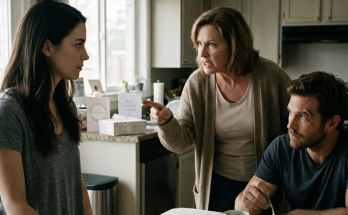
For 12 years, I made scrambled eggs for my husband’s father every Sunday after he moved in with us because of dementia. He always called me Margaret, and my husband insisted I let him believe it was my name. When my father-in-law died of pneumonia, a woman approached me at his funeral and whispered, “Thank you for taking care of him, Margaret.” I explained that I was his daughter-in-law, but her face turned pale. “Margaret was his first wife. She died—or so everyone believed—in 1982. She made him scrambled eggs every Sunday.” I turned to my husband, but he refused to meet my eyes. Then the woman revealed that he had deliberately let his father mistake me for Margaret for 12 years. But the biggest shock came when she explained why Margaret had really disappeared—and what my father-in-law had done that made her leave without looking back.
The woman introduced herself as Eleanor Whitmore, an old friend of my father-in-law, Arthur.
She was in her late seventies, dressed in a black coat, with silver hair tucked neatly beneath a small hat. Her hands trembled as she held mine.
“I’m sorry,” she whispered. “I thought you knew.”
“Knew what?”
“That Margaret was alive.”
For a moment, I couldn’t understand the sentence.
Margaret had been dead for more than forty years—or so everyone in Arthur’s family had always said. My husband, David, had told me his father’s first wife died in a tragic accident in England in 1982. Arthur rarely spoke about her, and when he did, the details were vague.
I had assumed the grief was simply too painful for him to discuss.
Now Eleanor was telling me that the woman I had unknowingly impersonated for twelve years might still be alive.
I turned toward David.
He stood beside his father’s coffin, staring at the polished wood as though he hadn’t heard a word.
“David,” I said. “What is she talking about?”
He swallowed.
“Not here, Claire.”
“Then where? At home? After twelve years of letting your father call me by another woman’s name?”
Several people turned toward us.
David stepped closer and lowered his voice.
“Please. Dad has just died. Don’t do this now.”
I stared at him.
Even then, he was asking me to protect him from the consequences of his own choices.
Eleanor touched my arm.
“There’s something you need to see,” she said. “Something Arthur kept for years. I think it’s time you knew the truth.”
I looked at David one last time.
He still wouldn’t meet my eyes.
So I followed Eleanor outside.
And everything I thought I knew about the man I had married began to unravel.
Arthur had moved into our house twelve years earlier, after his dementia became too severe for him to live alone.
At first, the changes were small.
He misplaced his glasses. He forgot where he’d put the newspaper. Sometimes he asked the same question three times in ten minutes.
Then he began wandering outside at night, convinced he needed to go home.
One winter evening, a neighbor found him standing at the end of our street without his coat, confused about where he lived.
David and I agreed that he could no longer remain alone.
We converted the spare bedroom into a comfortable space for him and installed a handrail beside the bathroom. I learned his medication schedule, attended medical appointments, and placed labels on drawers so he could find his clothes.
David helped when he could, but his work often kept him away for long hours.
Most of Arthur’s daily care fell to me.
I never resented that responsibility. He was an elderly man losing his memories, and he deserved patience and dignity.
What troubled me was the way he sometimes looked at me.
He would stand in the kitchen doorway, studying my face with a strange mixture of tenderness and confusion.
“Margaret?” he would ask.
At first, I corrected him.
“No, Arthur. It’s Claire, your daughter-in-law.”
He would frown, look frightened, and sometimes begin searching the house for someone who wasn’t there.
His doctor explained that people with dementia can confuse memories, identities, and different periods of their lives. He advised us to avoid unnecessary confrontations if correcting Arthur repeatedly caused him distress.
So I learned to redirect him gently.
When he called me Margaret, I would answer his question, offer him a cup of tea, or ask whether he’d like to sit in the garden.
David was the one who suggested I stop correcting him altogether.
“Just let him call you Margaret,” he said one evening. “It makes him feel safe.”
I hesitated.
“Is that really the best thing to do?”
“Dad has been through enough. If he thinks you’re Mom, what harm does it do?”
I agreed because I wanted Arthur to feel secure.
I didn’t realize David was asking me to participate in a secret.
Every Sunday morning, Arthur wanted scrambled eggs.
He insisted they had to be cooked slowly, with butter, a little milk, and a pinch of salt. He said Margaret had made them that way for years.
Sometimes he would sit at the kitchen table and tell me stories about their early marriage.
He described a small house with a blue front door, a garden full of roses, and a radio that never seemed to work properly.
He spoke about dancing in the living room while rain battered the windows.
He remembered Margaret laughing when he burned toast.
I listened.
Occasionally, he would reach across the table and pat my hand.
“You always knew how to make an ordinary morning feel special,” he would say.
I smiled because I didn’t know what else to do.
Over the years, those Sunday breakfasts became part of our routine.
I made the eggs. Arthur sat by the window. We talked about the weather, the garden, and whatever fragments of the past he could still reach.
Sometimes he remembered David as a little boy.
Sometimes he asked where his first wife had gone.
And sometimes, he looked at me with tears in his eyes and said, “I’m sorry, Margaret.”
I always assumed he was remembering some old disagreement.
I never imagined he might be apologizing for something much worse.
Eleanor drove me to a small café a few streets from the cemetery.
She ordered tea, but neither of us touched our cups.
“I was Margaret’s closest friend,” she began. “We met when we were young women. She was clever, funny, and far more independent than Arthur ever understood.”
“What happened to her?”
Eleanor took a deep breath.
“Arthur wasn’t always the quiet, confused man you knew. When they were young, he could be charming. But he was also controlling. He believed a husband had the right to make the important decisions, and he expected Margaret to accept them.”
She explained that Arthur and Margaret had married in the late 1950s. Their early years seemed happy from the outside, but their relationship became increasingly strained.
Margaret wanted to work as a bookkeeper and save enough money to buy a small house of her own.
Arthur wanted her to stay home and build the life he had imagined for them.
Their arguments grew worse after the birth of their son, David.
“Margaret loved her boy,” Eleanor said. “She never wanted to leave him. But she was afraid of what Arthur was becoming.”
I sat very still.
“Are you saying he hurt her?”
Eleanor looked down.
“I am saying he controlled her money, monitored her letters, and made it difficult for her to see her friends. When she tried to become more independent, he threatened to take David away from her.”
My stomach tightened.
“How do you know all this?”
“Because she told me. And because I helped her.”
Eleanor reached into her handbag and removed a small envelope.
Inside was a faded photograph of a young woman standing beside a train platform. She had dark hair, a determined expression, and a small suitcase in her hand.
I recognized her immediately from the few old photographs I’d seen in Arthur’s bedroom.
Margaret.
“On a night in 1982, she came to my house,” Eleanor continued. “She was terrified. Arthur had discovered that she was planning to leave him. They had argued, and she feared he would make sure she never saw David again.”
I covered my mouth.
“What did she do?”
“She left.”
Eleanor paused.
“I helped her travel to another part of the country, where she had relatives who could protect her identity and help her start again. She wanted to take David, but she believed Arthur would find them and use him to force her back.”
“So she abandoned her son?”
The words came out harsher than I intended.
Eleanor shook her head.
“No. She believed she was making the only choice that might keep them both safe in the long run. She planned to contact David when she had established herself. But Arthur had already begun telling people that she was dead.”
My hands went cold.
“He told everyone she died in an accident.”
“Yes.”
“Why?”
“Because he wanted the world to believe she had left him no choice. He said she was gone and there was nothing anyone could do. He made sure David grew up believing that his mother had died rather than choosing to leave.”
I stared at the photograph.
A terrible thought was taking shape.
“David knew she was alive?”
Eleanor didn’t answer immediately.
Then she nodded.
“He found out years ago.”
I felt as though the floor had disappeared beneath me.
“How long ago?”
“About twelve years ago, when Arthur’s dementia first began to worsen. David contacted me after finding some old documents among his father’s belongings. He asked whether I knew what had really happened to his mother.”
I remembered the exact period.
Arthur had just moved into our house. David had begun insisting that I allow his father to call me Margaret.
Twelve years.
The timing was not a coincidence.
“He knew,” I whispered.
“Yes.”
“And he let me spend twelve years pretending to be a woman who was still alive.”
Eleanor’s eyes filled with tears.
“He told me he thought it would comfort his father. Arthur was beginning to lose his memories, and he became increasingly distressed when he couldn’t remember where Margaret was. David said that when you answered to her name, his father became calmer.”
I looked away.
“Why didn’t he tell me?”
“Because he was afraid you’d refuse.”
The answer was so simple that it hurt.
David hadn’t trusted me to make my own decision.
He had made it for me.
I returned home that evening with Eleanor’s photograph and a head full of questions.
David was sitting in the living room, still wearing the black suit from his father’s funeral.
He stood when I entered.
“Claire, we need to talk.”
I placed the photograph on the coffee table.
“Yes. We do.”
He looked at it and closed his eyes.
“How much did Eleanor tell you?”
“Enough to know that your mother didn’t die in an accident.”
He sat down heavily.
I remained standing.
“Tell me the truth.”
For several seconds, he said nothing.
Then he began to speak.
He told me that he had found letters in Arthur’s study twelve years earlier. Some were addressed to Margaret, while others were written by her. They described arguments, threats, and her desperate attempts to arrange a life away from Arthur.
One letter had been written shortly before she disappeared.
In it, Margaret explained that she could no longer live in a home where she was afraid to disagree with her husband.
Another letter, written years later, had been sent to Arthur by Eleanor. It asked whether he would allow Margaret to contact David without threatening her or demanding that she return.
Arthur’s response was brief.
He accused Margaret of abandoning her family and said she had no right to return after what she had done.
There was no mention of the circumstances that had driven her away.
“There were also documents proving she’d changed her name and moved,” David said. “I contacted Eleanor. She confirmed that Mom was alive.”
I stared at him.
“Did you speak to her?”
“Yes.”
The room seemed to shrink around us.
“You spoke to your mother?”
He nodded.
“When?”
“Several years ago.”
“And you never told me?”
“I was angry. I didn’t know what to believe. She had been gone my whole life, and suddenly I was supposed to accept that everything Dad had told me was a lie.”
“So you decided to keep the truth from me, too?”
“I didn’t know how to handle it.”
I laughed once, without humor.
“You had twelve years to figure it out.”
He rubbed his face.
“When Dad started calling you Margaret, I realized that the name calmed him. He seemed to remember being happy with her. I thought if you went along with it, we could give him some peace.”
“And you knew the real Margaret was alive.”
“Yes.”
“Did you ever consider that she might want to see him?”
David looked at the floor.
“I didn’t know if she did.”
“Did you ask?”
He hesitated.
“Once.”
“And?”
“She said she wasn’t ready.”
I felt a painful mixture of anger and disbelief.
“You had a conversation with your mother, and you never told me. You let me care for your father while he mistook me for her, and you let me believe I was helping him remember a dead wife.”
“I was trying to protect Dad.”
“From what? The truth?”
He flinched.
I sat down opposite him.
“David, I understand dementia. I understand that your father was frightened and confused. I would never have deliberately caused him distress just to prove a point. But you didn’t give me the chance to decide how I wanted to handle this. You used my kindness as a way to keep your family’s secret.”
He looked at me, his eyes red.
“I never wanted to hurt you.”
“But you did.”
The words fell quietly between us.
I thought about all those Sunday mornings. The butter melting in the pan. Arthur’s gentle smile. His stories about the woman he believed I was.
I had thought I was helping an old man hold on to precious memories.
I hadn’t understood that the people who knew the truth were also protecting a lie.
“There’s something else,” I said. “Why did your father make everyone believe she was dead?”
David swallowed.
“I think he was ashamed. He couldn’t admit that she had left because of the way he treated her. It was easier to say she’d died than to explain what had happened.”
“And you repeated his story.”
“Yes.”
“Even after you knew the truth.”
He nodded.
I looked at my husband and wondered how many other things he had decided I didn’t need to know.
The following morning, I asked Eleanor for Margaret’s address.
She hesitated.
“Claire, she has lived a very private life. I won’t give you her address without asking her first.”
I understood.
After everything Margaret had endured, she deserved control over who entered her life.
“Will you tell her that I want to speak with her?”
Eleanor nodded.
“I will.”
Two days later, she called.
“Margaret would like to meet you,” she said. “But she wants to be clear about one thing. She isn’t ready to see David.”
“I understand.”
“She also asked me to tell you that you did nothing wrong by caring for Arthur.”
I closed my eyes.
I hadn’t realized how badly I needed to hear those words.
A week later, I met Margaret in a quiet garden behind a small community center.
She was eighty years old, with silver hair and a walking stick. She wore a pale blue coat and held a small handbag in both hands.
For a moment, neither of us spoke.
I had imagined this meeting many times, but nothing had prepared me for the reality of standing in front of the woman whose name I had answered to for twelve years.
“I’m Claire,” I said.
She gave a small, sad smile.
“I know.”
We sat on a bench beneath a tree.
I told her about Arthur’s Sunday breakfasts, the scrambled eggs, and the stories he used to tell me about their early marriage.
Margaret listened with tears in her eyes.
“He always liked his eggs soft,” she said. “If they were cooked too long, he would complain that I was trying to punish him.”
I laughed softly.
“He said almost exactly the same thing to me.”
For the first time, Margaret smiled.
Then her expression grew serious.
“Did he ever seem frightened when he spoke about me?”
I thought carefully.
“Sometimes he looked sad. He would apologize, but I never understood why.”
She nodded.
“I imagine he remembered pieces of what happened, even when he couldn’t remember the whole story.”
I wanted to ask whether she had loved Arthur, whether she missed him, and whether she had ever regretted leaving.
Instead, I asked the question that mattered most to me.
“Why did you leave without taking David?”
Margaret’s hands tightened around her handbag.
“Because I was afraid,” she said.
She told me that Arthur had threatened to use his money and influence to make sure she never saw their son again. She had little income of her own, and she feared that if she challenged him without support, she would lose David completely.
“I thought I could build a safe life first and then find a way to reach him,” she said. “But Arthur had already convinced everyone I was dead. By the time I understood how firmly that story had taken hold, I was afraid that coming back would only cause David more pain.”
“Did you ever stop loving him?”
Margaret looked at me as if I had asked whether she had stopped breathing.
“Never.”
She wiped her cheeks.
“I missed every birthday. Every school photograph. Every ordinary moment a mother should have been there for. I learned to live with the loss, but I never stopped thinking about my boy.”
I reached for her hand.
“I’m sorry.”
She shook her head.
“You have nothing to apologize for. You gave Arthur kindness when he needed it. You gave him dignity when his memories were failing. That was a gift, not a mistake.”
I began to cry.
For twelve years, I had believed I was simply doing what any loving family member would do.
Now I understood that my kindness had become entangled in a secret I had never agreed to keep.
Margaret squeezed my hand.
“Please don’t let what David did take away the good you gave Arthur. He was still a human being who needed care. You helped him feel safe.”
We sat together for a long time.
Before we parted, she handed me a sealed envelope.
“Arthur sent me this several years ago,” she explained. “I never answered. I thought you should read it before you decide what you want to do next.”
I looked at the handwriting on the front.
It was Arthur’s.
That evening, I opened the envelope alone.
Inside was a letter dated eight years earlier, written in a shaky hand.
Arthur addressed Margaret by name.
He admitted that he had spent years telling himself she had abandoned him and their son without cause. He wrote that he had been angry, that he had wanted to punish her for leaving, and that he had made it difficult for her to return because he couldn’t bear the thought of being the one who had been left.
He did not excuse himself.
He wrote that he had been controlling and cruel, and that his fear of losing Margaret had turned into the very behavior that drove her away.
The final paragraph read:
I cannot ask you to forgive me. I do not know whether I deserve it. I only want you to know that David was never the reason you had to leave, and I am sorry that I made you believe you had to choose between your safety and your son.
I sat with the letter for a long time.
It didn’t erase what Arthur had done.
It didn’t give Margaret back the years she had lost.
But it revealed something I had never known about the quiet old man who sat at my kitchen table every Sunday.
Somewhere beneath the confusion of dementia, he had understood the truth.
And perhaps that was why he had looked at me with such sadness when he called me Margaret.
Perhaps he wasn’t only remembering his first wife.
Perhaps he was remembering the person he had been before his memories began to disappear.
David and I spent the next several weeks living separately.
I needed time to understand what his deception meant for our marriage.
He apologized repeatedly, but I told him that regret was only the beginning. He needed to accept that he had taken away my ability to make an informed choice.
Eventually, he agreed to meet with a counselor.
During one session, he admitted that he had spent his entire life protecting his father’s reputation because he had been taught that family secrets should never leave the house.
He had known that Margaret was alive, but he had been unable to face the consequences of telling the truth.
Allowing me to be called Margaret had seemed like a harmless way to keep his father calm.
Over time, he stopped thinking about the woman whose identity I was carrying.
He thought only about preserving the routine.
That explanation helped me understand his behavior.
It did not make it acceptable.
I told him that if we were going to rebuild our marriage, there could be no more decisions made on my behalf under the excuse of protecting someone else.
He listened.
For once, he didn’t interrupt or defend himself.
Whether our marriage would fully recover was something neither of us could know immediately. We had to rebuild trust through actions, not promises.
But I was no longer willing to pretend that silence was the same as peace.
Several months later, Margaret invited me to her home.
She showed me photographs of David as a toddler, his first birthday, and the little boy who had once fallen asleep in her arms while she sang to him.
She had kept them all.
In one photograph, David was sitting in a high chair with scrambled eggs smeared across his cheeks.
I laughed through my tears.
“He must have loved them.”
“He did,” Margaret said. “He would eat them every Sunday morning. Arthur insisted it was a family tradition.”
We looked at the photograph together.
Then Margaret handed it to me.
“Would you give this to David, when you think he’s ready?”
I nodded.
“I will.”
She hesitated.
“I don’t know if I can forgive Arthur for everything. And I don’t know when I’ll be ready to see David. But I don’t want the rest of my life to be controlled by what happened all those years ago.”
I understood.
She had spent decades carrying a story that other people had rewritten for her.
Now she was choosing what came next.
Before I left, she walked me to the door.
“Claire, I hope you understand something,” she said. “You didn’t steal my place. You were asked to fill an empty space by a man who didn’t know how to face his past. You gave him kindness. That belongs to you, not to me.”
I hugged her.
For the first time since Arthur’s funeral, I felt that I could remember those twelve years without feeling betrayed by every Sunday morning.
I had cared for a frightened old man.
That care had been real.
The secret around it had been wrong.
Both things could be true.
Today, I still think about Arthur whenever I make scrambled eggs.
I remember him sitting by the kitchen window, telling me about the roses in his old garden and the rainy evenings when he and Margaret danced in their living room.
I remember his hands trembling as he held his fork, and the relief on his face when he recognized the familiar breakfast.
I no longer answer to Margaret when someone calls me by that name.
But I no longer feel that the twelve years were wasted, either.
I cared for Arthur because he needed someone to care for him. I gave him patience when his memories failed and kindness when he was frightened.
I wish David had trusted me with the truth.
I wish Margaret had been given a safer way to return to her son’s life.
And I wish Arthur had found the courage to admit what he had done long before dementia took away his ability to explain himself.
But wishing cannot restore the lost years.
What we can do is choose what happens next.
Margaret and I still meet occasionally. We share photographs and stories, and sometimes we make scrambled eggs together using her original recipe.
She laughs whenever I add too much butter.
“Arthur would have approved,” she tells me.
I smile.
I don’t know whether David and Margaret will ever have the reunion they both deserve. That decision belongs to them, and neither of them can force the other to heal on a schedule.
But I have learned that compassion does not require us to surrender the truth.
We can care for someone without agreeing to their secrets. We can understand why someone made a terrible decision without pretending it caused no harm. And we can honor the good we did, even when the circumstances surrounding it were painful.
For twelve years, I made scrambled eggs for a man who called me by another woman’s name.
I thought I was helping him remember his past.
At his funeral, I discovered that I had unknowingly become part of a secret that had shaped an entire family.
The truth hurt.
But it also gave Margaret a chance to tell her own story, and it gave me the chance to stop carrying a name that had never belonged to me.
Sometimes, the greatest kindness is not pretending everything is fine. It is caring enough to face the truth, even when the truth arrives far too late.