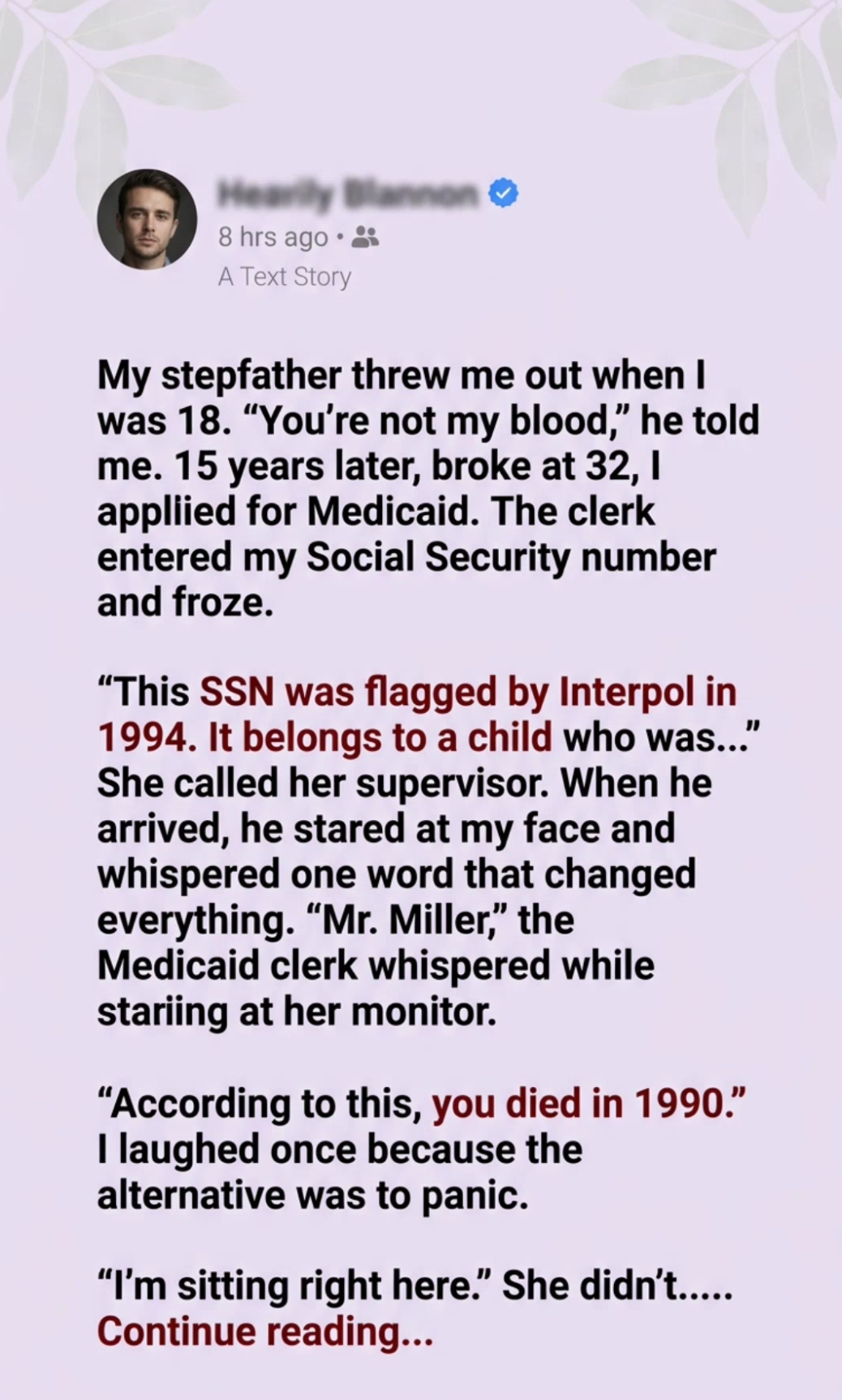
“Mr. Miller,” the Medicaid clerk whispered while staring at her monitor.
“According to this, you died in 1990.”
I laughed once because the alternative was to panic.
“I’m sitting right here.”
The clerk didn’t laugh.
Her name badge said Angela Brooks, and until that moment, she’d been moving through my application with the tired efficiency of someone who had processed hundreds of people that week. She had asked for my address, my employment history, my income, and whether I had any dependents.
Now her fingers hovered above the keyboard.
“Could you please repeat your Social Security number?” she asked.
I gave it to her again.
She checked the screen, then looked at me.
“I’m going to need you to wait here.”
“Is something wrong with my application?”
“I don’t know yet.”
She stood, walked through a door behind the reception counter, and disappeared.
I was thirty-three years old, unemployed, behind on rent, and sitting in a government office trying to qualify for medical assistance. I’d spent the previous six months applying for warehouse jobs, delivery positions, and anything else that might cover groceries and electricity.
I hadn’t expected my Social Security number to become the most frightening thing in the room.
A few minutes later, Angela returned with a man in a gray suit. He introduced himself as Mr. Miller, the office’s eligibility supervisor.
He looked at the monitor.
Then he looked at me.
His expression changed so suddenly that I thought he might be sick.
He stepped closer, studying my face as though he were comparing it to a photograph he had seen a very long time ago.
Finally, he whispered one word.
“Jonathan.”
I stared at him.
“That’s not my name.”
He swallowed.
“Your name is Jonathan Miller.”
“No. My name is Daniel Hayes.”
The supervisor pulled out the chair beside me but didn’t sit.
“Daniel, I need to ask you something. Did you grow up in a town called Ashford?”
I felt my stomach tighten.
“Yes.”
“Did you have a mother named Rebecca?”
I nodded slowly.
“And a stepfather named Robert Hayes?”
For a moment, I couldn’t speak.
Those names belonged to a life I had spent fifteen years trying not to think about.
“Yes,” I finally said. “Why?”
Mr. Miller glanced at Angela.
Then he said something that made the room feel smaller.
“Because the child listed under your Social Security number was reported missing in 1989. A year later, he was declared legally dead. His name was Jonathan Miller, and his father has been searching for him ever since.”
I looked at him.
“My father died when I was two.”
“No,” he replied quietly. “Your stepfather wasn’t your biological father.”
I shook my head.
“That doesn’t explain anything.”
Mr. Miller sat down.
“Daniel, I think you’ve been living under someone else’s identity since you were a child.”
And suddenly, the worst thing my stepfather had ever said to me came rushing back.
You’re not my blood.
I had always thought he meant I wasn’t family.
I was beginning to understand that he might have known something much worse.
1. The Boy Who Never Asked Questions
My earliest memories were of a small house on the outskirts of Ashford.
My mother, Rebecca, worked at a nursing home. She came home exhausted, but she always found the energy to make dinner and ask about my day.
I remembered her singing while she washed dishes.
I remembered the smell of cinnamon toast.
I remembered a photograph of a young man in a military uniform that she kept in a drawer beside her bed.
When I asked who he was, she would say, “Someone who loved you very much.”
I assumed he was my biological father.
My mother never explained his absence.
When I was six, she married Robert Hayes.
Robert was a mechanic who owned a small repair shop. He was polite when other people were around, but at home he was distant. He never hit me, and he never went out of his way to frighten me.
He simply made it clear that I was an inconvenience.
He called me Rebecca’s responsibility.
He corrected me whenever I called him Dad.
“I’m Robert,” he would say. “You already have a father.”
At first, I thought that was reasonable.
I was too young to understand why my mother looked uncomfortable whenever he said it.
As I grew older, the distance between us became more obvious.
Robert had a daughter from a previous relationship named Emily. She visited every other weekend. He bought her birthday presents, attended her school events, and helped her with homework.
I watched him do things for her that he never did for me.
When Emily needed a bicycle, he spent an entire Saturday repairing an old one and buying new tires.
When I needed shoes, my mother took me shopping.
It wasn’t that Robert owed me the same things he gave his daughter.
I just wanted him to treat me as though I belonged in the house.
My mother tried to keep peace.
“Robert has his own way of showing love,” she would tell me.
I believed her because I wanted to.
Then, when I was thirteen, she became seriously ill.
At first, she missed work because of exhaustion. Later, she began spending more time in the hospital.
The diagnosis was cancer.
For nearly two years, our home revolved around medication schedules, appointments, and quiet conversations that stopped whenever I entered the room.
Robert became more impatient.
He complained about medical bills. He complained about driving to appointments. He complained that my mother had become too weak to manage the household.
I started cooking for myself and doing the laundry.
At fifteen, I had learned how to stretch a grocery budget.
At sixteen, I had learned how to recognize when my mother was having a difficult day without asking.
One evening, while she was resting, I sat beside her bed.
“Mom, what happens if you don’t get better?”
She reached for my hand.
“You’ll be all right.”
“Will Robert take care of me?”
Her eyes filled with tears.
“He promised me you would always have a home.”
I wanted to believe her.
I asked her about my father again.
“Why don’t I have pictures of him?”
She looked toward the drawer beside her bed.
“Some things are complicated, sweetheart.”
“Was he a bad man?”
“No,” she whispered. “He wasn’t.”
She squeezed my fingers.
“Promise me something. Don’t let anyone make you believe you are less worthy of love because of where you came from.”
I promised.
It was the last serious conversation we ever had.
She died three months later.
I was seventeen.
And the only person left in the house who knew anything about my childhood was the man who had never wanted me there.
2. The Night I Became Homeless
After my mother’s funeral, Robert changed.
He stopped pretending to be patient.
He began telling me that the house was expensive to maintain and that he wasn’t responsible for raising another man’s child.
I found a part-time job at a grocery store and contributed what I could.
I thought if I stayed out of his way and paid for my own expenses, he might let me finish school.
But Robert had other plans.
One night, shortly after my eighteenth birthday, I came home and found two cardboard boxes beside the front door.
My clothes were inside.
I stared at them.
“What is this?”
Robert stood in the living room with his arms crossed.
“You’re old enough to take care of yourself.”
“I have school.”
“You can finish somewhere else.”
“Where am I supposed to go?”
He shrugged.
“That’s not my problem.”
I looked at him, waiting for him to soften.
He didn’t.
“Your mother asked you to look after me,” I said.
His jaw tightened.
“Your mother made a lot of promises when she was sick.”
“I’m her son.”
He took one step toward me.
“You’re not my blood.”
The sentence landed harder than I expected.
I had heard versions of it before, but this time there was no attempt to disguise the meaning.
“You have no claim on this house,” he continued. “You have no claim on my money. You’re eighteen. Find somewhere else to live.”
I asked for my mother’s belongings.
He told me I could take whatever was in the boxes.
I asked for the photograph of the man in the military uniform.
Robert’s expression changed.
“What photograph?”
“The one in Mom’s drawer.”
He stared at me for several seconds.
“Your mother had a lot of photographs.”
“Can I have it?”
“No.”
“Why?”
“Because I said no.”
I was too tired to argue.
I picked up my boxes and walked out.
It was raining.
I spent the first night in the back room of a coworker’s apartment. The next week, I slept on a friend’s couch. Eventually, I found a cheap room above a laundromat.
I finished school through an alternative program while working evenings.
I learned how to survive without expecting anyone to rescue me.
But there was one problem.
I didn’t have a birth certificate.
My mother had always kept our important documents. After she died, I assumed Robert had put them somewhere.
When I asked him, he told me he had thrown away the things that weren’t his.
I needed identification to get a better job, so I applied for a replacement Social Security card.
The number I had memorized from an old school document worked.
I never questioned it.
My driver’s license was issued.
I opened a bank account.
I paid taxes.
I went to work.
For fifteen years, I lived as Daniel Hayes.
I never knew that the number attached to my life belonged to another child.
3. The Supervisor’s Question
Back in the Medicaid office, Mr. Miller opened a folder on his computer.
“I need to explain what we’re seeing,” he said.
I folded my arms.
“Please do.”
“The Social Security number you provided was originally assigned to a child named Jonathan Miller, born in 1985.”
“I’m not Jonathan.”
“I understand.”
“Then why are you saying I am?”
He paused.
“Because there is a missing-child record associated with that identity. The original report was filed in 1989. The child disappeared from a family residence in Ohio. After an extensive search, authorities obtained a legal declaration of death in 1990.”
I shook my head.
“That’s impossible. I was born in Ashford.”
“Do you know your exact birth date?”
I gave it to him.
He typed.
His eyes narrowed.
“That’s the same birth date recorded for Jonathan Miller.”
I felt cold.
“What about my mother? Rebecca Hayes?”
He searched again.
“There’s no Rebecca Hayes listed as Jonathan’s mother.”
“Then your records are wrong.”
“Perhaps. But there’s something else.”
He turned the monitor slightly.
A photograph appeared.
It showed a little boy with light brown hair, a small scar near his left eyebrow, and a serious expression.
I leaned closer.
The scar was familiar.
I had the same scar.
I touched my eyebrow.
“When did you get this?”
Mr. Miller looked at me.
“Do you remember?”
I did.
I was five or six. My mother had told me I fell against a metal garden gate while playing outside.
But the photograph showed a boy younger than that.
And he had the scar already.
“Where did you get this picture?”
“It was included in the original missing-child file.”
I stared at the boy.
Something about his eyes felt familiar.
Not because I recognized the photograph.
Because I recognized myself.
Mr. Miller lowered his voice.
“There is a contact listed in the case file. The child’s father has been receiving periodic updates for decades. He is still alive.”
I looked up.
“Who?”
“Thomas Miller.”
I had never heard that name.
“Is he in Ohio?”
“Yes. He’s in Ashford now.”
I felt my throat tighten.
Ashford.
The same town where I had grown up.
The same town where Robert had thrown me out.
“Why would he be there?”
Mr. Miller closed the folder.
“I don’t know. But I think we need to contact law enforcement before anyone makes assumptions.”
I stared at the photograph again.
For the first time in fifteen years, I wondered whether my mother had known something about my identity that she had never told me.
4. The Photograph in the Drawer
A county investigator arrived later that afternoon.
Her name was Detective Laura Bennett.
She didn’t treat me like a suspect. She asked questions, took notes, and explained that the old case would need to be reopened carefully.
I told her everything I could remember.
My mother.
Robert.
The photograph.
The night I was thrown out.
The missing birth certificate.
The replacement Social Security card.
When I mentioned Robert Hayes, she stopped writing.
“Do you know where he lives?”
I gave her the address.
She looked at me.
“Has he ever contacted you?”
“No.”
“Have you tried contacting him?”
“Once. About six years ago. I wanted to ask for my mother’s documents. He told me never to call again.”
Detective Bennett nodded.
“We’ll need to speak with him.”
The following morning, she asked me to accompany her to the station.
She had received permission to examine an old box of documents connected to the missing-child case.
Inside were photographs, handwritten reports, and copies of letters.
One document caught my attention.
It was a photograph of a young woman standing beside a man in a military uniform.
My mother.
And the man from the drawer.
I turned it over.
Written on the back were four words:
Rebecca and Thomas, 1984.
My hands began to shake.
“Who’s Thomas?” I asked.
Detective Bennett looked at the photograph.
“Thomas Miller. Jonathan’s father.”
I sat down.
The detective opened another envelope.
Inside was a letter written by my mother.
The paper was yellowed, and the handwriting was unmistakable.
She had written it in 1991.
It began:
Thomas,
I know you have been searching for your son. I know what happened was unforgivable. But I need you to understand that I did not take him because I wanted to hurt you.
I stopped reading.
“What happened?”
Detective Bennett turned the page.
The letter continued.
Jonathan was in danger. I thought I could keep him safe until everything was settled. I was wrong to leave without telling you the truth. I was wrong to let the years pass. But I could not bring myself to return after what happened.
There was no signature at the bottom.
Only my mother’s initials.
R.H.
I looked at the detective.
“Was my mother involved in taking me?”
She didn’t answer immediately.
“We don’t know the whole story yet.”
“But this says she took him.”
“It says she believed she was protecting him.”
“From what?”
The detective placed the letter back in its envelope.
“That is what we’re trying to establish.”
For fifteen years, I had believed my mother had left me with a man who hated me.
Now I was learning that she might have spent my childhood hiding me from a father I had never known.
5. The Man Who Never Stopped Searching
Two days later, Detective Bennett arranged a meeting.
Thomas Miller arrived at the station shortly after ten in the morning.
He was sixty-two, with silver hair, a slightly stooped posture, and a photograph folded carefully inside his jacket pocket.
When he saw me, he stopped.
He didn’t rush forward.
He didn’t call me son.
He simply stared.
Then he pulled out the photograph.
It was the same little boy from the missing-child record.
“I’ve carried this for thirty-seven years,” he said.
His voice trembled.
“I was told you were gone.”
I swallowed.
“I don’t know you.”
“I know.”
He looked down.
“I wish I had a better answer for why.”
We sat in a small interview room.
Detective Bennett remained with us.
Thomas explained that he had been married to my mother, Rebecca, before I was born. They had separated when I was very young.
He worked as a traveling electrical technician and was away from home frequently.
Their marriage had been strained, but he said he loved his son.
In 1989, he returned from a work assignment and discovered that Rebecca and Jonathan were gone.
He called her family.
He contacted the police.
He hired investigators.
He appeared on television programs and distributed photographs.
Months passed.
Then years.
In 1990, after an extensive search and no reliable evidence that Jonathan was alive, the court granted a declaration of presumed death.
Thomas refused to accept it.
He continued searching.
“Why did she take me?” I asked.
Thomas rubbed his hands together.
“I don’t know everything. Rebecca told me you were in danger. She said I had become involved with people who could hurt you.”
“What people?”
He looked toward Detective Bennett.
“Business partners. I was managing a construction company at the time. I discovered that someone had been falsifying invoices and diverting money. I reported it.”
He explained that he had received threats.
One evening, a man had followed Rebecca home.
She became frightened.
They argued about what to do.
Thomas wanted to contact the authorities and arrange protection. Rebecca wanted to disappear before anyone could find them.
“I thought we had agreed to keep you with her temporarily,” he said. “I didn’t know she was leaving the state.”
I stared at him.
“Why didn’t you find her?”
“I tried.”
“Did you know she married Robert Hayes?”
“No.”
“Did you know I grew up in his house?”
Thomas shook his head.
“I didn’t know you were alive.”
I wanted to be angry with him.
Part of me was.
But I could see something in his face that I recognized.
It was the expression of someone who had spent years asking himself what he could have done differently.
“Did you know my name was Daniel?” I asked.
He shook his head again.
“Your name was Jonathan when you were born.”
I looked at Detective Bennett.
“So my mother changed my identity?”
“We need to establish exactly how that happened,” she replied.
Thomas leaned forward.
“There’s something I should tell you.”
He took another photograph from his pocket.
It showed a small boy standing in front of a birthday cake.
On the back, my mother had written:
Jonathan’s fifth birthday. He wants to be called Danny.
I stared at it.
Danny.
The nickname my mother had always used.
The name I had eventually grown into.
She hadn’t simply invented a new identity.
She had kept part of my original name.
And somehow, she had allowed me to believe the rest of my life was ordinary.
6. What Robert Hayes Knew
Detective Bennett located Robert Hayes the following week.
He was still living in the same house.
I hadn’t seen him in fifteen years.
When I walked through the front door with the detective, he looked older, but his expression was exactly as I remembered.
“What do you want?”
I stood in the hallway.
“Answers.”
He glanced at the detective.
“About what?”
“About my identity.”
His face went still.
I saw it.
The moment he realized what we knew.
Detective Bennett explained that an old missing-child investigation had been reopened and that Robert might have information relevant to it.
He denied knowing anything.
Then she showed him a copy of my mother’s 1991 letter.
His jaw tightened.
“Rebecca made a lot of mistakes.”
“Did you know I was Jonathan Miller?” I asked.
He looked at me.
For a few seconds, he said nothing.
Then he sighed.
“I knew your mother had changed your name.”
My stomach dropped.
“Why?”
“She said it was necessary.”
“Did you know my real father was searching for me?”
Robert looked away.
“I heard something about a missing-child case years ago.”
“You heard something?”
He sat down.
“Rebecca told me that the boy’s father was dangerous. She said she had to protect you.”
“And you believed her?”
“I was married to her.”
“Did you ever ask why I didn’t have a birth certificate?”
He rubbed his forehead.
“She said the papers had been lost.”
“Did you ever try to find out?”
“No.”
“Did you know I was using someone else’s Social Security number?”
His silence answered before he did.
“I knew the number wasn’t originally yours.”
I felt as though the floor had shifted beneath me.
“You knew?”
“I didn’t understand the details.”
“You let me use it.”
“You were a child.”
“And when I turned eighteen?”
Robert’s expression hardened.
“I had no obligation to keep you.”
There it was again.
The same coldness.
The same belief that the truth was something he could avoid as long as it didn’t inconvenience him.
Detective Bennett asked him to explain what he knew about the original identity documents.
Robert said Rebecca had arrived in Ashford with Jonathan when he was a young child. She had used the name Daniel Hayes in school and medical records.
He claimed he had not arranged the paperwork.
He also admitted that he had kept a folder containing Rebecca’s documents after she died.
“Where is it?” I asked.
He hesitated.
“In the garage.”
Detective Bennett asked permission to retrieve it.
After a few minutes, Robert returned with a battered folder.
Inside were old medical records, school enrollment forms, photographs, and a photocopy of a document bearing my original name.
There was also a letter addressed to Robert.
It was dated six months before my mother died.
I recognized her handwriting immediately.
I unfolded it.
Robert,
If anything happens to me, please make sure Jonathan is given the opportunity to know his father. I know you have never accepted him as your own, but he deserves the truth.
I am sorry I asked you to carry a secret that was never yours to carry.
Please don’t let him grow up believing he was unwanted by everyone.
I read it twice.
Then I looked at Robert.
“She asked you to tell me.”
He didn’t respond.
“She specifically asked you to help me find my father.”
Robert stood up.
“I had my own life to manage.”
“You threw me out.”
“You were eighteen.”
“You knew I had nowhere to go.”
He looked at the floor.
“I thought you’d figure it out.”
I felt something inside me settle.
For years, I had wondered whether I had done something to deserve his rejection.
Whether I had been difficult.
Whether I had failed to become the kind of son he could love.
Now I understood that his decision had never been about my behavior.
He had known I was carrying a secret that he didn’t want to deal with.
And when my mother was gone, he had decided that my existence was no longer his responsibility.
I turned toward the door.
“I’m glad I know the truth now.”
Robert said nothing.
I left without asking him to apologize.
7. The DNA Test
The next step was confirmation.
Although the records and photographs were compelling, the authorities needed biological evidence.
Thomas agreed to provide a DNA sample.
I did the same.
The results took several weeks.
During that time, Thomas called occasionally.
He never pressured me to visit.
He asked about my work, whether I had found somewhere affordable to live, and whether I was eating properly.
Sometimes I didn’t answer.
Sometimes I answered and kept the conversation short.
I wasn’t ready to call him Dad.
I wasn’t even sure I wanted to.
One afternoon, he invited me to his house.
I accepted.
His home was small and neat. There were bookshelves along one wall and photographs on a table near the window.
One photograph showed a little boy sitting on his shoulders.
Me.
Another showed my mother holding me beside a birthday cake.
Thomas had never taken those pictures down.
“I kept them because I didn’t want to forget your face,” he explained.
I looked at the photographs.
“You could have married someone else. Had another family.”
“I did date after Rebecca disappeared,” he said. “But I never had another child.”
“Why not?”
He considered the question.
“I don’t think I ever stopped waiting.”
I didn’t know what to say.
He made coffee, and we sat at the kitchen table.
He showed me old birthday cards he had written but never sent.
There were thirty-seven of them.
Some were addressed to a little boy.
Others were written to a teenager.
One was addressed to an eighteen-year-old.
The final one was written on my twenty-first birthday.
I picked it up.
The handwriting was uneven.
I hope you are safe. I hope someone is proud of you. I hope you know that wherever you are, your father never stopped loving you.
I put the card down.
My eyes were burning.
Thomas didn’t reach for me.
He let me sit with it.
That was the first time I began to believe that perhaps he was different from the man who had raised me.
8. The Result
The DNA report arrived on a Thursday.
Detective Bennett called me in the morning.
“Daniel, the results are conclusive.”
I sat on the edge of my bed.
“What do they say?”
“You are biologically related to Thomas Miller as his son. The probability of paternity is greater than 99.99 percent.”
I closed my eyes.
For several seconds, I couldn’t speak.
The detective continued.
“The records also support that you are the child originally reported missing in 1989. The state will begin the process of correcting your identity records.”
I thanked her.
Then I hung up.
I sat there for almost an hour.
I had spent thirty-three years believing I was Daniel Hayes.
I had been a student, an employee, a tenant, and a taxpayer under that name.
I had celebrated birthdays without knowing that another family had been grieving the loss of a child who was still alive.
I wasn’t sure what I was supposed to feel.
Relief?
Anger?
Grief?
All I knew was that I had finally found the explanation for the empty spaces in my childhood.
A few days later, Thomas invited me over again.
He had received the same report.
He stood by the front door when I arrived.
“It’s official,” he said.
I nodded.
He looked at me carefully.
“Would you be comfortable if I called you Jonathan?”
I thought about it.
“Maybe someday.”
He nodded.
“Then I’ll keep calling you Daniel until you tell me otherwise.”
That small answer meant more than he probably realized.
9. The Truth About My Mother
The investigation continued for several months.
Authorities discovered that my mother had used altered identity documents after leaving Ohio. Some of the documents had been obtained through an acquaintance who helped her secure housing and enroll me in school.
The investigation did not establish that Thomas had ever intended to harm me.
It did, however, uncover that my mother had misunderstood the danger surrounding his business dispute.
The threats against Thomas had been real, but there was no evidence that anyone had planned to abduct or harm his son.
Rebecca had acted out of fear.
She had believed that disappearing was the safest option.
But the decision had consequences.
Thomas lost his son.
I lost my identity.
And for years, two people who loved me in different ways lived separate lives without knowing the truth.
My mother had intended to tell me eventually.
Her final letter to Robert made that clear.
But she died before she could.
Robert had received the opportunity to correct the situation.
He chose not to.
I struggled most with that part.
My mother had made a terrible decision, but she had never told me I was unwanted.
Robert had known the truth and still made me feel as though I was.
There was a difference.
A few months after the investigation began, I visited my mother’s grave.
I brought flowers and sat beside the headstone.
“Mom,” I said quietly, “I found him.”
The wind moved through the trees.
“I don’t know why you didn’t tell me. I don’t know whether I’ll ever understand everything you did.”
I wiped my eyes.
“But I know you loved me. I remember that.”
I stayed until the cemetery staff began closing the gates.
Before leaving, I placed a small photograph beside the flowers.
It showed Thomas holding me when I was a baby.
For the first time, the two halves of my childhood were together in one picture.
10. Getting My Life Back
Correcting my records wasn’t simple.
The Social Security Administration required documentation, the court needed to review the old identity records, and several agencies had to update their files.
The Medicaid office kept my application open while the identity issue was resolved.
Eventually, my records were corrected.
I received confirmation that my legal identity was Jonathan Miller, although I was allowed to retain Daniel as a middle name.
I chose to use Jonathan Daniel Miller.
I didn’t want to erase the life I had lived.
Daniel was the boy who worked after school, paid his own rent, and learned to survive when nobody was coming to help.
Jonathan was the child whose father had never stopped searching.
Both were part of me.
Thomas helped me find a lawyer who specialized in identity-record corrections. He also offered to help with my medical expenses, but I accepted only what I needed.
I wanted a relationship with him.
I didn’t want to feel as though I owed him one.
He understood.
We began meeting for dinner every Sunday.
At first, conversation was awkward.
We discussed the weather, old movies, and the neighborhood.
Then we started talking about my childhood.
He told me stories about my first steps, my favorite toy, and the way I used to fall asleep whenever he drove.
I told him about the grocery store job, the laundromat room, and the years I spent believing I had no family.
He listened without interrupting.
One Sunday, he asked whether I would like to see the old family house.
I hesitated.
“Is it still there?”
“No,” he said. “It was sold years ago.”
I nodded.
“Maybe another time.”
He didn’t push.
That was another thing I appreciated.
He never demanded that I make up thirty-seven years in a few months.
We were building something new.
Slowly.
Honestly.
Without pretending the lost years hadn’t happened.
11. The Man Who Threw Me Away
About a year after the Medicaid office incident, I received a letter from Robert.
It was short.
He wrote that he was getting older and had been thinking about the past. He said he regretted the way things had ended between us.
He asked whether I would consider meeting him.
I read the letter several times.
For years, I had imagined receiving an apology.
I thought it would make me feel whole.
Instead, I felt tired.
I called him.
He answered after the third ring.
“Daniel?”
“It’s Jonathan now.”
There was a pause.
“Right. I heard.”
“You wanted to meet?”
“Yes. I thought we could talk.”
“Why now?”
He sighed.
“I’ve been thinking about your mother.”
I waited.
“She wanted me to look after you. I should have done more.”
“You knew I wasn’t your biological son before I turned eighteen.”
“Yes.”
“You knew my real father was searching for me.”
“I knew there was someone.”
“You had my mother’s letter.”
“Yes.”
“Then why did you throw me out?”
He was silent.
Finally, he said, “I didn’t know how to deal with everything. I was angry. I felt like I had been left with a responsibility I hadn’t asked for.”
I closed my eyes.
“You could have told me the truth.”
“I know.”
“You could have helped me find my father.”
“I know.”
“You could have let me finish school without making me feel like I was stealing space in your house.”
His voice became quiet.
“I know.”
I waited for the apology I had wanted since I was eighteen.
It came eventually.
“I’m sorry,” he said.
I believed that he regretted what he had done.
But regret didn’t erase the consequences.
“I appreciate you saying that,” I replied. “But I don’t think meeting is a good idea.”
“Can’t we start over?”
“No.”
He didn’t argue.
I continued.
“I spent a long time thinking there was something wrong with me because you didn’t want me. I don’t want to go back to that place.”
“I understand.”
“I hope you find peace, Robert.”
Then I ended the call.
I didn’t feel victorious.
I simply felt free.
12. The Name on the Door
Two years later, I was working as a maintenance supervisor for a hospital facilities department.
The job offered steady income, health insurance, and a chance to build a future without constantly worrying about the next bill.
Thomas came to visit one afternoon.
He brought a framed photograph.
It showed him holding me as a baby, with my mother standing beside us.
I placed it on my desk.
“That’s a good picture,” I said.
“It was taken the week before your first birthday.”
He smiled.
“I remember you throwing your cake on the floor.”
I laughed.
“Sounds like something I’d do.”
We sat together for a while.
Before he left, he handed me a small envelope.
Inside was a copy of the original birth certificate.
It listed my name as Jonathan Miller.
My father’s name was Thomas Miller.
My mother’s name was Rebecca Miller.
I stared at the document.
For years, I had believed my story began with a boy who had been unwanted.
Now I knew it began with a little boy who had been loved, frightened adults, a terrible decision, and decades of silence.
The truth didn’t give me back my childhood.
It didn’t erase the nights I had slept on borrowed couches or the humiliation of being thrown out.
It didn’t make Robert a different person.
But it gave me something I had never had before.
An explanation.
And a chance to choose what happened next.
I placed the birth certificate inside a drawer beside the photograph.
Then I looked at the name printed on my office door.
Jonathan Daniel Miller.
For the first time, it felt like it belonged to me.
I hadn’t been unwanted.
I hadn’t been forgotten.
And I had never been the mistake Robert made me believe I was.
I was a son who had been lost, a man who had survived, and someone who finally knew where he came from.
My father was waiting outside when I finished work.
He had brought dinner.
I locked the office, walked toward him, and handed him my keys.
“Ready to go, Dad?”
He stopped.
His eyes filled.
Then he smiled.
“Whenever you are, son.”
And this time, I knew exactly who he meant.
THE END.