Infrastructure was calling again.
I hadn’t slept properly in four days.
The company’s payment platform was experiencing intermittent failures, a database migration was approaching its deadline, and two engineering teams were waiting for my approval before proceeding with a recovery plan.
I was forty-six years old, had worked at Northstar Commerce for twelve years, and had become the person everyone called when something important broke.
When payments stopped processing, they called me.
When a deployment threatened to corrupt customer data, they called me.
When a vendor’s software update unexpectedly overloaded our servers, they called me.
And when the company’s executives wanted to announce another record-breaking quarter, they rarely mentioned my name.
I was Martin Hayes, Director of Platform Reliability.
My department maintained the infrastructure that supported Northstar’s entire online business. At peak periods, our systems processed billions of dollars in annual transactions across multiple markets.
The company had grown from a relatively small digital retailer into a major international commerce platform.
I had been there through almost every stage.
I helped build the original infrastructure, designed the systems that supported our expansion, and led the engineering response during three major outages.
I had missed birthdays, canceled vacations, and spent more weekends in the office than I cared to count.
I never expected executives to applaud me every time something worked.
In infrastructure engineering, success is often invisible.
If customers can place orders, payments clear, and the website remains online, nobody asks who spent the night making sure it happened.
But I did expect the company to respect the people responsible for keeping its most important systems operational.
That expectation began to disappear when Todd Mercer became our new Vice President of Product.
Todd was thirty-nine, ambitious, and exceptionally skilled at presenting simple solutions to complicated problems.
He had arrived six months earlier with an impressive résumé and a promise to make Northstar more efficient.
During his first company-wide meeting, he announced that our engineering organization had become too expensive.
“We’re spending too much money maintaining systems that customers never see,” he said. “We need to stop treating infrastructure as an untouchable department.”
The executives applauded.
I sat near the back of the conference room and looked at the presentation.
Todd’s proposal included consolidating several production environments, reducing redundant capacity, replacing experienced support engineers with cheaper outsourced teams, and moving critical services onto a less expensive hosting configuration.
Some of the ideas were reasonable.
Others were dangerous.
The problem wasn’t that Todd wanted to reduce costs.
The problem was that he wanted to reduce costs without understanding what those expenses protected.
Our payment infrastructure wasn’t an ordinary application that could simply be restarted if something went wrong.
It supported transactions across different markets, financial institutions, inventory systems, fraud detection services, and customer accounts.
Redundant systems weren’t unnecessary luxuries.
They were the reason a single hardware failure didn’t become a company-wide disaster.
I requested a technical review.
Todd rejected it.
“We don’t need another six-week engineering study,” he said. “We need results.”
I explained that the proposed consolidation would eliminate several independent recovery paths.
He smiled.
“Martin, I appreciate your experience, but we can’t let people who built the old system prevent us from building the next one.”
That sentence told me everything I needed to know.
He didn’t see me as the person responsible for protecting the company’s infrastructure.
He saw me as an obstacle to his transformation plan.
Still, I tried to work with him.
I prepared a technical assessment showing the likely consequences of his proposed changes.
It included estimated recovery times, capacity limits, dependency diagrams, and historical incident data.
I also presented three alternatives that would reduce operating expenses without eliminating critical protections.
Todd barely looked at the document.
“This is exactly what I’m talking about,” he said during the next review. “Every solution from your department involves spending more money.”
“Not every solution,” I replied. “But every safe solution needs to account for the actual failure scenarios.”
He leaned forward.
“You’re making this personal.”
“I’m making it technical.”
He closed his laptop.
“Then perhaps you should remember that product strategy isn’t your responsibility.”
I returned to my office without responding.
For the next several weeks, Todd pushed the plan forward.
He began asking for weekly savings reports and instructed managers to identify positions that could be eliminated.
He also started questioning the performance bonuses of employees who challenged his decisions.
My own bonus was worth $200,000.
It wasn’t guaranteed simply because I wanted it. It was tied to documented performance objectives, operational reliability, and the terms of my compensation agreement.
I had earned it through twelve years of difficult work.
Todd knew that.
He also knew I had raised concerns about his plan.
One Thursday evening, I received an invitation to a meeting titled “Operational Efficiency Alignment.”
The attendees included Todd, two finance executives, the head of infrastructure, and me.
Todd opened the meeting by displaying a spreadsheet.
He had identified several systems that he believed could be consolidated within thirty days.
One of them handled payment authorization recovery.
I immediately recognized the problem.
“That service can’t be consolidated in the way you’ve described,” I said.
Todd looked at me.
“Why not?”
“Because the two environments are designed to operate independently. If we merge them without redesigning the recovery process, a failure in one shared dependency could affect both.”
He pointed at the projected savings.
“You’re telling me we should spend another four million dollars maintaining duplication?”
“I’m telling you that the proposed savings don’t account for the potential cost of an extended payment outage.”
“How likely is that?”
I opened the incident history.
“We’ve had three events in the last eighteen months where independent recovery prevented a wider outage. If this design had been in place, at least one of those incidents could have affected every payment region.”
Todd shook his head.
“That’s hypothetical.”
“No. The incidents are documented. The failure paths are documented. The difference is that you’re choosing to ignore them.”
The room became quiet.
Todd closed the spreadsheet.
“Martin, I don’t think you understand how this company makes decisions.”
I looked at him.
“I understand exactly how it makes decisions. That’s why I’m documenting my objections.”
He ended the meeting early.
Two days later, my manager told me Todd had complained about my attitude.
I asked whether the technical concerns were being reviewed.
He hesitated.
“Martin, I agree with you. But Todd has executive support. Be careful about how you approach this.”
I nodded.
I had spent twelve years learning how to keep systems alive.
I knew how to monitor failures, isolate dependencies, and prevent cascading incidents.
But I was beginning to understand that protecting a company from its own decisions could be more difficult than protecting it from a technical failure.
Then came the message.
At 12:08 a.m. on Monday, my phone vibrated beside my keyboard.
I had been reviewing a deployment failure when Todd’s name appeared.
His message read:
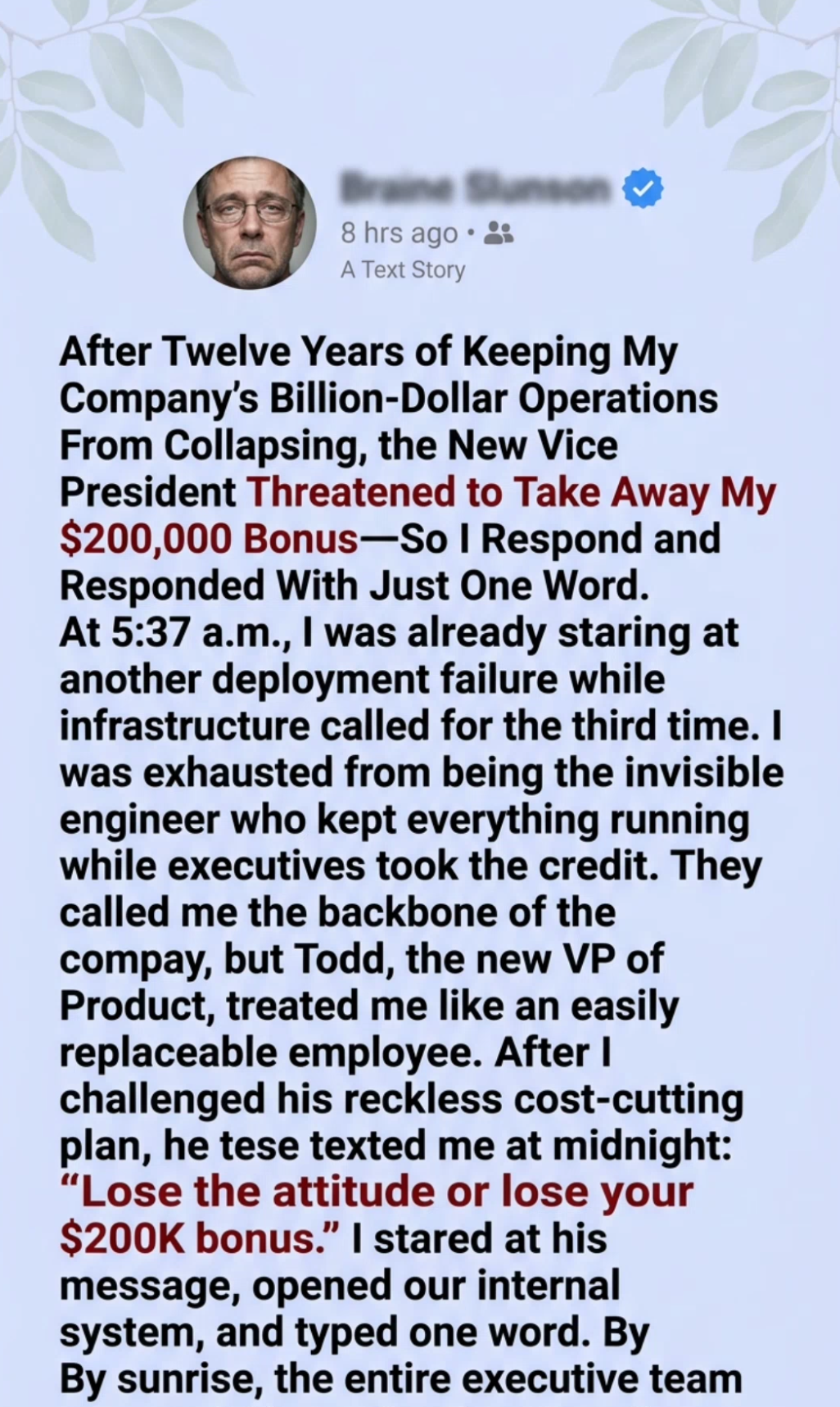
“Lose the attitude or lose your $200K bonus.”
I read it once.
Then again.
I didn’t respond.
I opened my compensation agreement and reviewed the bonus conditions.
I opened the company’s change-management policy.
Then I opened the internal deployment governance system.
There was a formal process for approving production changes that could materially affect critical infrastructure.
It required a technical owner, a documented risk assessment, an identified rollback procedure, and approval from the designated reliability authority.
I was that authority for the payment platform.
Todd’s proposed consolidation had been scheduled for a production change window the following morning.
The technical review was incomplete.
The rollback procedure had not been tested.
The independent recovery environment was scheduled for decommissioning before the replacement system had passed its validation requirements.
The deployment request was still marked as pending.
I had warned Todd about these problems in writing.
I had submitted the risk assessment.
I had requested additional testing.
The requests had been ignored.
I opened the change record.
There was a large text field asking for the final authorization status.
I typed one word.
REJECTED.
Then I selected the documented reasons:
-
Unverified recovery architecture.
-
Incomplete failure-isolation testing.
-
No validated rollback procedure.
-
Critical dependency consolidation without approved risk acceptance.
-
Failure to satisfy production readiness requirements.
I attached the technical assessment and the incident references.
Then I submitted the decision.
The system automatically notified the relevant engineering managers, infrastructure leadership, security, and the executive change-approval group.
I closed my laptop.
For the first time that night, I allowed myself to stop working.
I went home and slept for three hours.
At 6:14 a.m., my phone began ringing.
It was my manager.
“Martin, are you awake?”
“Yes.”
“Did you reject the production change?”
“Yes.”
He exhaled.
“Todd is furious.”
“That’s unfortunate.”
“The executive team wants an emergency meeting. They’re asking why the deployment is blocked.”
I sat up.
“Because it isn’t ready.”
“Can you come in?”
“I’ll be there.”
By the time I reached the office, the atmosphere had changed.
People were moving between conference rooms. Engineers were checking their phones. Several managers were standing near the operations dashboard.
The production deployment had been scheduled for 7:00 a.m.
Without my approval, it couldn’t proceed through the established process.
Todd was already in the executive conference room.
He looked as though he hadn’t slept.
The moment I entered, he stood.
“What exactly do you think you’re doing?”
I placed my laptop on the table.
“Following the change-management policy.”
“You blocked my deployment.”
“I rejected a production change that doesn’t meet the required readiness standards.”
“You don’t have the authority to stop a company initiative.”
I opened the approval matrix.
“I have the authority to reject an unsafe production change within my assigned reliability scope. The policy is available to everyone in this room.”
Todd turned toward the chief operating officer, Helen Brooks.
“He’s refusing to cooperate with the product organization.”
Helen looked at the documents.
“Martin, is the change technically unsafe?”
“Yes.”
“Explain.”
I connected my laptop to the conference display.
For the next twenty minutes, I walked the room through the architecture.
I showed how the proposed consolidation would create a shared dependency between two systems designed to fail independently.
I explained that the recovery environment Todd wanted to remove was not simply a duplicate server.
It was a separate operational path.
If the primary environment experienced a failure involving the shared authentication or routing layer, the proposed configuration could prevent the backup environment from taking over.
I showed the incident history.
I showed the missing test results.
I showed the incomplete rollback plan.
And then I showed the written warnings I had sent over the previous three weeks.
Nobody interrupted.
When I finished, Helen looked toward Todd.
“Did you review this assessment?”
Todd shifted in his chair.
“We reviewed the general direction. Engineering is always going to identify reasons not to move forward.”
“That wasn’t my question,” Helen said.
He didn’t answer.
The chief financial officer, Robert Klein, opened the risk report.
“Who approved removing the independent recovery environment?”
Todd replied that the decision had been included in the efficiency plan.
Robert looked at the document.
“This is a proposed savings target. It’s not an engineering approval.”
Todd’s face tightened.
Helen turned back to me.
“What would it take to make this deployment safe?”
I had prepared the answer weeks earlier.
“Keep the independent recovery environment active. Complete the failure-isolation tests. Validate the rollback procedure. Run the new configuration in parallel before moving payment traffic. Then we can review the results and approve a controlled rollout.”
Robert looked at the estimated savings.
“How much of the planned reduction would that eliminate?”
“Approximately thirty percent of the original target, depending on the final hosting configuration.”
Todd immediately interrupted.
“Which defeats the entire point.”
I looked at him.
“No. It prevents the company from saving money by removing the systems that keep its payments running.”
Nobody laughed.
Helen asked for a short recess.
When the executives returned, they announced that the deployment would remain blocked pending an independent technical review.
Todd looked directly at me.
“This isn’t over.”
I nodded.
“I understand.”
I returned to my office and resumed monitoring the production environment.
I thought the matter would end with the deployment being delayed.
I was wrong.
At 9:42 a.m., the chief technology officer called me.
His name was David Chen. He had joined Northstar two years earlier and generally stayed out of operational disputes unless something serious happened.
“Martin, I need you in my office.”
When I arrived, he closed the door.
“Have you heard anything about your bonus?”
“No.”
“Finance has received a request to remove it.”
I felt my stomach tighten.
“From whom?”
“Todd.”
David turned his monitor toward me.
There was a compensation adjustment request with my name on it.
The justification read:
Failure to demonstrate collaborative leadership during strategic transformation.
I stared at the screen.
“Is this connected to the deployment rejection?”
“That’s what I’m trying to establish.”
I explained the midnight message.
David asked me to forward it.
I did.
He read it silently.
Then he looked up.
“Did Todd have any authority to unilaterally cancel your bonus?”
“Not according to my agreement.”
David opened the compensation policy.
The bonus required performance evaluation and approval through a defined executive process. A vice president could submit feedback, but could not simply remove an earned award because an employee disagreed with a technical proposal.
David shook his head.
“Then this needs to be reviewed.”
He also asked me to provide the full record of the deployment warnings and my rejection.
I sent everything.
By lunchtime, the issue had reached the company’s general counsel.
I didn’t know what would happen next.
I had no desire to turn the situation into a personal battle. I wanted the company to follow its own policies and make decisions based on evidence.
But the following morning, the internal review uncovered something that made the situation considerably more serious.
The proposed consolidation had been included in Todd’s quarterly cost-reduction presentation.
He had already reported projected savings to the board as though the project were substantially approved.
The presentation listed the retirement of the independent recovery environment as a completed milestone.
It wasn’t completed.
It hadn’t even passed testing.
The projected savings also assumed that several senior infrastructure roles would be eliminated after the migration.
Those positions included the engineers responsible for the recovery systems Todd wanted to remove.
In other words, his financial plan depended on eliminating the people who understood how the replacement architecture was supposed to work.
The board had been given a picture of a transformation that didn’t yet exist.
The chief financial officer requested a reconciliation of the reported savings against approved projects.
The general counsel requested the change-management records.
The chief technology officer ordered an independent review of the proposed architecture.
Todd was placed on administrative leave from the production decision process while the review was conducted.
He was not fired immediately.
The company needed to establish what had happened and who had approved the financial reporting.
During the following two weeks, I worked with an independent engineering team.
We reviewed the architecture, the cost assumptions, the proposed staffing changes, and the historical incident data.
The review confirmed that several parts of Todd’s plan could be implemented safely.
However, the payment recovery consolidation was not ready.
The proposed schedule was unrealistic, and the risk assessment had been materially incomplete.
The review also found that the cost-reduction presentation had treated unapproved savings as committed results.
That discovery changed the tone of the entire investigation.
Todd was eventually removed from his position.
The company announced that he was leaving following an internal leadership review. I wasn’t involved in the employment decision, and I never learned every detail of the discussions between him and the board.
What I did know was that the deployment had been redesigned.
The new plan retained the independent recovery environment while allowing several other cost reductions to proceed.
We completed the required tests, ran the new configuration in parallel, and performed a controlled migration several months later.
The result was a measurable reduction in infrastructure costs without compromising the recovery architecture.
My bonus was also reviewed.
The company confirmed that Todd’s request had not followed the required compensation process.
After evaluating my performance records, operational results, and the terms of my agreement, the compensation committee approved the full $200,000 bonus.
When the payment appeared in my account, I didn’t celebrate.
I felt relieved.
But something had changed.
For twelve years, I had believed that being indispensable was the same as being valued.
I had believed that if I worked hard enough, solved enough problems, and stayed available long enough, the company would naturally recognize what I contributed.
Todd had shown me how fragile that assumption was.
A person could spend twelve years protecting an organization and still be treated as an inconvenience by someone who had arrived six months earlier.
The following quarter, Northstar created a formal production risk review process.
Critical infrastructure changes required documented technical approval, independent risk acceptance, and a verified rollback plan.
The company also introduced a policy requiring financial savings to be classified accurately as proposed, approved, or realized.
I was asked to lead the reliability governance group.
The position gave me authority to review major infrastructure changes across the company and to work directly with the CTO and finance leadership.
I accepted.
But I also made a personal decision.
I stopped answering every late-night call simply because someone expected me to.
I helped establish a proper on-call rotation, trained additional engineers, and documented the systems that had previously existed mostly in my head.
For the first time, I began building an organization that could function without depending on one exhausted person.
A few months later, David stopped by my office.
He looked at the new reliability dashboard and smiled.
“Things seem quieter around here.”
“They should be.”
“How does it feel?”
I thought about it.
“Different.”
He pulled up a chair.
“You know, when you typed that rejection, the executive team thought you were making a statement.”
“I was.”
He laughed.
“What statement?”
I turned toward the monitor.
“That production readiness isn’t negotiable.”
David nodded.
Then he asked, “Do you regret it?”
I looked at the systems dashboard.
Every critical service was operating normally. The recovery environments were healthy. The deployment process was documented. The engineers who had spent years working behind the scenes finally had a voice in decisions that affected their responsibilities.
“No,” I said. “I regret waiting so long to make the decision.”
That afternoon, I received a message from an engineer who had been working on my team for only eight months.
He wrote:
I used to think the most important person in engineering was the person who could fix the biggest outage. Now I think it’s the person willing to stop an outage before it happens.
I read it twice.
Then I saved it.
Because that was the part of the story I wanted to remember.
Todd had threatened my bonus because I refused to approve a dangerous shortcut.
He thought the number on my compensation statement would make me hesitate.
He thought twelve years of loyalty would make me ignore what I knew was wrong.
But the company didn’t need another executive presentation promising efficiency.
It needed someone willing to say no when the evidence demanded it.
And sometimes, protecting everything you’ve spent twelve years building begins with a single word.
REJECTED.
THE END.