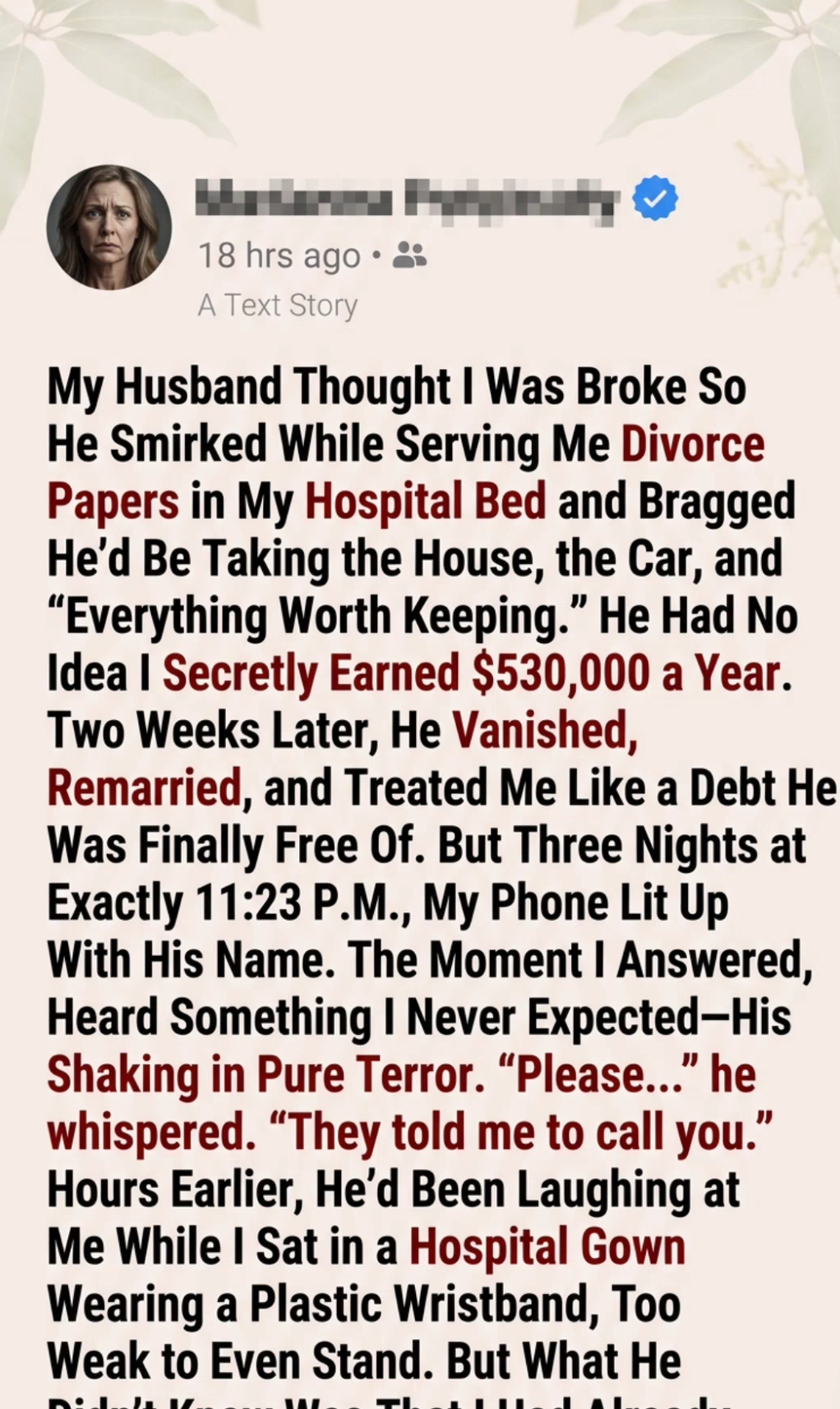
The first time my husband handed me divorce papers, I was wearing a hospital gown.
I was thirty-nine years old, lying in a private hospital room with an IV in my arm, a plastic wristband around my wrist, and enough medication in my system to make standing feel like climbing a mountain.
My husband, Richard, stood beside the bed wearing a navy suit.
He wasn’t carrying flowers.
He wasn’t asking whether I was in pain.
He was holding a brown envelope.
“Sign these, Claire.”
I looked at it.
“What is it?”
He smiled.
“Something we should have done a long time ago.”
I opened the envelope with trembling fingers.
Divorce papers.
I looked up at him.
“You’re giving me divorce papers here?”
“You’re not exactly difficult to find.”
I couldn’t believe what I was hearing.
I had been admitted after collapsing at work. The doctors were still investigating the cause of my severe exhaustion and abnormal heart rhythm. I had spent the previous night undergoing tests, and I was frightened.
Richard knew that.
He also knew I had been working long hours for months.
Yet he stood beside my hospital bed looking impatient.
“Richard, can we talk about this when I get home?”
He laughed softly.
“Why? So you can pretend everything is fine again?”
I stared at him.
He placed another document on the blanket.
“The house will be mine. The car too. I’ll handle the accounts. You can take your clothes and whatever personal things you want.”
I felt my throat tighten.
“The house is in both our names.”
“Not for much longer.”
“And the savings?”
He shrugged.
“We’ll divide what’s left.”
I looked at him.
“What does that mean?”
He leaned closer.
“Claire, let’s be honest. You haven’t earned enough to maintain the lifestyle we’ve had. You don’t have the money to fight me. Just sign, and we can avoid making this ugly.”
I almost laughed.
Not because it was funny.
Because he had no idea how wrong he was.
For nearly seven years, Richard had believed I worked as a freelance accounting consultant who occasionally helped small businesses with bookkeeping.
That was how I had described my work when we first met.
It was true at the time.
But over the years, my career had changed.
I had become a senior financial risk consultant, working remotely with several international firms and advising on large corporate restructuring projects.
My annual compensation had reached approximately $530,000, including bonuses and consulting income.
Richard knew I worked.
He simply never asked what my work had become.
He preferred believing he was the successful one.
I had never hidden my income to deceive him. My tax returns, financial records, and business accounts were properly documented. But I had kept my professional life separate from his because he had repeatedly dismissed my work as “little computer jobs.”
I had stopped correcting him.
Now he was standing beside my hospital bed, convinced I had nothing.
I looked at the papers.
“I’m not signing anything today.”
His smile disappeared.
“Don’t make this difficult.”
“I’m not. I’m asking for time to read them.”
He collected the envelope.
“Fine. But don’t expect me to keep paying for everything.”
Then he walked out.
He didn’t ask when the doctors expected to discharge me.
He didn’t ask whether I needed anything.
He didn’t even turn around.
That evening, I called my lawyer.
And for the first time in my marriage, I told someone everything.
Richard and I had been married for seven years.
When we met, he worked in commercial property management. He was charming, ambitious, and extremely proud of his ability to recognize an opportunity.
He liked expensive restaurants, weekend trips, and talking about the future.
I liked that he made plans.
At the beginning, we were happy.
I had recently started building my consulting career. Richard was working his way toward a management position, and we bought a modest house together.
I contributed to the down payment.
We divided household expenses according to our incomes.
For a while, it worked.
Then Richard began earning more, and his attitude changed.
He started introducing me as someone who “helped with accounts.”
If I mentioned a difficult project, he would smile and say, “You and your little spreadsheets.”
At first, I laughed.
Eventually, it stopped being funny.
He liked being the person who earned the larger visible paycheck. He enjoyed paying for dinner in front of friends and telling people he was taking care of the household.
I never corrected him.
I didn’t need recognition.
I needed respect.
But the more successful my career became, the less interested he seemed in hearing about it.
When I received my first major annual contract, I told him I had been offered a significant increase in compensation.
He barely looked up from his phone.
“That’s nice, sweetheart.”
Then he asked whether I had remembered to pay the electricity bill.
I began keeping my professional accounts separate, as any independent consultant would. My business income went into an account in my name, with records maintained by my accountant.
Our joint finances remained transparent where they needed to be. We both knew about the mortgage, household bills, and shared savings.
But Richard never showed much interest in my separate professional accounts.
He assumed there wasn’t much in them.
That assumption eventually became part of his plan to divorce me.
The first serious warning came six months before my hospitalization.
Richard began spending more evenings away from home.
He said he was attending networking events, meeting clients, and discussing a possible property development opportunity.
He also became protective of his phone.
One evening, I noticed a message appear on his screen.
Can’t wait until we don’t have to hide anymore.
He turned the phone facedown.
“Who was that?”
“A colleague.”
“At eleven at night?”
He sighed.
“Claire, not everything needs to become an interrogation.”
I didn’t push.
A few weeks later, I found a hotel receipt in his jacket.
The date matched a night he had told me he was working late.
When I asked him about it, he said the meeting had run over and he had stayed nearby.
I asked who else had been there.
He became angry.
“You don’t trust me.”
I looked at him.
“I asked a question.”
He walked away.
After that, I stopped trying to investigate.
I was working too hard, sleeping too little, and dealing with health symptoms I couldn’t explain.
My doctor had warned me to reduce my workload.
Richard told me I was being dramatic.
Then I collapsed.
And while I was in the hospital, he served me divorce papers.
My lawyer, Elaine Foster, arrived the following morning.
She was in her early fifties, practical, direct, and not easily impressed.
She read the divorce petition carefully.
“He’s asking for temporary exclusive use of the house,” she said.
“Can he do that?”
“He’s asking. That doesn’t mean he’ll get it.”
She turned another page.
“He’s also claiming you have limited independent income and that he has been the primary financial provider.”
I stared at her.
“That’s ridiculous.”
“Do you have documentation of your income?”
I nodded.
“All of it.”
“Good. We’ll need your tax returns, consulting agreements, bank statements, business records, and any documentation showing how household expenses were paid.”
I hesitated.
“Elaine, I want to ask you something.”
“Go ahead.”
“Can he take everything?”
She closed the folder.
“No. And you shouldn’t sign anything without a full review.”
I told her about the $530,000 annual income.
She raised her eyebrows slightly.
“Does your husband know?”
“He knows I work. He doesn’t know the full amount.”
“Is that income earned during the marriage?”
“Most of it, yes.”
“Then we need to examine the applicable marital-property rules. Your income may be relevant to the division of assets, support, and financial disclosures. Having separate accounts does not automatically make marital earnings separate property.”
I nodded.
I had expected that.
I wasn’t trying to hide money from the court.
I wanted to protect myself from a husband who believed I was financially helpless.
Elaine asked me another question.
“Do you know why he’s filing now?”
I looked toward the hospital window.
“I think there’s someone else.”
She made a note.
“Then we’ll address that carefully. But our priority is protecting your legal and financial position.”
I signed the authorization allowing her to communicate with Richard’s attorney.
Then I did something I had never imagined doing.
I asked the hospital social worker to remove Richard as my emergency contact and replace him with my sister, Julia.
I wasn’t sure whether he would visit again.
He didn’t.
Two weeks later, I was discharged.
Richard had already moved out.
He had taken several suitcases, his personal electronics, and most of his expensive clothing.
He had also removed some household items.
Elaine advised me not to change any locks or dispose of shared property without legal guidance.
So I didn’t.
I returned to the house with my sister and began sorting through the documents Elaine needed.
Then I discovered that Richard had already started a new life.
A mutual acquaintance sent me a photograph.
Richard was standing outside a restaurant with a woman named Melissa.
The caption read:
Congratulations to Richard and Melissa on their wedding! Wishing you both happiness.
I stared at the photograph.
He had remarried.
Two weeks after serving me divorce papers.
I called Elaine.
“Can he do that?”
She asked for the date.
I sent her the photograph and the public marriage announcement.
She reviewed the documents and explained that the legal implications depended on whether our divorce had actually become final and the jurisdiction involved.
It had not.
There was no valid final divorce judgment.
Richard had apparently told Melissa that the paperwork was already completed.
Elaine’s voice became firm.
“Claire, do not contact him. We need to confirm the facts and handle this through the lawyers.”
I felt sick.
He hadn’t simply left me while I was ill.
He had moved on so quickly that he apparently hadn’t even bothered to complete the legal process.
I sat at the kitchen table for a long time.
Then I received an email from Richard.
I hope you’re doing better. I think it’s best that we keep communication limited to the lawyers. I’ve started a new chapter, and I hope you can respect that.
I read it twice.
He sounded as though I were an old business contract he had finally closed.
I forwarded it to Elaine.
Then I turned off my phone.
The first call came at 11:23 p.m.
I was awake because my medication had disrupted my sleep.
My phone lit up.
Richard.
I stared at the screen.
For a moment, I considered letting it ring.
Then I answered.
“Hello?”
His voice was barely recognizable.
“Claire?”
“Yes.”
“Please…”
He was breathing heavily.
“What’s wrong?”
“They told me to call you.”
I sat upright.
“Who told you?”
“I can’t explain. Please, Claire. I need you to help me.”
His voice shook.
I heard a door close somewhere in the background.
“Richard, where are you?”
“I’m at home.”
“Which home?”
He didn’t answer.
Then he whispered, “The bank froze everything.”
I closed my eyes.
“What?”
“My accounts. The business account. The money I was expecting. Everything.”
I was silent.
He continued.
“They said there’s an investigation. They said I need to provide documents. I don’t understand what’s happening.”
I looked at the clock.
11:23.
“Why are you calling me?”
He hesitated.
“Because your name is on something.”
My stomach tightened.
“What something?”
“A guarantee. A financial authorization. I don’t know. They said I need to speak to you.”
I sat very still.
“Richard, I never signed any guarantee for you.”
He began speaking faster.
“Please don’t do this. They said you have to confirm something.”
“Who said that?”
“The bank’s compliance department.”
I took a breath.
“Listen carefully. I am not going to confirm anything I haven’t personally authorized. If they need information from me, they can contact my lawyer.”
He went quiet.
Then he said something that chilled me.
“Claire, they said there could be a criminal investigation.”
I looked toward the dark hallway.
“What did you do?”
He didn’t answer.
Instead, the call ended.
I remained seated for several minutes.
Then I called Elaine.
She answered after two rings.
“Claire?”
“Richard just called. His bank accounts are frozen. He says there’s an investigation involving a guarantee with my name on it.”
Her voice sharpened.
“Did you sign anything?”
“No.”
“Do not contact him again. Send me every detail you remember. We will deal with this through the bank and the appropriate authorities.”
I sent her the call time and a written summary.
Then I waited.
The second call came the following night.
11:23 p.m.
I almost didn’t answer.
“Claire, please.”
His voice sounded worse.
“What’s happened now?”
“They showed me the document.”
“What document?”
“The guarantee.”
I felt cold.
“Did you sign my name?”
Silence.
“Richard?”
He began breathing heavily.
“I thought it was just a formality.”
I stood up.
“What did you do?”
He spoke so quietly I could barely hear him.
“The lender wanted additional security for the property project. I used the authorization we had from the house purchase.”
I gripped the edge of the table.
“What authorization?”
“The old financial paperwork. The one you signed when we bought the house.”
“That was for the mortgage.”
“I know.”
“Then why is my name on a business guarantee?”
He started crying.
“I didn’t think they’d check.”
I closed my eyes.
For seven years, I had trusted this man with my life.
Now I was hearing that he had used an old document to support a financial obligation I had never agreed to.
“Did you forge my signature?”
He didn’t answer.
That was enough.
I told him not to call me again and to communicate through the lawyers.
Then I contacted Elaine.
She asked me to send every document I had relating to the house purchase and the business.
She also told me not to make assumptions about the legal outcome until the records were examined.
The next morning, she contacted the lender’s legal department.
She formally disputed any claim that I had guaranteed Richard’s business debt.
She requested the complete document package, including the original authorization, signature records, witness information, and any electronic audit trail.
She also advised me to make a formal report to the relevant authorities because my identity might have been used without permission.
I did.
The investigation began.
The third call came at exactly 11:23 p.m.
This time, I answered on speakerphone with Elaine present.
“Richard, you’re speaking with me and my lawyer.”
He sounded exhausted.
“Claire, please don’t let them destroy me.”
Elaine leaned toward the phone.
“Mr. Hayes, I am Claire’s legal representative. Any discussion concerning the disputed guarantee must be made through the proper legal channels.”
Richard ignored her.
“Claire, I made a mistake.”
I looked at the wall.
“You made a decision.”
“I was trying to secure the project.”
“Using my name?”
“I thought the old authorization would be enough.”
“Did you sign it?”
Silence.
Then he said, “Yes.”
Elaine wrote something down.
“Mr. Hayes,” she said, “we need to establish exactly what happened. Do not destroy or alter any documents. Your lawyer should contact us.”
Richard started crying again.
“Claire, you know I never wanted to hurt you.”
I felt a strange calm settle over me.
“You served me divorce papers in a hospital bed while I was still recovering from a medical emergency. You told me I was broke. You laughed about taking my home and everything I had. And now you’re asking me to protect you because you used my name on a financial document.”
He whispered, “I didn’t think it would go this far.”
“That’s the problem, Richard. You didn’t think about what would happen to me.”
I ended the call.
For the first time since the hospital, I slept through the night.
The investigation took several months.
The lender provided copies of the disputed documents.
The signature on the guarantee appeared to be mine, but the document had been assembled using an old scanned signature from the mortgage application.
A forensic document examiner found evidence that the signature image had been inserted electronically rather than signed directly on the guarantee.
The lender also produced emails showing Richard had submitted the paperwork himself.
He had represented that I had approved the business obligation.
I had not.
The financial exposure was substantial.
The business project had borrowed money against expected revenue from a commercial property development. When the project ran into trouble, the lender began reviewing the guarantees and supporting documentation.
That review exposed the false authorization.
The bank froze certain accounts and restricted further transactions while it investigated the disputed documents and the project’s finances.
Richard’s new wife, Melissa, had apparently believed he was financially secure.
She had not known about the full extent of the debt.
When the investigation began, she contacted Elaine’s office.
She wanted to know whether I had any information about Richard’s business dealings.
I refused to discuss anything beyond what was legally required.
I had no interest in becoming involved in his new marriage.
Richard’s lawyers eventually acknowledged that the guarantee was disputed and that he had submitted it without my authorization.
The lender removed me from the claimed obligation after reviewing the evidence and confirming I had not consented.
The matter involving Richard’s conduct was referred to the appropriate authorities.
I did not control what happened next.
I simply cooperated and allowed the process to proceed.
Meanwhile, my divorce continued.
Richard’s original financial disclosures had described me as a low-income spouse with limited assets.
That claim collapsed when our lawyers exchanged the required financial records.
My income was fully documented.
My consulting contracts, tax returns, business accounts, and investment statements showed that I had earned approximately $530,000 annually in recent years.
But the revelation did not mean I automatically received everything.
The court still had to consider the applicable property rules, the timing and source of the income, our contributions, and the ownership of our assets.
Elaine made sure my position was properly presented.
She also raised the issue of the disputed financial guarantee and Richard’s failure to disclose the business debt.
The divorce settlement took months to negotiate.
The house was appraised.
Our joint accounts were reviewed.
The car and other shared assets were valued.
The court-approved agreement reflected the applicable division of marital property and resolved the financial claims between us.
Richard did not get everything.
Neither did I.
But I retained my professional assets and received a fair settlement of the marital property.
Most importantly, I was not held responsible for the business guarantee he had submitted using my identity.
One afternoon, nearly a year after the hospital incident, I received a letter from Richard.
It was handwritten.
I almost threw it away.
Instead, I opened it.
Claire,
I know I have no right to ask for your forgiveness.
I was arrogant. I believed that because I earned a good living and had become accustomed to making decisions, I was entitled to control everything around me.
I underestimated you because I didn’t understand your work. I thought your income was small because I never bothered to ask.
When I filed for divorce, I wanted to leave quickly and take as much as I could. I told myself I deserved it.
I used your old signature because I thought the lender would accept it. I knew you had not agreed, but I convinced myself it was temporary.
I lost my business position, my marriage, and the trust of people who had believed me.
I am not writing to ask you to help me. I only want you to know that I understand what I did.
Richard.
I read it once.
Then I folded it and placed it in a drawer.
I didn’t write back.
Some apologies arrive too late to change anything.
Two years later, my health had improved.
I reduced my workload, hired additional support for my consulting practice, and began spending more time outdoors.
I moved into a smaller house with a bright kitchen and a garden.
I kept working, but I no longer measured my worth by how much I could accomplish in a week.
One evening, I attended a dinner hosted by a professional association.
A woman named Helen sat beside me.
She was a financial adviser who worked with people rebuilding their lives after major changes.
During dinner, she asked how I had entered the consulting field.
I told her about my early career and the years I spent working behind the scenes.
Then she asked whether I had ever considered mentoring younger women.
I laughed.
“Who would want advice from me?”
Helen looked at me seriously.
“Someone who needs to hear that they don’t have to make themselves smaller to keep someone else comfortable.”
I thought about that sentence for days.
Eventually, I agreed to mentor a small group of women starting careers in finance and risk management.
Some were young graduates.
Others were mothers returning to work after years away.
A few were rebuilding after difficult marriages.
I never told them my entire story unless they asked.
But I always told them one thing:
“Never allow someone else’s opinion of your financial value to become your understanding of your own worth.”
I sometimes think about that hospital room.
The plastic wristband.
The IV.
The brown envelope Richard placed on my blanket.
And the smirk on his face when he told me he would take everything worth keeping.
He thought my value could be measured by what he believed I earned.
He thought I was powerless because I was sick.
He thought I would sign whatever he placed in front of me because I had nowhere else to go.
He was wrong.
The three calls at 11:23 p.m. were not a victory.
They were not revenge.
They were the sound of a man finally facing the consequences of decisions he had made when he believed nobody could hold him accountable.
I didn’t save him.
I didn’t destroy him.
I simply refused to carry responsibility for something I had never agreed to.
And when I look back now, I realize the most important thing I did that week wasn’t protecting my money or proving how much I earned.
It was refusing to sign those papers while lying in that hospital bed.
Because the moment I said no, I stopped allowing Richard to decide what my future would look like.
THE END.