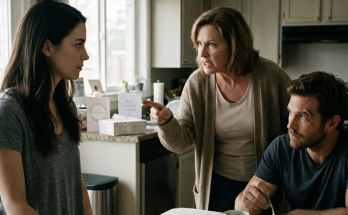
Ten years ago, I came home early from work.
I opened the bedroom door.
My husband was in our bed.
My sister, Rachel, was with him.
For a few long seconds, nobody moved.
Then Rachel burst into tears.
My husband tried to explain.
I never gave either of them the chance.
Within a month, I filed for divorce.
I changed my phone number.
I moved to another city.
Anyone who told me to “hear them out” disappeared from my life too.
My parents insisted there was more to the story.
I refused to listen.
To me, there was only one truth.
My husband and my sister had destroyed my family.
For the next ten years, I never spoke Rachel’s name again.
Then, one rainy afternoon, my cousin called.
“Rachel died during childbirth.”
I closed my eyes.
“I thought you should know.”
Relatives begged me to come to the funeral.
I declined every invitation.
“She stopped being my sister ten years ago.”
That was the end of it.
Or so I believed.
The following morning, my doorbell rang.
A man in a gray suit introduced himself as an attorney.
“Your sister left instructions that this envelope be delivered only after her funeral.”
Across the front were six handwritten words.
Please finish reading before judging me.
I almost threw it away.
Instead, I opened it.
Inside was a thick letter.
A flash drive.
And several old photographs.
The letter began simply.
“You saw exactly what I wanted you to see.”
I frowned.
“If you stop reading now, you’ll hate me forever.”
“If you keep reading, you’ll finally understand why I sacrificed everything.”
My heart pounded.
I plugged the flash drive into my laptop.
The video began with Rachel sitting alone in a lawyer’s office.
She looked terrified.
“If you’re watching this,” she said, “I’m probably gone.”
She took a deep breath.
“Your ex-husband wasn’t just cheating.”
“He was dangerous.”
Months before I discovered them together, Rachel had uncovered evidence that my husband had been stealing money from clients through his construction company.
When she confronted him, he laughed.
Then he threatened her.
“If you tell your sister,” he said, “I’ll make sure she loses everything with me.”
Rachel secretly contacted the police.
The investigators told her they needed stronger evidence before they could act.
So she agreed to help them.
Her job was to gain his trust long enough for investigators to document the financial fraud.
Everything had been carefully planned.
Except one thing.
I came home nearly an hour earlier than expected.
The officers who were supposed to arrive later never had the chance.
I walked in before the operation was complete.
Rachel cried into the camera.
“I chased you into the driveway.”
“You drove away.”
“You changed your number before I could explain.”
She showed copies of emails.
Police reports.
Search warrants.
Bank records.
Months after our divorce, my ex-husband had been arrested—not for anything related to our marriage, but for a large financial fraud investigation that eventually sent him to prison.
Much of the evidence had come from Rachel.
Then she held up one final document.
A letter from the lead detective.
It confirmed that Rachel had worked with investigators under legal supervision after reporting suspected fraud.
She had never intended for me to discover her with my husband.
That moment had destroyed the investigation almost as much as it had destroyed our family.
“I could have forced the truth,” Rachel whispered.
“But every lawyer told me the same thing.”
“The criminal case had to come first.”
“If I contacted you directly, it could jeopardize everything.”
“So I waited.”
“I waited too long.”
At the end of the video, she smiled sadly.
“I don’t expect forgiveness.”
“I only hope you stop believing I chose him over you.”
“I never did.”
“I chose what I believed would protect you.”
“I was just too late.”
I sat frozen.
For ten years I had carried hatred that suddenly felt heavier than grief.
The next day, I drove to the cemetery.
Fresh flowers still covered her grave.
I knelt in the wet grass.
“I’m sorry,” I whispered.
“I should have listened.”
There was no answer.
Only the sound of the wind moving through the trees.
A few weeks later, Rachel’s husband asked to meet me.
He placed a small photo album on the table.
Inside were dozens of pictures.
Rachel at birthdays.
Rachel outside my office.
Rachel sitting quietly in the back row at my college graduation ceremony after my divorce.
She had never approached me.
She had simply wanted to know I was alright.
On the final page was a photograph of Rachel holding her newborn daughter in the hospital.
Written beneath it were the words:
“Please tell her she had an aunt who loved her more than pride.”
Today, my niece is ten years old.
Every year on her birthday, we bake the same chocolate cake Rachel used to make when we were children.
When she asks about her mother, I tell her the truth.
Not that Rachel was perfect.
Not that she never made mistakes.
But that love sometimes looks complicated from the outside, and silence can leave wounds that last far longer than the truth.
For years, I believed betrayal had destroyed my family.
Looking back, I realized something else had done even greater damage.
Assumptions.
Because sometimes the moment that seems to explain everything…
…is only the beginning of the story.