The last conversation I ever had with my father lasted less than five minutes.
He was weak.
The machines around his hospital bed hummed softly.
He reached for my hand and whispered,
“Promise me one thing.”
“I will.”
“Take care of your mother.”
I nodded without hesitation.
“I promise.”
He smiled.
Then he closed his eyes.
I took that promise seriously.
For the next twelve years, I quietly made sure Mom never worried about money.
Every month I paid her rent.
I covered groceries.
Prescription medications.
Utilities.
Medical insurance premiums.
When the refrigerator broke, I replaced it.
When the furnace failed in the middle of winter, I paid for a new one.
I never asked my three brothers for help.
At first, I did.
Each had an excuse.
“I’m between jobs.”
“I’ve got kids.”
“I’m stretched too thin.”
Eventually, I stopped asking.
I simply handled it.
Over twelve years, I spent roughly $156,000 helping my mother.
Then everything changed.
At eighty-one, Mom became seriously ill.
She needed emergency surgery.
Weeks in the hospital.
Months of rehabilitation.
Insurance covered part of the costs.
The rest came to nearly $45,000.
I paid every dollar.
When she finally returned home, I felt relieved.
Keeping my promise to Dad had been worth every sacrifice.
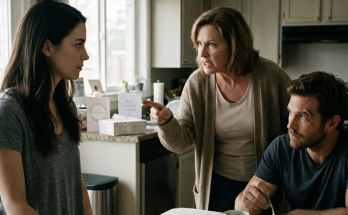
A few months later, Mom invited the whole family over.
“I’ve updated my will,” she announced.
Everyone smiled.
“I’ve decided everything will be divided equally.”
“Twenty-five percent to each of my four sons.”
My youngest brother actually grinned.
“Fair is fair.”
I stared at Mom.
“I’ve spent more than two hundred thousand dollars taking care of you.”
She nodded gently.
“I know.”
“So…?”
“Your brothers are family too.”
I looked around the room.
Not one of them corrected her.
Not one offered to repay a single dollar.
The youngest even shrugged.
“Nobody forced you.”
That’s when I stood.
I walked to my briefcase.
And removed a thick folder.
Inside were twelve years of records.
Bank transfers.
Canceled checks.
Medical invoices.
Receipts.
Every payment I’d ever made on Mom’s behalf.
Then I placed one final document on the table.
A promissory note.
Signed by my mother six years earlier.
The room fell silent.
Mom’s face turned white.
“Where… where did you get that?”
I looked at her.
“You signed it after your surgery.”
Years earlier, while recovering in the rehabilitation center, she’d insisted she didn’t want my help to become a burden.
“I’ll never be able to repay you,” she’d said.
I told her repayment didn’t matter.
She insisted anyway.
At her request, an attorney prepared a simple promissory note acknowledging the money I’d advanced for her care.
She signed it voluntarily.
The note stated that any unpaid balance would be secured by her house and repaid from her estate if she never reimbursed me during her lifetime.
After signing it, she hugged me.
“This way your brothers can never say you took advantage of me.”
She had completely forgotten.
Or perhaps she hoped I had.
My oldest brother picked up the document.
“It’s real?”
“It was witnessed and notarized,” I replied.
The attorney who drafted Mom’s estate plan quietly nodded.
“It is legally valid.”
My youngest brother slammed his hand on the table.
“You’re stealing our inheritance!”
I calmly shook my head.
“No.”
“I’m collecting a debt.”
The attorney spoke next.
“Any legitimate debt owed by the estate must generally be addressed before the remaining assets are distributed according to the will.”
The room became very quiet.
For the first time in twelve years, everyone understood what “taking care of Mom” had actually cost.
That evening, after my brothers left, Mom asked me to stay.
She cried harder than I’d seen since Dad’s funeral.
“I never meant to hurt you.”
“I know.”
“I just wanted peace between my children.”
I took her hand.
“Dad asked me to take care of you.”
“He didn’t ask me to pretend my sacrifices never happened.”
She nodded through tears.
The next week, she met with her attorney again.
She kept her will equal.
But she also instructed that the documented debt be repaid to me from her estate before any inheritance was divided.
The remainder would still be shared equally among all four brothers.
Years later, when Mom passed away peacefully, that’s exactly what happened.
I received repayment for the documented loans.
The remaining estate was divided evenly.
None of my brothers liked the outcome.
But none could honestly claim it was unfair.
I never wanted more than anyone else.
I only wanted the promise I made to my father to stop costing only one son.
Looking back, I realized something important.
Love should be given freely.
But when generosity quietly becomes an expectation while everyone else contributes nothing, it stops being generosity.
It becomes invisibility.
And sometimes, the most important document in a family isn’t a will.
It’s the one that makes sure sacrifice is remembered instead of forgotten.