When my husband, Thomas, passed away after a long battle with cancer, the silence in the house became almost unbearable.
We had been married for fifteen years.
I never had children of my own, but Thomas had a son, Evan, from his first marriage.
Evan was nineteen.
I had helped raise him since he was four.
I packed his lunches.
Cheered at his soccer games.
Stayed up helping with science projects.
When he called me by my first name instead of “Mom,” I never pushed him.
Love doesn’t always need a title.
After Thomas died, I inherited our home.
There wasn’t much else.
Years of medical bills had emptied our savings.
Life insurance barely covered the funeral.
Evan was living at home, working part-time while taking community college classes.
I wanted to help him become independent.
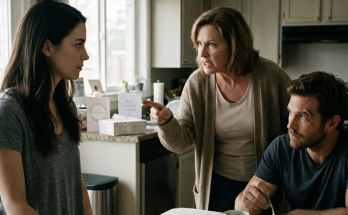
So one evening, I sat him down.
“I’m not asking for much,” I said gently.
“If you’re going to stay here, I’d like you to contribute $500 a month toward utilities, groceries, and the mortgage.”
He looked at me for a second.
Then laughed.
Actually laughed.
“You can’t be serious.”
“I am.”
He leaned back in his chair.
“You’re childless.”
I frowned.
“So?”
He smirked.
“I’m your retirement plan.”
“It’s your job to support me.”
For a moment, I genuinely thought he was joking.
He wasn’t.
“You owe me.”
“My dad would’ve wanted that.”
I stood slowly.
“No.”
“Your father wanted you to become a good man.”
The next morning, while Evan was out with friends, I called a locksmith.
I changed every exterior lock.
I packed his belongings carefully into boxes.
When he returned that evening, I handed him the new key to a small storage unit I’d rented for a month.
“You have thirty days to collect everything.”
He exploded.
“You can’t kick me out!”
“I can.”
“And I just did.”
He stormed away, calling me every name he could think of.
The house finally became quiet again.
A few days later, I started cleaning his old room.
While vacuuming beneath the bed, I noticed an old duffel bag pushed all the way against the wall.
Across the top, written in black marker, were three words.
For Sarah.
My name.
Confused, I unzipped it.
Inside wasn’t money.
Or valuables.
It was dozens of sealed envelopes.
Every one addressed to me.
In Thomas’s handwriting.
My heart stopped.
The first letter began:
If you’re reading this, it means I waited too long to tell you the truth.
Tears blurred the page before I reached the second paragraph.
Thomas explained that during his illness, he had written a letter every month.
He knew there was a chance he wouldn’t survive.
He wanted me to have something to read after he was gone.
But then came the sentence I never expected.
I asked Evan to give you these only after he believed he was ready to stand on his own.
I stared at the page.
The next letter explained why.
Thomas worried that grief might cause Evan to become dependent instead of independent.
He wanted his son to learn responsibility before leaning on anyone else.
The final instruction was simple.
If Evan ever expects you to carry him through life instead of walking beside you, he isn’t ready.
My hands shook.
At the bottom of the bag sat a small locked box.
The key was taped beneath the lid.
Inside was another envelope.
Along with the deed to a small parcel of land Thomas had quietly purchased years earlier.
There was also a savings account statement.
Balance:
$186,000.
The account wasn’t in my name.
Or Evan’s.
It belonged to a trust.
Thomas had left instructions that the money could only be distributed after Evan completed either a college degree, a skilled trade certification, or maintained full-time employment for three consecutive years.
If he refused to become self-supporting by age thirty, the money would instead go to a scholarship fund for young adults who had lost a parent.
Suddenly everything made sense.
Thomas hadn’t left Evan with nothing.
He had left him with motivation.
A week later, Evan called.
“I need to pick up the rest of my stuff.”
“I’ll be here.”
When he arrived, I handed him one of the letters.
“The rest aren’t for me anymore.”
He frowned.
“What is this?”
“It’s from your father.”
He read silently.
Halfway through, his shoulders began to shake.
The letter ended with these words:
Son, if you’re reading this because Sarah finally said no to you, then listen carefully.
She isn’t abandoning you.
She’s honoring my final wish.
The greatest gift she can give you isn’t a free place to live.
It’s the chance to discover you’re capable of building your own life.
Evan cried harder than I had ever seen.
“I thought he wanted you to take care of me.”
I shook my head.
“He wanted us to take care of each other.”
“That’s different.”
Months passed.
Evan rented a small apartment with two friends.
He enrolled in an electrician’s apprenticeship.
The work was hard.
But he stayed with it.
Three years later, he invited me to dinner.
He smiled as he handed me a folded piece of paper.
It was his apprenticeship completion certificate.
“I think Dad would say I’m ready now.”
I smiled through tears.
“I think he would.”
The trust was released according to Thomas’s wishes.
Evan used part of it for a down payment on his first home.
The rest he invested wisely.
Before we left the restaurant, he hugged me.
Not awkwardly.
Not out of obligation.
For the first time in fifteen years, he quietly whispered,
“Thank you… Mom.”
Sometimes love means opening your door.
Sometimes love means closing it.
And sometimes, the hardest “no” you ever say becomes the greatest “yes” someone else will ever receive.