When my father turned eighty-seven, he became forgetful.
Not confused.
Not incapable.
Just slower.
He still balanced his checkbook with a calculator he’d owned for thirty years, insisted on paying every bill himself, and refused to let anyone mow his lawn.
After he slipped on the front porch one winter, my younger sister, Karen, convinced him to let her “help.”
“It’ll just make paying your bills easier,” she told him.
“You don’t have to worry if you’re in the hospital.”
Dad finally agreed.
She was added to his primary checking account.
At every family gathering, Karen repeated the same sentence.
“It’s only for convenience.”
Even Dad said the same thing.
“I still own my money.”
We believed him.
None of us imagined that decision would eventually divide the family.
…
Dad passed away peacefully two years later.
The grief was overwhelming.
He left behind four children.
Me.
Karen.
Our brothers, Michael and David.
Dad’s will was simple.
Everything was to be divided equally among his children.
There were no surprises.
Or so we thought.
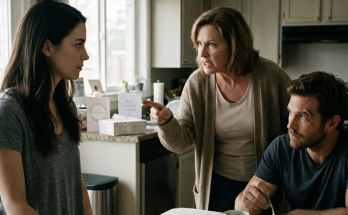
Three days after the funeral, Karen called us together.
“I’ve already spoken with the bank.”
“Good,” Michael said.
“We can start settling the estate.”
Karen folded her arms.
“There isn’t anything to settle.”
“What do you mean?”
“The checking account belongs to me.”
David frowned.
“Dad’s account?”
“Yes.”
“The entire balance.”
“That’s impossible.”
“My name was on the account.”
“It became mine automatically.”
“That’s how joint accounts work.”
I stared at her.
“How much is in the account?”
She answered without hesitation.
“$2.8 million.”
The room fell silent.
Dad had sold several commercial properties the previous year, and until the estate was distributed, much of the proceeds had remained in that account.
Michael looked sick.
“Dad intended that money for all of us.”
Karen shrugged.
“He should’ve thought about that before adding me.”
David slammed his hand on the table.
“That’s not what he wanted.”
“Prove it.”
…
For the next several days, everyone argued.
Lawyers were mentioned.
Relationships cracked.
Then something kept bothering me.
Karen was assuming the account passed to her automatically.
But she had never shown us any paperwork.
Only her interpretation.
So I made one phone call.
I asked the bank whether the estate representative could meet with someone to review the account records.
To my surprise…
They agreed.
…
The following Tuesday, all four siblings sat inside the branch manager’s office.
The manager was polite but careful.
“I can’t provide legal advice.”
“But I can explain how this particular account was established.”
He disappeared into the records room.
Several minutes later, he returned carrying a thick folder.
He opened the original signature card.
“Dated March 11, 2022.”
Karen smiled confidently.
“Exactly.”
The manager adjusted his glasses.
“When your father requested that your name be added, he selected a specific account designation.”
He pointed to a paragraph near the bottom.
Then he stopped.
He read it aloud.
“This account is established as a Convenience Account only. The additional signer is authorized to conduct transactions solely for the benefit of the primary account holder. Ownership of funds shall remain with the primary account holder during life and become part of the owner’s estate upon death unless otherwise specified in a separate written agreement.”
The room became completely silent.
Karen’s smile vanished.
“What?”
The manager looked at her kindly.
“This is not a joint account with rights of survivorship.”
“It is a convenience account.”
“Your authority to access the funds ended when your father passed away.”
She shook her head.
“No…”
“There must be some mistake.”
He slowly turned the signature card toward her.
At the bottom…
Dad’s signature.
Karen’s signature.
The bank employee’s signature.
And the box labeled Convenience Account clearly checked.
No one spoke.
Finally, Michael let out a long breath.
“So…”
“The money belongs to Dad’s estate?”
“Correct.”
“The estate representative and probate process will determine distribution according to the will and applicable law.”
Karen looked stunned.
“I thought…”
The manager gently interrupted.
“I understand many people confuse different types of accounts.”
“But your father’s paperwork is very clear.”
…
Outside the bank, Karen sat on a bench without saying a word.
After several minutes, she quietly admitted something.
“I never read the documents.”
“You signed them.”
“I know.”
“I just assumed.”
“You told all of us the account became yours.”
“I believed it.”
I wasn’t sure whether to be angry or relieved.
Maybe she’d convinced herself as much as she’d tried to convince everyone else.
Either way, the documents spoke for themselves.
…
The probate process continued.
Dad’s debts, taxes, and final expenses were handled properly.
The remaining estate, including the funds from the convenience account, was distributed according to his will.
Each of us received an equal share, just as Dad had written years earlier.
Karen apologized to all of us.
Not everyone accepted it immediately.
Trust takes longer to rebuild than money takes to divide.
But over time, family dinners slowly returned.
The tension eased.
…
Months later, while sorting through Dad’s old desk, I found a yellow legal pad.
Near the top was a handwritten reminder.
“Make sure the kids know Karen’s on the account only to help with the bills. Everything gets divided equally someday.”
I smiled sadly.
He had trusted the paperwork to protect his wishes.
Fortunately, it had.
The following Father’s Day, all four of us visited his grave together.
Karen placed fresh flowers beside the headstone.
“I wish I’d listened more carefully,” she whispered.
“So do I.”
None of us talked about the money again.
Because in the end, Dad hadn’t left us a lesson about inheritance.
He’d left us a lesson about assumptions.
One unchecked detail can divide a family.
One carefully written sentence can preserve a lifetime of intentions.
And on a form signed years before anyone imagined we would need it…
That single overlooked clause quietly made sure our father’s final wishes were honored exactly as he intended.