For ten years, I was Mr. Harold Whitmore’s caregiver.
Officially, I was his live-in nurse.
Unofficially…
I became family.
I cooked his meals.
Organized his medications.
Drove him to every doctor’s appointment.
Read to him when his eyesight began to fail.
Held his hand through countless sleepless nights.
His children rarely visited.
His oldest son, Richard, stopped by every few months.
His daughter usually sent flowers on holidays.
His youngest son lived in another state and seldom called.
Mr. Whitmore never complained.
He would simply smile and say,
“People get busy.”
I knew he missed them.
But he loved them anyway.
As his health declined, he often told me,
“If I ever forget who you are…”
“Please remind me that you stayed.”
I always laughed.
“You’ll never forget.”
Sadly…
In the final months, dementia slowly stole pieces of his memory.
Some mornings he called me by his late wife’s name.
Other days he remembered everything perfectly.
But one thing never changed.
Whenever I helped him into bed each night, he’d squeeze my hand and whisper,
“Thank you for not leaving.”
…
He passed away peacefully on a quiet Tuesday morning.
I was holding his hand.
He smiled once.
Then he was gone.
I cried harder than I ever expected.
After helping the funeral home with the arrangements, I packed a small suitcase and waited to hear what the family wanted me to do next.
The answer came only hours after the funeral.
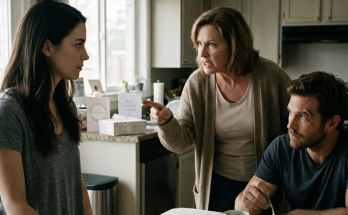
Richard stood in the doorway.
“We’re selling the house.”
“You’ll need to leave today.”
I blinked.
“What about my final week’s pay?”
“We’ll deal with that later.”
He never did.
His sister folded her arms.
“Dad’s gone.”
“We don’t need a nurse anymore.”
I quietly asked if I could spend one last minute in Mr. Whitmore’s room.
“No.”
“You’ve already said goodbye.”
As I carried my suitcase to the front door, Richard spoke one final sentence.
“You were just the help.”
“Don’t come back.”
The words hurt far more than the unpaid salary.
For ten years, I’d treated that house like my own home.
Apparently, to them…
I had never belonged there at all.
…
Five days later, my phone rang.
Richard.
I considered ignoring it.
Instead, I answered.
His voice shook.
“Please…”
“You have to come back.”
“What happened?”
“Just…”
“Please.”
“We need you.”
Against my better judgment, I drove to the house.
When I arrived, Richard met me outside.
He looked exhausted.
Without saying a word, he led me upstairs to Mr. Whitmore’s bedroom.
The bed had been pulled away from the wall.
The rug was folded back.
“Look.”
He pointed underneath the bed.
There, pushed deep beneath the wooden frame, was a small iron box coated in years of dust.
“I’ve never seen that before,” he whispered.
Neither had I.
Together we slid it into the open.
It was locked.
Richard handed me a small brass key.
“We found this taped beneath one of Dad’s dresser drawers.”
The lock clicked open.
Inside were dozens of neatly labeled envelopes.
Old photographs.
A leather journal.
And another sealed envelope.
Across the front, in Mr. Whitmore’s handwriting, were the words:
Open Only If Martha Is Present.
Martha.
Me.
Richard looked stunned.
“I didn’t even know Dad knew your last name.”
I carefully opened the envelope.
Inside was a handwritten letter.
“If you’re reading this, then I’ve finally gone where Eleanor has been waiting for me.”
“If my children have remembered what matters, they’ll already know why Martha is standing beside them.”
“If they forgot…”
“This letter will remind them.”
Richard swallowed.
I continued reading aloud.
“For ten years, Martha has cared for me with kindness, patience, and dignity.”
“She has missed birthdays with her own family to spend holidays with me.”
“She has sat beside hospital beds no child should have left their father to face alone.”
“She has earned every penny of her wages—and much more than money can repay.”
Richard lowered his head.
The letter continued.
“My attorney has a signed agreement providing Martha with a completion bonus for remaining in my care until my death, together with all earned but unpaid wages.”
“Those payments are to be made by my estate before any distributions to my beneficiaries.”
I stopped reading.
Richard looked horrified.
“I… I never knew.”
There was one final paragraph.
“More importantly, if my children have failed to treat Martha with respect, I ask them to remember that kindness shown to those who care for the vulnerable says more about a family than any inheritance ever could.”
No one spoke.
…
The next morning, Richard contacted the estate attorney.
The attorney confirmed that Mr. Whitmore had indeed signed an employment agreement years earlier.
It included payment of any earned wages, along with a completion bonus that became payable if I remained his caregiver until the end of his life.
The agreement had been properly executed and was already part of the estate records.
The attorney also reminded the family that estate debts and contractual obligations were required to be handled before the remaining assets could be distributed to the beneficiaries.
Richard looked embarrassed.
“I should’ve called the attorney before making assumptions.”
“Yes,” I answered quietly.
“You should have.”
…
A week later, Richard visited my apartment.
He handed me a cashier’s check covering my unpaid wages and the completion bonus required under the agreement.
Then he handed me something else.
Mr. Whitmore’s favorite pocket watch.
“I know it’s not mentioned in the agreement,” Richard said.
“But Dad always said he wanted you to have it someday.”
“I can’t accept that unless the estate and all beneficiaries agree.”
“We all do.”
His brother and sister had signed a written acknowledgment approving the gift.
Only then did I accept it.
Not because it was valuable.
Because every evening at exactly eight o’clock, Mr. Whitmore had opened that watch, smiled at the old photograph of his late wife tucked inside the cover, and said,
“Time goes too fast.”
Now it rested in my hand.
Still ticking.
…
Several months later, Richard invited me to lunch.
“I’ve been reading Dad’s journal,” he admitted.
“What did you learn?”
He smiled sadly.
“That he wasn’t lonely because he lacked children.”
“He was lonely because we stopped showing up.”
He looked down at his coffee.
“You did.”
I didn’t know what to say.
Some truths don’t need a response.
…
Every year on the anniversary of Mr. Whitmore’s passing, I visit his grave with fresh white lilies.
Sometimes Richard joins me.
Sometimes he comes alone.
Before leaving, we always wind the old pocket watch together.
Its quiet ticking reminds me of the lesson Mr. Whitmore left behind.
People often measure a life by the size of an inheritance.
He measured it differently.
By loyalty.
By compassion.
By the people who stayed when staying was difficult.
His children thought I was “just the help.”
He knew better.
And in the end, the greatest thing hidden beneath his bed wasn’t an old iron box.
It was the final chance he quietly left behind for his family to become the people he had always hoped they would be.