The day my mother died, I didn’t think anything else could possibly break my heart.
I was wrong.
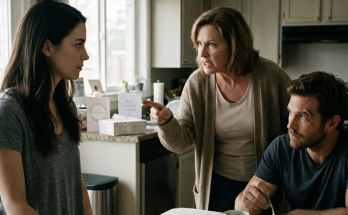
Three days after the funeral, my stepfather, Thomas, asked me to sit down in the living room.
The lawyer had already explained everything.
The house belonged to Thomas because he and my mother had owned it jointly.
Her retirement account had been drained by years of chemotherapy.
The small savings she once had had gone toward treatments insurance wouldn’t cover.
There was no hidden fortune.
No secret inheritance.
No forgotten trust fund.
I accepted that.
Money wasn’t why I’d stayed by her bedside for eleven months.
I would’ve done it all again for one more hour with her.
Thomas folded his hands.
“I think it’s time you found your own place.”
I stared at him.
“What?”
“This house is mine now.”
His son, Derek, leaned against the doorway.
He’d never particularly liked me.
Now he didn’t bother pretending.
He shrugged.
“She never loved you.”
“You were never real family.”
Those words hurt far more than losing the house.
I looked around the room.
The Christmas tree corner where Mom always placed handmade ornaments.
The piano she’d insisted I learn, even though I never became very good.
The faded pencil marks on the kitchen doorway where she’d measured my height every birthday.
Every memory suddenly felt like it belonged to someone else.
I packed quietly.
Three boxes.
One suitcase.
A framed photograph of Mom and me at the beach when I was twelve.
Her favorite blue recipe binder.
The knitted blanket she’d made while recovering from her second surgery.
I left without saying goodbye.
Because there was no one left who wanted to hear it.
…
My apartment was small.
One bedroom.
Second floor.
The radiator hissed all night long.
Still…
It was peaceful.
One evening I found one of Mom’s old aprons tucked into a box.
Inside its pocket was a tiny grocery receipt.
On the back she’d written,
“Emily likes extra cinnamon.”
I laughed.
Then cried.
Sometimes grief arrives disguised as handwriting.
…
Eight days later, my phone rang.
Thomas.
His voice was almost unrecognizable.
“Emily…”
“You have to come back.”
“What happened?”
“Please.”
“I’ve made a terrible mistake.”
I thought he’d had a heart attack.
Or Derek had been injured.
Instead…
When I opened the front door, Thomas was standing exactly where he’d told me to leave.
His eyes were swollen.
He held a sealed envelope with both hands as though he were afraid to drop it.
Across the front, in my mother’s careful handwriting, were the words:
For Thomas and Emily—Read Together.
“Where did you find it?” I asked.
He pointed toward the hallway.
“The old grandfather clock.”
“I was moving it.”
“It caught on something.”
Hidden inside the back panel had been a narrow wooden compartment none of us had ever noticed.
The envelope rested inside.
Nothing else.
Thomas handed it to me.
“You should open it.”
My hands trembled.
I carefully broke the seal.
The first sentence stole every breath from the room.
“Thomas, if Emily isn’t standing beside you while you read this… then you’ve broken the promise that mattered most to me.”
Thomas covered his face.
“Oh God.”
“I did.”
…
The letter continued.
“Before my final surgery, you sat beside my hospital bed and promised me one thing.”
“You promised Emily would never lose her home because she had already lost enough.”
“If she’s gone, stop reading.”
“Bring her back first.”
Thomas whispered,
“I remember.”
“I promised.”
“I don’t know why I…”
His voice collapsed into tears.
“I was terrified.”
“Terrified of what?” I asked quietly.
He looked around the empty house.
“Being alone.”
“I convinced myself pushing everyone away would somehow hurt less.”
“It didn’t.”
“It only made the house emptier.”
…
Page two was addressed to Derek.
He’d quietly walked into the room while we were reading.
His face had lost every trace of arrogance.
“Derek…”
“You once asked me if I loved Emily more because she was my daughter.”
“The answer was no.”
“I loved you differently.”
“Love isn’t divided.”
“It’s multiplied.”
Derek lowered his head.
“If you’ve ever made Emily feel like she wasn’t your sister…”
“Then you’ve misunderstood everything I spent twenty years trying to teach you.”
He whispered,
“I’m sorry.”
No one answered.
Not because we rejected his apology.
Because none of us were ready yet.
…
Then I reached the final page.
Taped to it was a folded sheet titled:
Christmas Instructions.
I frowned.
Thomas looked confused.
I unfolded it.
“Every Christmas after I’m gone…”
“Emily makes the cinnamon rolls.”
“Thomas burns the turkey exactly the way he always does.”
Thomas laughed through tears.
“I only burned it twice.”
I smiled for the first time in days.
The letter continued.
“Derek pretends he doesn’t like decorating cookies.”
“Then secretly eats more frosting than everyone else.”
He wiped his eyes.
“I can’t believe she wrote that.”
“No one is ever to celebrate Christmas in separate houses.”
“Not while there’s still one table big enough for everyone.”
Then came the final paragraph.
“The greatest fear I carry isn’t dying.”
“It’s that grief will convince the people I love to stop being a family.”
“Don’t let that happen.”
“Promise me.”
…
For several minutes no one moved.
Finally Thomas reached into his pocket.
He removed the house key I’d left on the counter when I moved out.
“I kept this.”
He placed it in my hand.
“This house is legally mine.”
“But if you’ll allow it…”
“I’d like it to be your home too.”
I looked at the key.
Then back at him.
“I’m not moving back today.”
“I understand.”
“But I need to know something.”
“What?”
“If you ever decide you want to come home…”
“You’ll never again wonder whether the door is open.”
…
Over the following months, we slowly rebuilt what grief had almost destroyed.
Not with dramatic speeches.
With ordinary moments.
Coffee on Saturday mornings.
Trips to the grocery store.
Repairing the old garden fence together.
Derek apologized more than once.
Not because I demanded it.
Because he meant it.
One afternoon he admitted something.
“I wasn’t jealous of you.”
“What then?”
“I was jealous of how easy loving you seemed for her.”
I shook my head.
“It wasn’t easier.”
“She just never stopped choosing both of us.”
He smiled sadly.
“I finally understand that.”
…
The following Christmas, fourteen chairs surrounded the dining table.
Just like always.
Only one remained empty.
Mom’s.
Before dinner, Thomas stood.
Instead of saying grace, he unfolded the letter one final time.
He read the last paragraph aloud.
No one could finish dessert without crying.
After everyone left, I noticed something.
The sealed envelope wasn’t back in the clock.
It rested inside the china cabinet beside the family photo albums.
Where everyone could find it if they ever forgot again.
Years later, people sometimes ask whether my mother left me an inheritance.
I always smile.
She did.
It wasn’t money.
It wasn’t the house.
It wasn’t jewelry.
She left me something far more valuable.
One final letter strong enough to remind a grieving family that love isn’t measured by whose name appears on a deed.
It’s measured by who still has a place at the table when the hardest days are over.
And because of that letter…
I never truly lost my home after all.