The last conversation I ever had with my father lasted less than a minute.
He was lying in a hospital bed, too weak to say much.
He squeezed my hand.
Looked me in the eye.
And whispered,
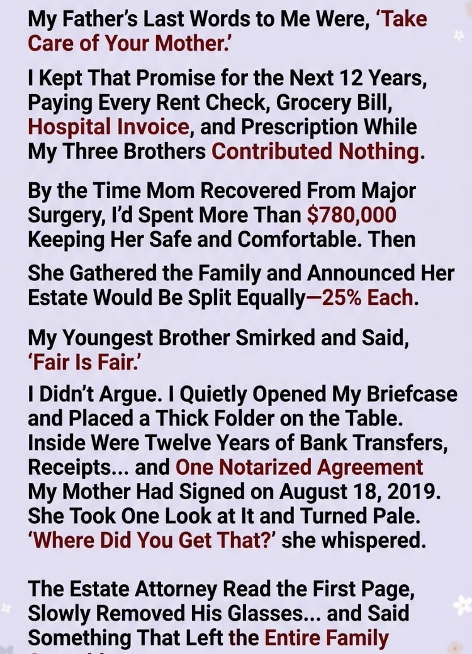
“Take care of your mother.”
Those were the last words he ever spoke to me.
I promised him I would.
At the time, I thought that meant checking in on her.
Driving her to appointments.
Helping around the house.
I had no idea that promise would shape the next twelve years of my life.
…
My mother struggled after Dad passed away.
The mortgage was nearly paid off, but her retirement income wasn’t enough to cover everything.
Then came diabetes.
A hip replacement.
Heart problems.
Eventually, major abdominal surgery.
Without ever making a formal announcement, I became the one everyone called.
Every month, I paid the rent after she downsized to an accessible apartment.
I covered her groceries.
Her insurance deductibles.
Medical equipment.
Prescription medications.
Home-health aides after surgery.
Transportation.
Repairs.
Anything she needed.
Whenever one of my three brothers said,
“You’ve got it covered, right?”
The answer was always yes.
Not because I was wealthy.
Because I had made a promise.
My wife and I postponed vacations.
We delayed remodeling our home.
We skipped buying a newer car.
Sometimes we quietly adjusted our own budget so Mom would never have to worry about hers.
Over twelve years, I kept meticulous records.
Not because I expected repayment.
Because my accountant insisted every large transfer be documented.
By the time Mom fully recovered from her last surgery, those records showed I had spent just over $780,000 for her care and support.
I never mentioned the number.
Not once.
…
A few months later, Mom invited the family to dinner.
“I’ve finalized my estate plan,” she announced.
“I want everyone here.”
Around the table sat my three brothers, their spouses, the estate attorney, and me.
Mom smiled warmly.
“I’ve decided everything will be divided equally.”
“Twenty-five percent each.”
My youngest brother leaned back in his chair.
“Fair is fair.”
The others nodded.
No one looked at me.
I didn’t interrupt.
I didn’t argue.
Instead, I quietly opened my briefcase.
Inside was a thick folder.
I placed it on the table.
The attorney looked curious.
“What is this?”
“Twelve years of financial records.”
Bank transfers.
Canceled checks.
Receipts.
Hospital invoices.
Insurance payments.
Pharmacy statements.
Everything carefully organized by year.
My brothers stared in silence.
Then I removed one final document.
A notarized agreement dated August 18, 2019.
My mother’s eyes widened the instant she saw it.
The color drained from her face.
“Where did you get that?” she whispered.
“I’ve kept it exactly where you asked me to.”
The attorney accepted the document.
He adjusted his glasses.
Read the first page.
Then stopped.
He slowly removed his glasses.
Looked around the room.
And said quietly,
“I think everyone needs to understand what this document actually is.”
No one breathed.
…
He began reading aloud.
“I, Margaret Collins, acknowledge that my son, Daniel Collins, has voluntarily provided substantial financial support for my housing, medical care, and living expenses.”
He continued.
“Although these payments are gifts motivated by love, if my estate is financially able to do so after all lawful debts, taxes, and expenses are paid, I direct my personal representative to consider reimbursing documented support expenses from the residue of my estate before dividing the remaining assets among my beneficiaries.”
The room fell silent.
The attorney looked up.
“This is not a loan agreement.”
“It is not an automatic debt.”
“But it is a signed expression of Mrs. Collins’ intentions that should be considered together with the rest of her estate planning documents and applicable law.”
My youngest brother frowned.
“So he gets everything?”
The attorney shook his head.
“No.”
“That’s not what it says.”
“It means this document must be reviewed with the complete estate plan.”
He turned to my mother.
“Mrs. Collins…”
“Do you remember signing this?”
She closed her eyes.
“Yes.”
…
Tears rolled down her cheeks.
“It was after my second surgery.”
She looked at me.
“I found out how much you and Sarah had been spending.”
“I was horrified.”
“You never wanted me to know.”
“I didn’t.”
“I was afraid you’d stop helping.”
She nodded.
“I asked my attorney how I could make things right.”
The attorney continued reading.
Attached to the agreement was a handwritten letter.
“Daniel has repeatedly refused repayment while I am alive.”
“If he continues to refuse after my death, I ask that the reimbursement be declined and the estate instead follow my next instruction.”
Everyone looked confused.
“There was another instruction?” my oldest brother asked.
The attorney turned the page.
“There was.”
…
He smiled faintly.
“If Daniel refuses reimbursement…”
“The amount that would have been reimbursed shall instead establish the Harold and Margaret Collins Family Education Fund for future grandchildren and great-grandchildren pursuing college, trade school, apprenticeships, or other career training.”
Mom covered her mouth.
“I’d forgotten I’d included that.”
My youngest brother blinked.
“So…”
“He wasn’t trying to take our inheritance?”
I quietly answered,
“No.”
“I never asked Mom for a dollar.”
“I brought the folder because I didn’t want today’s conversation to begin with the assumption that all of us had carried the same responsibilities.”
…
The attorney nodded.
“The records don’t create blame.”
“They create context.”
He looked around the table.
“An equal inheritance and equal contribution during life are not always the same thing.”
No one argued.
Because no one could.
The receipts spoke for themselves.
The canceled checks.
The pharmacy invoices.
The hospital bills.
Every sacrifice had been recorded without a single complaint.
My oldest brother finally whispered,
“I didn’t know.”
“You never asked,” I replied.
He lowered his head.
“You’re right.”
“I didn’t.”
…
A month later, my mother amended her estate plan.
Not out of anger.
Not to punish anyone.
After long discussions with her attorney and with all four of us present, she chose a plan that reflected both her values and the realities of what had happened.
She also insisted on something else.
Beginning immediately, each of my brothers would share responsibility for her appointments, shopping, and weekly visits.
“No more excuses,” she said.
“I have four sons.”
“I’d like to enjoy all of them.”
To my surprise, they agreed.
Not perfectly.
Not overnight.
But consistently.
For the first time in years, I wasn’t carrying the entire burden alone.
…
My mother lived another seven happy years.
When she finally passed away peacefully at ninety-one, none of us argued over her estate.
The attorney carried out her final instructions exactly as written.
The family education fund was created in my parents’ names.
Today, it has helped pay tuition, apprenticeships, certification courses, and books for several grandchildren and great-grandchildren.
At every family reunion, someone eventually asks about the framed copy of my father’s photograph that hangs beside the scholarship plaque.
Beneath it are the words he spoke on the last day of his life:
“Take care of your mother.”
People often assume I kept that promise alone.
The truth is, by the end of her life, all four of her sons finally learned how.
And that—not the money—became the greatest inheritance my parents ever left us.