When I landed in Singapore for what was supposed to be the biggest business meeting of my career, the last thing I expected was to lose my home.
I was seven thousand miles from home.
Jet-lagged.
Running on coffee.
Focused on closing a partnership my company had spent nearly a year negotiating.
Just before walking into the conference room, my phone buzzed.
From: Mom
I smiled.
I assumed it was another message reminding me to eat something besides airport food.
Instead, I read words that made my stomach drop.
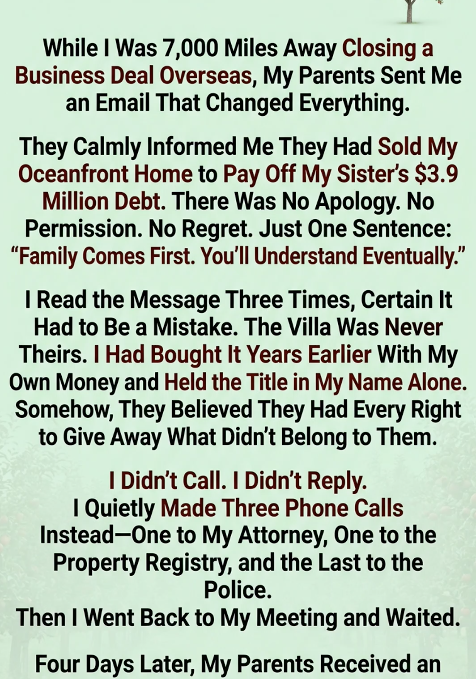
“Your father and I have sold the beach villa.”
“Your sister’s financial problems became too serious to ignore.”
“The proceeds paid off her debts.”
“Family comes first.”
“You’ll understand eventually.”
I stared at the screen.
Then read it again.
And again.
The words never changed.
The villa wasn’t theirs.
It never had been.
I bought it eleven years earlier after selling my first company.
Every mortgage payment had come from my account.
Every tax bill.
Every renovation.
Every insurance payment.
The title had always been registered solely in my name.
My parents had only been allowed to stay there while I traveled for work.
I trusted them.
Apparently, they confused trust with ownership.
My assistant noticed my expression.
“Everything okay?”
I locked my phone.
“Not exactly.”
“Should we postpone the meeting?”
I looked through the glass wall at investors who had flown halfway around the world.
“No.”
“There’s nothing I can do in the next two hours.”
So I walked into the boardroom.
Made the presentation.
Answered every question.
Signed the agreement.
Only after the meeting ended did I allow myself to think about home.
I didn’t call my parents.
I didn’t send an angry email.
I didn’t argue.
Instead, I made three phone calls.
The first was to my attorney.
The second was to the local property registry.
The third was to the police non-emergency line to report that I believed there had been an unauthorized transfer or attempted sale involving my property.
Then I booked the first flight home.
During the flight, my attorney called.
“I’ve reviewed the records.”
“And?”
“The title hasn’t changed.”
I frowned.
“What do you mean?”
“The registry still lists you as the sole owner.”
“So how did they sell it?”
“They appear to have signed documents claiming authority to act on your behalf.”
“I never gave anyone power of attorney.”
“I know.”
There was a long pause.
“That’s why investigators are interested.”
By the time I landed, four days had passed.
My parents hadn’t heard from me once.
Apparently, they interpreted my silence as acceptance.
They were wrong.
Later that afternoon, my attorney called again.
“They’ve arrived.”
“Who?”
“The detectives.”
I wasn’t there.
But according to the reports later shared with me, two investigators and a representative from the land records office knocked on my parents’ front door.
My father answered confidently.
“Can I help you?”
One investigator introduced himself.
“We’re here regarding the attempted transfer of a property located on Seaview Point.”
My father’s smile disappeared.
Inside, the investigators asked straightforward questions.
“Did you sign documents relating to the property?”
“Yes.”
“Did you own the property?”
“It belongs to the family.”
“That’s not what we asked.”
“It belonged to our son.”
“So you understood it was legally registered in his name?”
My father hesitated.
“We’re his parents.”
The investigator nodded politely.
“I understand.”
“Did he authorize you in writing to sell it?”
Silence.
“No.”
My mother tried to explain.
“Our daughter needed help.”
“We assumed he’d understand.”
The investigator replied calmly,
“Whether he understands isn’t the legal issue.”
Fortunately, the buyer’s attorney had insisted on verifying the chain of title before completing the transaction.
When inconsistencies appeared, the sale funds had been placed in escrow pending clarification.
The transaction had never legally closed.
No ownership changed hands.
No buyer received title.
The legal review had prevented a far more complicated situation.
Two days later, I met my parents in my attorney’s office.
My sister sat beside them.
No one smiled.
My father spoke first.
“You called the police.”
“I reported what happened.”
“You embarrassed this family.”
I looked at him quietly.
“You tried to sell property that wasn’t yours.”
“It was for your sister.”
“It was still my home.”
My sister finally spoke.
“I didn’t ask them to do it.”
I believed her.
The financial records showed she knew they were trying to help, but there was no evidence she had participated in the property paperwork.
She looked exhausted.
“I didn’t even know they’d gone that far.”
I turned to my parents.
“You could have called me.”
My mother whispered,
“We were afraid you’d say no.”
“I might have.”
“But that decision belonged to me.”
The room fell silent.
For the first time, my father looked genuinely shaken.
“I thought…”
“…because we’re family…”
“…it wasn’t really different.”
“It is different,” I answered.
“Love doesn’t create ownership.”
“Trust isn’t permission.”
The buyer eventually recovered the escrowed funds, and the failed sale was unwound.
My attorney handled the remaining legal issues.
I also changed the locks, updated access permissions, and ensured no one could represent themselves as acting for me without proper legal authority.
Months later, my sister came to see me alone.
She handed me a folder.
“I’ve started paying off my debts myself.”
Inside were repayment plans, employment contracts, and a realistic budget.
“I’m done expecting other people to rescue me.”
I smiled.
“I’m proud of you.”
She looked down.
“I wish Mom and Dad had trusted me enough to let me solve my own problems.”
“So do I.”
My relationship with my parents never returned to what it had been.
We still spoke.
We still met on holidays.
But trust, once broken, takes far longer to rebuild than a house ever could.
One evening, my father stood with me on the villa’s balcony watching the waves roll in.
“I kept telling myself I was protecting the family,” he said quietly.
I answered without anger.
“You were.”
He looked surprised.
“I just think you forgot that I was part of it too.”
He didn’t respond.
He simply watched the ocean for a long time.
Looking back, people often assume this story is about property.
It isn’t.
Houses can be rebuilt.
Money can be earned again.
The hardest thing to recover is the belief that the people you trusted most would never make life-changing decisions on your behalf without even asking.
The email my parents sent ended with one sentence:
“Family comes first.”
Years later, I finally understood what those words should have meant.
In a healthy family, putting family first begins with respecting one another—not taking what belongs to someone else, even when you believe your reasons are noble.