By the time I pulled into the driveway, it was 10:34 p.m.
I’d just finished a fifteen-hour shift as an emergency department nurse.
Two trauma cases.
One cardiac arrest.
A frightened little boy with a broken arm who reminded me why I loved my job.
All I wanted was a shower, clean clothes, and six uninterrupted hours of sleep.
Instead…
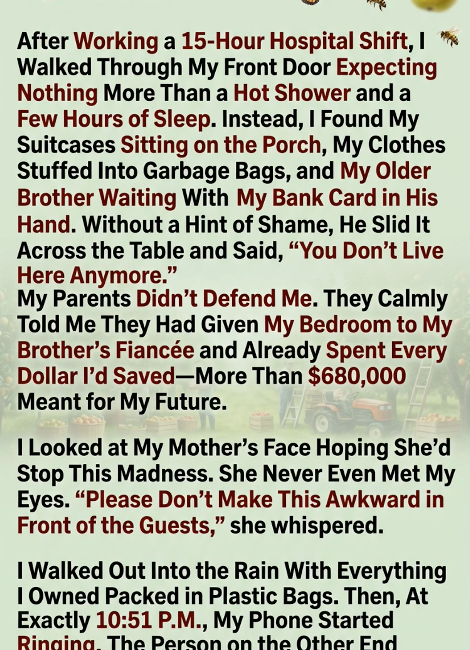
My suitcases were sitting on the front porch.
My clothes had been shoved into black garbage bags.
For one strange second, I thought we’d been robbed.
Then the front door opened.
My older brother, Kyle, stepped outside carrying my bank card.
He held it between two fingers as though he were returning a library book.
“You don’t live here anymore.”
I laughed.
Not because it was funny.
Because my exhausted brain refused to believe what I was hearing.
“What?”
He tossed the card onto one of the suitcases.
“You heard me.”
I walked inside.
My parents sat in the dining room.
The table was covered with flowers, desserts, and folded napkins.
Several relatives were already there.
Kyle’s fiancée stood beside them looking uncomfortable.
“My room…” I whispered.
My mother finally spoke.
“We’ve given it to Kyle and Emily.”
I stared at her.
“I’m thirty-two.”
“I’ve lived here while working and saving because we all agreed I was helping with the house.”
No one answered.
Then my father calmly said,
“You’re doing well.”
“You can start over.”
My heart began pounding.
“My savings.”
“Where are they?”
Silence.
For years, I’d deposited part of every paycheck into a joint account my parents managed.
It had started when I was working seventy-hour weeks during nursing school.
Later, I left it that way because I trusted them.
The account was meant for a future home.
Maybe graduate school.
Maybe opening a community clinic someday.
More than $680,000 had accumulated through savings, investments, overtime, and an inheritance from my late grandmother.
My father folded his hands.
“We used it.”
I felt the room tilt.
“What do you mean… used it?”
“Kyle needed help.”
Emily burst into tears.
“I told them not to do this.”
Kyle interrupted.
“It stayed in the family.”
I looked at my mother.
Surely she would stop this.
Surely this was some terrible misunderstanding.
She couldn’t even meet my eyes.
Instead, she whispered,
“Please…”
“Don’t make this awkward in front of the guests.”
Something inside me broke.
Not loudly.
Quietly.
The way trust breaks.
I picked up the garbage bags.
Walked through the front door.
It had begun raining.
No one followed.
No one called my name.
At 10:51 p.m., my phone rang.
Unknown number.
For a moment, I considered ignoring it.
Instead, I answered.
“Hello?”
A calm woman’s voice spoke.
“Is this Olivia Grant?”
“Yes.”
“My name is Rebecca Lawson.”
“I’m the attorney handling your grandmother Eleanor’s estate.”
I stopped walking.
“My grandmother’s estate was settled years ago.”
“Not completely.”
Rebecca explained that my grandmother had created two separate estate plans.
The first covered her obvious assets.
The second involved a trust that would become irrevocable only after specific conditions were met.
One of those conditions was that I reach the age of thirty-two.
Another was that the trustee become aware of any attempt by another person to improperly access or misappropriate funds intended solely for me.
My grandmother had chosen an independent trustee rather than a family member.
“I received information this afternoon,” the attorney said.
“I believe we need to meet tomorrow morning.”
The next day, I sat in a conference room across from Rebecca.
She placed several folders on the table.
“The money in the joint account was legally complicated because of how ownership had been structured.”
My stomach sank.
“Does that mean it’s gone?”
She shook her head.
“No.”
“Your grandmother anticipated that possibility.”
Rebecca opened another file.
“She established a separate trust entirely outside that account.”
I stared at the figures.
My grandmother had quietly transferred substantial assets into the trust years earlier.
She had also written a letter.
“Olivia,”
“If you’re reading this, then someone has probably mistaken your kindness for permission.”
“You always believed family meant trusting people.”
“Trust is a beautiful gift—but it should never replace good records or independent advice.”
“I hope this trust gives you freedom, not revenge.”
“Build the life you dreamed about.”
“Leave bitterness behind.”
Rebecca continued.
“We’ve also reviewed the withdrawals from the joint account.”
“Depending on the facts and documentation, you may have civil claims regarding those funds.”
She didn’t promise an outcome.
She simply explained my options.
For the first time in twenty-four hours, I felt something besides shock.
I felt steady.
Over the following months, the dispute was resolved through the legal system.
Financial records were examined.
Everyone obtained independent legal advice.
Some funds were recovered through settlement.
Others were not.
The process was expensive, emotional, and far more complicated than anyone had expected.
The biggest lesson wasn’t about winning.
It was about understanding that even within families, financial arrangements should be transparent and properly documented.
Nearly two years later, I bought a modest home.
Not a mansion.
Not the biggest house on the street.
Just a place that was entirely mine.
The first thing I unpacked wasn’t expensive furniture.
It was one of the black garbage bags I’d kept.
Inside was the set of blue hospital scrubs I’d worn the night I was thrown out.
I folded them carefully and placed them in the back of my closet.
Not because I wanted to remember the betrayal.
But because I never wanted to forget the turning point.
People sometimes ask what changed my life.
They assume it was the inheritance.
Or the legal case.
Or the unexpected phone call.
They are all wrong.
The moment my life truly changed happened the instant I realized something simple:
Home isn’t the place that throws you out when you’re inconvenient.
Home is the place where your dignity is welcome, your work is respected, and your future isn’t treated as someone else’s property.
The call at 10:51 p.m. didn’t give me a new life.
It simply gave me the chance to build one on my own terms.