The happiest day of my life began with one empty row of chairs.
My husband’s family filled nearly every pew on the left side of the church.
Friends smiled.
My coworkers cheered.
My college roommates cried through the ceremony.
On the right side…
Eight chairs remained completely empty.
Reserved for my family.
My parents.
My younger brother.
My grandmother.
None of them came.
Not even a text message.
Not a phone call.
Not an apology.
Nothing.
It wasn’t as though we had been estranged.
For years, I’d been the dependable one.
When Dad lost his job, I paid three months of their mortgage.
When my brother failed two semesters of college, I covered his tuition so he wouldn’t be expelled.
When Mom needed surgery that insurance wouldn’t fully cover, I emptied most of my savings without hesitation.
I never kept score.
Because they were my family.
When I mailed our wedding invitations six months earlier, every RSVP came back “Yes.”
They even asked what meals would be served.
They discussed hotel options.
Mom insisted she’d help me into my wedding dress.
Then…
The wedding day arrived.
No one came.
During the reception, I checked my phone every few minutes.
No missed calls.
No emergency.
Nothing.
By midnight, I stopped looking.
My husband, Nathan, squeezed my hand.
“You don’t have to pretend this doesn’t hurt.”
I finally cried.
Not because my wedding was ruined.
Because I realized I wasn’t as important to my family as they had always been to me.
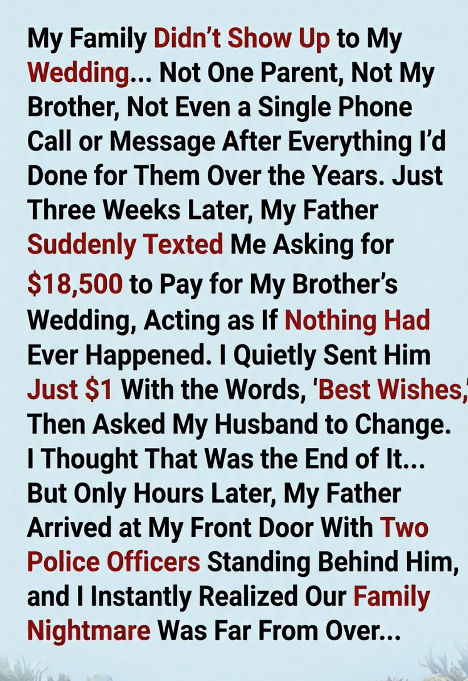
Three weeks passed.
Still nothing.
Then, on a quiet Tuesday afternoon, my phone buzzed.
It was my father.
For one hopeful second, I thought it was finally an apology.
Instead, the message read:
“Need $18,500 for your brother’s wedding. Send it today if possible.”
No greeting.
No congratulations.
No explanation for missing my wedding.
Just a request for money.
As though the previous three weeks had never happened.
I stared at the screen for several minutes.
Then I opened my banking app.
I transferred exactly $1.00.
In the note, I wrote:
“Best wishes.”
Then I blocked his number.
Nathan looked over my shoulder.
“Think they’ll understand the message?”
I shook my head.
“No.”
“But they’ll understand the boundary.”
That evening, we scheduled a locksmith to rekey every exterior lock.
Not because I expected trouble.
Because the house key I’d once given my parents years earlier had never been returned.
The next morning, around ten o’clock, someone pounded on our front door.
Not knocked.
Pounded.
Nathan looked through the peephole.
“Your father is here.”
I walked over.
Behind him stood two uniformed police officers.
For a brief moment, my heart raced.
Had something terrible happened?
I opened the door.
One officer spoke politely.
“Good morning, ma’am.”
“Your father requested that we accompany him during what he described as a family property dispute.”
I blinked.
“What property dispute?”
Dad pointed toward the house.
“My furniture.”
I stared at him.
“What furniture?”
“The dining table.”
“The washer.”
“The refrigerator.”
“You bought those with my money.”
I almost laughed from disbelief.
No.
I’d bought them myself after years of saving.
He simply assumed that because he’d once helped me move into an apartment a decade earlier, everything I owned somehow belonged to him.
The older officer remained calm.
“Sir, do you have receipts or documentation showing ownership?”
Dad hesitated.
“Well…”
“No.”
“But she’s my daughter.”
The officer nodded.
“I understand.”
“But that doesn’t establish ownership.”
He turned to me.
“Do you have purchase records?”
“I do.”
Nathan quietly brought out a folder.
When we’d purchased our home, we’d scanned every receipt, warranty, and invoice into one file.
Within minutes, the officer had everything he needed.
He handed the folder back.
“Ma’am, thank you.”
Then he faced my father.
“Sir, this is a civil disagreement at most.”
“There is no basis for us to remove property from this home.”
Dad’s face turned red.
“You’ve always been selfish!”
I looked at him quietly.
“No.”
“I’ve been generous.”
“Those aren’t the same thing.”
The officers exchanged a quick glance.
One of them gently suggested it was time for everyone to leave.
Dad stormed back to his car without another word.
Several days later, a letter arrived from my grandmother.
Unlike everyone else, she hadn’t known what had happened.
She lived in another state and had been recovering from surgery.
Inside the envelope was a handwritten note.
“Your parents told me you canceled the wedding.”
“When I found out the truth from your cousin, I cried for an hour.”
“I’m sorry I wasn’t there.”
She enclosed an old photograph of us baking cookies when I was six.
On the back she had written:
“Family isn’t defined by who shares your last name.”
“It’s defined by who shows up.”
Months later, one of my cousins finally explained why my parents hadn’t attended.
My brother’s wedding venue had become available on the same weekend after another couple canceled.
Rather than ask him to choose another date, my parents decided the entire family should attend his celebration planning events instead of mine.
No emergency.
No tragedy.
Just priorities.
Hearing that hurt.
But it also brought clarity.
A year later, Nathan and I celebrated our first anniversary with a backyard barbecue.
Our guest list was much smaller than our wedding.
Neighbors.
Close friends.
My grandmother.
My husband’s family.
People who had consistently shown up for us.
As the evening ended, Nathan raised his glass.
“To everyone here.”
“Thank you for proving that love is measured by presence, not obligation.”
Everyone smiled.
Including me.
Looking back, people often ask whether I regret sending my father only one dollar.
I don’t think the amount mattered.
It wasn’t about money.
It was about finally refusing to pretend that generosity should only flow in one direction.
For years, I believed keeping peace meant giving more of myself.
Eventually, I learned something different.
Healthy families don’t keep one person permanently responsible for everyone else’s needs.
They celebrate each other’s joys.
They share burdens.
They show up.
Sometimes the strongest family you ever build isn’t the one you were born into.
It’s the one you create with the people who choose to stand beside you—even when they don’t have to.