In the spring of 2024, I was convinced my children would be better off without me.
Those words are difficult to admit now.
But they were true.
My divorce had drained every ounce of confidence I had left.
My ex-husband insisted I was unstable.
Too emotional.
Too overwhelmed.
He said our children deserved “a real parent.”
After hearing those words often enough, I began believing them.
Our son was six.
Our daughter was nine.
I loved them more than anything.
Which was exactly why I thought maybe I should let them go.
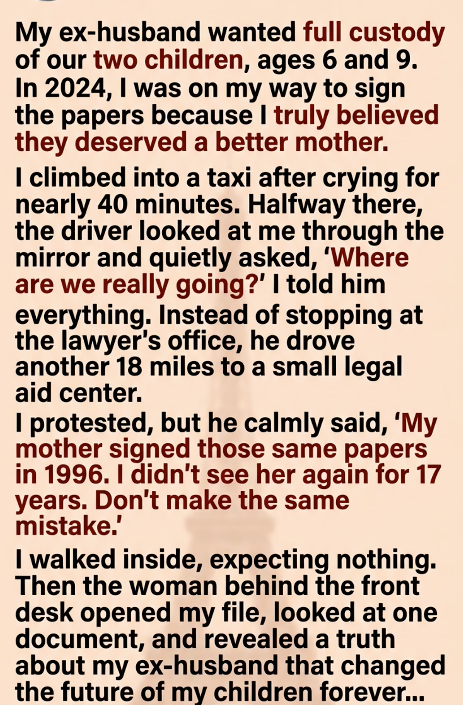
On the morning I was supposed to sign the custody agreement, I sat alone in my car outside my apartment and cried for nearly forty minutes.
I could barely see through the windshield.
Finally, I called a taxi because I didn’t trust myself to drive.
The agreement was already printed.
My attorney had warned me that signing it would be extremely difficult to undo.
At that moment, I didn’t care.
I simply wanted the fighting to end.
About halfway to the lawyer’s office, the driver looked at me in the rearview mirror.
“You’ve been crying since I picked you up.”
I apologized.
“I’m sorry.”
“I’ll be okay.”
He was quiet for a moment.
Then he asked,
“Where are we really going?”
Not where the GPS was taking us.
Where my heart was taking me.
Without meaning to, I told him everything.
The divorce.
The custody hearing.
The guilt.
The fear that my children deserved someone stronger.
When I finished, he didn’t speak for several seconds.
Then he turned off the main road.
“Excuse me,” I said.
“You’re going the wrong way.”
“No.”
“I’m taking you somewhere first.”
Eighteen miles later, we stopped outside a modest brick building.
The sign read:
Community Family Legal Aid Center.
“I can’t afford another lawyer,” I whispered.
He smiled gently.
“My mother signed those same papers in 1996.”
I looked at him.
“I didn’t see her again for seventeen years.”
His voice cracked.
“Don’t make the same decision because today feels impossible.”
I almost asked him to take me to my original destination.
Instead, something inside me said,
Walk in.
The receptionist welcomed me kindly.
I explained I didn’t have an appointment.
She asked for my paperwork.
I handed her the custody agreement.
She skimmed the documents.
Then stopped.
Her expression changed.
“Who prepared this?”
“My ex-husband’s attorney.”
“And your lawyer approved it?”
“I… I don’t know.”
She immediately stood.
“Please wait here.”
A staff attorney joined us a few minutes later.
He carefully reviewed every page.
Then looked directly at me.
“When was the last time you saw your own financial disclosure?”
“I don’t think I ever received one.”
He frowned.
“In our jurisdiction, both parties are generally required to exchange financial information before a court can fully evaluate issues such as child support and property division.”
He flipped to another page.
“Has anyone explained why this agreement gives your ex full decision-making authority while also limiting your contact with the children far beyond what is typical?”
I slowly shook my head.
“I thought…”
“…I thought this was standard.”
“It isn’t.”
The attorney asked one more question.
“Has your ex-husband ever been treated for substance abuse or arrested for violence?”
My heart skipped.
“There was one arrest years ago.”
“He told me it had been dismissed.”
The attorney made a note.
“We need to verify that before you sign anything.”
Over the next several weeks, the legal aid team helped me gather records I didn’t even know existed.
Employment documents.
Financial disclosures.
Court filings.
Medical records.
Everything was reviewed through the proper legal process.
Among those records was documentation showing that my ex-husband had failed to disclose important financial information during the proceedings.
The court also reviewed evidence concerning issues that had not been included in the original proposed agreement.
Those facts became part of the custody case.
Months later, after hearing evidence from both sides, the judge declined to approve the agreement I had almost signed.
Instead, the court ordered a full custody evaluation.
Independent professionals interviewed both parents, spoke with the children in an age-appropriate manner, and prepared recommendations based on their best interests.
The final parenting arrangement looked nothing like the document I had carried into that taxi.
The court concluded that the children benefited from having a meaningful relationship with both parents, subject to conditions the judge found appropriate based on the evidence presented.
After the hearing, I sat outside the courthouse thinking about the taxi driver.
I never even learned his last name.
I returned to the legal aid center hoping someone knew him.
The receptionist smiled.
“He brings people here sometimes.”
“He says he can’t give legal advice…”
“…but he can make sure they find someone who can.”
A year later, my daughter asked me a question while we were baking cookies.
“Mom?”
“Were you ever going to leave us?”
I set down the mixing bowl.
“I was afraid I wasn’t enough.”
She wrapped her arms around me.
“You didn’t leave.”
“No,” I whispered.
“I didn’t.”
Looking back, I realize I almost made a permanent decision on the worst day of my life.
Grief, exhaustion, and fear had convinced me there were no other options.
The taxi driver didn’t solve my problems.
He simply took me somewhere I could get qualified help before making an irreversible choice.
Sometimes the most important person you’ll ever meet isn’t the judge, the lawyer, or even the person who wins the case.
Sometimes it’s the stranger who quietly asks one simple question:
“Where are we really going?”