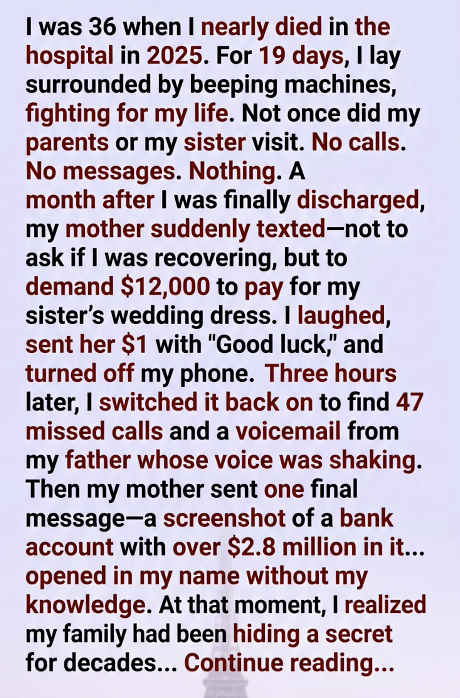
I was thirty-six when I nearly died.
In the spring of 2025, a sudden medical emergency landed me in intensive care.
For nineteen days, machines breathed beside me.
Doctors spoke quietly outside my room.
Nurses became the faces I saw more often than my own family.
Every morning, I looked toward the door hoping someone would walk in.
My parents never did.
My younger sister never did.
No flowers.
No text messages.
No phone calls.
Nothing.
The nurses eventually stopped asking whether I was expecting visitors.
They already knew the answer.
When I was finally discharged, recovery became my full-time job.
Walking across my apartment without resting felt like climbing a mountain.
Friends brought groceries.
Neighbors checked on me.
My family remained silent.
I finally accepted that they had chosen not to be part of my life.
As painful as it was, I decided to move forward.
A month later, my phone buzzed.
It was my mother.
For one hopeful second, I thought she was calling to ask how I was feeling.
Instead, the message read:
“Your sister found the perfect wedding dress.”
“We need $12,000 immediately.”
Not a single word about my health.
Not one question about whether I was recovering.
Just money.
I laughed.
Opened my banking app.
Sent exactly $1.
In the payment note I wrote:
“Good luck.”
Then I switched off my phone and went back to reading my book.
Three hours later, I turned it back on.
The screen exploded with notifications.
Forty-seven missed calls.
Dozens of messages.
One voicemail from my father.
His voice was shaking.
“Please call us.”
“It’s an emergency.”
Then another message arrived from my mother.
It wasn’t an apology.
It wasn’t an explanation.
It was a screenshot.
A bank account.
The balance read more than $2.8 million.
The account holder’s name…
…was mine.
My hands went numb.
I had never opened that account.
The next morning, I went directly to the bank.
The manager listened carefully before reviewing the documents.
Within minutes, she frowned.
“There appears to be a trust account associated with your name.”
“A trust?”
She nodded.
“It was established many years ago.”
“I’ve never heard of it.”
“That’s why we’re going to review everything carefully.”
She explained that I would need to verify my identity and obtain the legal trust documents before anyone could determine exactly what had happened.
Over the following week, with the help of an attorney, I received copies of the trust records.
The truth wasn’t what I expected.
When I was an infant, my late grandfather had created an educational and family trust for me after selling a successful business.
The trust named me as the primary beneficiary when I reached a specified age.
However, during my childhood, my parents had acted in certain administrative roles related to the trust.
The funds had grown substantially over the decades through investments managed by professional trustees.
The trust wasn’t “hidden” because someone had stolen it.
It had simply never been explained to me.
According to the attorney, I should have been notified years earlier under the trust’s terms.
For reasons that still weren’t entirely clear, that never happened.
I invited my parents to my lawyer’s office.
They arrived looking exhausted.
My father spoke first.
“We were going to tell you.”
“When?”
“When your sister got married.”
I stared at him.
“So you remembered the trust because you needed money.”
Silence.
Finally, my mother admitted the truth.
They had assumed I would use part of the trust to help pay for my sister’s wedding once I knew about it.
Instead of telling me honestly, they had tried to pressure me first.
I looked at both of them.
“Do you know what hurts the most?”
Neither answered.
“You didn’t visit me when I almost died.”
“You didn’t call.”
“You didn’t even ask if I survived.”
“But somehow you remembered me when there was money involved.”
Neither of them could meet my eyes.
Over the next several months, I worked with the trustees and my attorney to understand exactly how the trust operated.
Most of the money couldn’t simply be withdrawn overnight.
It was governed by legal terms my grandfather had carefully written decades earlier.
I chose to use part of the distributions to pay my remaining medical bills, purchase a modest home, and establish a scholarship in my grandfather’s name.
I didn’t spend lavishly.
Nearly dying had taught me that security mattered far more than luxury.
Months later, my father asked if we could meet for coffee.
He looked older than I remembered.
“I failed you,” he said quietly.
“When you were in the hospital…”
“I didn’t know how to face you.”
“So you stayed away.”
He nodded.
“It was the worst decision I’ve ever made.”
I accepted his apology.
But I also told him something I’d learned the hard way.
“An apology can begin healing.”
“It can’t erase absence.”
People often ask whether the trust changed my life.
It did.
Not because of the money.
Because it revealed something I’d spent years trying not to see.
The people who stood beside my hospital bed weren’t connected to me by blood.
They were connected by love.
And in the end, that was the inheritance that mattered most.
My grandfather left me financial security.
My illness taught me something even more valuable:
When your life hangs in the balance, you quickly discover who is investing in you—not just in what you own.