After seventeen years of marriage, I thought my husband and I agreed on one thing.
Major financial decisions were made together.
Apparently, I was the only one following that rule.
It started with a notification from my credit card company.
$8,940.
Then another.
$11,275.
Then another.
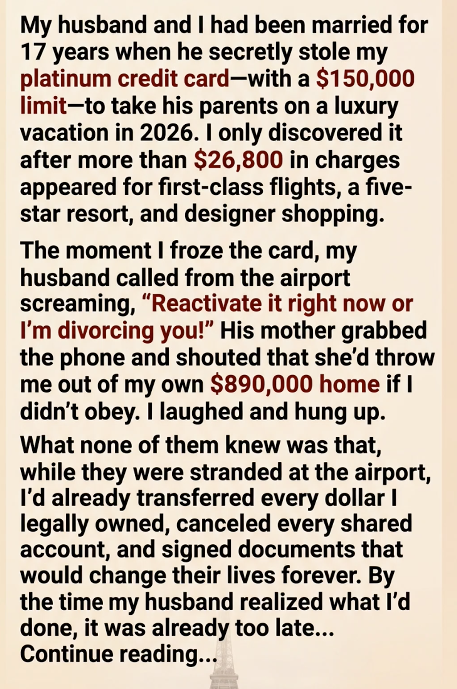
By lunchtime, more than $26,800 had been charged to my platinum credit card.
First-class airline tickets.
A five-star beachfront resort.
Luxury boutiques.
Airport lounge memberships.
I stared at the screen, convinced there had to be fraud.
There was.
Just not the kind I expected.
I called the credit card company immediately.
The representative confirmed the purchases had been made using my physical card.
“My physical card?”
“Yes.”
I reached into my purse.
The card was gone.
Then I remembered.
The night before, my husband had borrowed my wallet, claiming he needed to compare insurance cards for a rental car reservation.
He had never returned everything.
I called him.
He answered on the first ring.
Background announcements echoed through the airport.
“What did you buy?”
He laughed.
“It was supposed to be a surprise.”
“For who?”
“My parents.”
“They’ve always wanted a luxury vacation.”
“With my credit card?”
“It’s our money.”
“No,” I replied calmly.
“It’s a credit account in my name.”
When I told him I’d frozen the card, he exploded.
“Reactivate it right now or I’m divorcing you!”
Before I could answer, his mother grabbed the phone.
“If you don’t fix this immediately, I’ll make sure you’re the one leaving this family.”
Then she added something that made me laugh out loud.
“We’ll throw you out of your own $890,000 house.”
I quietly replied,
“The deed says otherwise.”
Then I hung up.
While they argued with airline staff about the declined transactions, I spent the afternoon doing something much less dramatic—but far more important.
I called my attorney.
Then my bank.
Then my financial adviser.
I asked exactly what steps I could legally take to protect my own accounts and document the unauthorized use of my credit card.
Every action I took was based on professional advice.
I changed passwords.
Canceled authorized-user access where applicable.
Opened a new personal checking account for my future income.
Documented every disputed charge.
Nothing more.
Nothing less.
That evening, my husband finally made it home.
The vacation had ended before it began.
He stormed through the front door.
“How could you embarrass my parents like that?”
I placed a folder on the kitchen table.
Inside were copies of the credit card statements, the fraud report, and a letter from my attorney.
“I didn’t embarrass them.”
“I refused to pay for a vacation I never agreed to.”
He insisted married couples shared everything.
My attorney later explained that marriage does not automatically give one spouse unlimited authority to incur personal charges on another spouse’s individual credit account without consent.
Exactly how those issues are resolved depends on the law and the specific facts.
The important thing was documenting everything and following the legal process.
Over the following months, we attended mediation.
The unauthorized spending became one of many issues discussed as part of the divorce.
Financial records were exchanged.
Assets were valued.
Debts were reviewed.
Nothing happened overnight.
Real legal proceedings rarely do.
One afternoon, my former mother-in-law called.
For the first time in years, she sounded quiet.
“I shouldn’t have spoken to you that way.”
“No,” I replied.
“You shouldn’t have.”
There wasn’t much else to say.
A year later, I was sitting on the back patio of the house.
The same house I had purchased before we were married.
The garden was peaceful.
My phone buzzed.
A friend asked whether I regretted freezing the credit card.
I smiled.
Not for a second.
Because the most expensive mistake in this story wasn’t the airline tickets.
It was my husband’s decision to confuse access with permission.
Looking back, I realized something important.
Standing up for yourself doesn’t always mean making dramatic speeches.
Sometimes it means making careful phone calls.
Keeping good records.
Getting qualified legal advice.
And calmly refusing to accept responsibility for choices you never made.
That afternoon at the airport, my husband thought the biggest problem was a declined credit card.
He didn’t realize the real problem had begun much earlier—the moment he decided that trust was something he could spend without asking.