When my grandfather’s will was read, no one expected an argument.
He had always believed in keeping things simple.
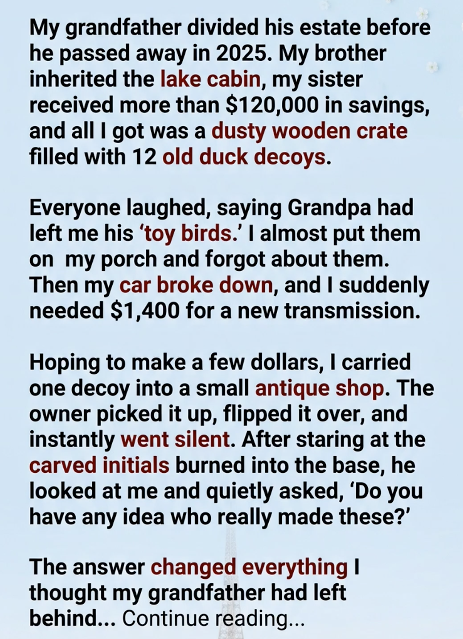
My older brother inherited the family lake cabin.
My sister received more than $120,000 in savings and investment accounts.
Then the attorney looked at me.
“And to my youngest grandchild…”
“…I leave the wooden crate in my workshop.”
That was it.
A wooden crate.
After the meeting, everyone gathered in Grandpa’s garage.
The crate was exactly where he’d always kept it.
Inside were twelve old wooden duck decoys.
The paint was chipped.
The wood was worn smooth from years of handling.
My brother laughed.
“Looks like Grandpa left you his toy birds.”
My sister smiled awkwardly.
“I’m sure they meant something to him.”
I shrugged.
“They’re fine.”
But I’d be lying if I said I wasn’t disappointed.
For weeks, the crate sat in my garage.
I thought about putting the decoys on the porch as decorations.
Then life intervened.
My car started making a terrible grinding noise.
The mechanic’s estimate wasn’t encouraging.
“You need a new transmission.”
The repair would cost about $1,400.
Money I didn’t have.
I remembered the decoys.
Maybe someone would pay twenty or thirty dollars for one.
Every little bit helped.
I carried a single decoy into a small antique shop downtown.
The owner, an older man named Frank, smiled politely.
“What have you got there?”
“Probably nothing special.”
“My grandfather left me a box of them.”
He picked one up.
Turned it over.
His expression changed instantly.
He became very quiet.
He reached for a magnifying glass.
Studied the underside.
Then looked at me.
“Do you know who made this?”
I shook my head.
“My grandfather?”
Frank smiled.
“No.”
“He owned it.”
“But he didn’t carve it.”
He pointed to a small set of burned initials on the base.
“These are important.”
He carefully explained that some early hand-carved duck decoys are highly collectible, particularly when they can be attributed to recognized makers.
He couldn’t identify it with certainty on the spot.
But he strongly suggested having it professionally evaluated before selling anything.
“Don’t clean it.”
“Don’t repaint it.”
“And don’t separate the collection.”
A week later, I met with a specialist.
She spent nearly two hours examining every decoy in the crate.
Some were ordinary.
Some were not.
Several appeared to have been carved by a well-known regional craftsman whose authentic works were sought after by collectors.
Because proper authentication requires careful examination, she recommended additional expert review before assigning any value.
I asked the question that had been bothering me.
“Why would Grandpa leave these to me?”
She smiled.
“I can’t answer that.”
“But collectors often keep groups like this together because the history matters almost as much as the objects.”
Back at Grandpa’s house, I searched his workshop one last time.
Hidden inside an old tackle box was a notebook.
The first page read:
“For whoever receives the birds.”
I sat down and began reading.
Grandpa wrote about every decoy.
Where he had found it.
Who had traded it to him.
Which hunting trip it reminded him of.
Some entries included sketches.
Others included stories about friends long gone.
One sentence caught my attention.
“Anyone can divide money.”
“It’s much harder to pass along a lifetime of memories.”
Near the end of the notebook, another envelope was tucked between the pages.
Inside was a short letter addressed to me.
“If you’re reading this, you were probably disappointed at first.”
I laughed despite myself.
He knew me well.
“Your brother needed a place for his family.”
“Your sister needed financial security.”
“You always loved learning how things were made.”
“I hope these birds send you on one more adventure.”
Months later, after the authentication process was complete, I sold one duplicate decoy through a reputable auction.
The proceeds covered my car repair with money left over.
The remaining decoys stayed together.
Not because they were valuable.
Because they had become part of my grandfather’s story.
I displayed them in a cabinet alongside his notebook.
Whenever visitors asked about the old wooden ducks, I didn’t begin by talking about money.
I told them about the quiet man who spent decades collecting pieces of history one at a time.
People still ask whether Grandpa treated us equally.
I think he did.
Just not in the way we expected.
My brother received a place to gather his family.
My sister received financial stability.
I received something different.
A reminder that the true value of an inheritance isn’t always obvious the day you receive it.
Sometimes it takes a broken transmission, a curious antique dealer, and one simple question—
“Do you know who really made these?”
—to realize that the greatest gifts often arrive covered in dust, carrying stories worth far more than anyone laughing in the lawyer’s office could ever imagine.