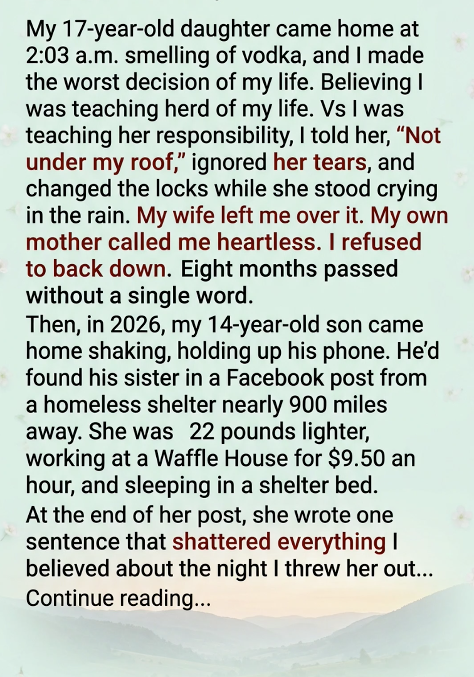
The clock said 2:03 a.m.
I remember because I kept staring at it afterward.
My seventeen-year-old daughter stumbled through the front door.
The smell hit me immediately.
Vodka.
Her eyes were red.
Her makeup was smeared.
She was crying before I even asked where she’d been.
I was furious.
“You’ve been drinking?”
She nodded.
“I’m sorry, Dad.”
Those four words should have made me stop.
They didn’t.
I thought I was teaching her responsibility.
I thought I was being the kind of father who didn’t tolerate dangerous behavior.
I pointed toward the door.
“Not under my roof.”
She froze.
“What?”
“You heard me.”
“Dad, please.”
“I said get out.”
She started crying harder.
“I have nowhere to go.”
“You should’ve thought about that before you came home drunk.”
My wife came downstairs.
“What are you doing?”
“Teaching her a lesson.”
My wife stared at me.
“She’s seventeen.”
“I don’t care.”
My daughter grabbed a jacket.
She stood on the porch crying.
“Dad, please don’t do this.”
I closed the door.
Then I changed the locks.
I still remember seeing her standing in the rain through the window.
Part of me wanted to open the door.
Another part kept saying:
Don’t give in.
You’re teaching her responsibility.
So I didn’t.
That decision destroyed my family.
My wife left me three days later.
She took our fourteen-year-old son with her.
She told me I had crossed a line that couldn’t be uncrossed.
My mother called me heartless.
I refused to listen.
I told everyone the same thing.
“She needs to learn.”
Months passed.
No calls.
No texts.
No birthday message.
Nothing.
I convinced myself that silence meant my daughter was finally becoming independent.
I was wrong.
Eight months later, my son came home one afternoon.
He was shaking.
He held his phone in both hands.
“Dad…”
“What happened?”
“Look.”
He showed me a Facebook post.
It was from a homeless shelter nearly 900 miles away.
There was a photograph of my daughter.
I barely recognized her.
She had lost 22 pounds.
Her hair was shorter.
Her face looked exhausted.
The post said she was working at a Waffle House for $9.50 an hour.
She was sleeping in a shelter bed.
My son started crying.
“That’s my sister.”
I couldn’t breathe.
I scrolled through the post.
Most of it was about resources and housing assistance.
Then I reached the final paragraph.
One sentence.
Just one.
It destroyed everything I’d been telling myself for eight months.
She had written:
“I don’t blame my dad for making me leave—I blame myself for coming home drunk, but I wish he’d asked why I was drinking before he changed the locks.”
I stared at the screen.
Read it again.
Then again.
Why?
I’d never asked.
I’d been so focused on punishment that I hadn’t asked the simplest question.
Why were you drinking?
Why were you crying?
Why did you come home at 2:03 in the morning?
Why were you afraid?
I had wanted to teach my daughter a lesson.
I never bothered to find out what lesson she was already living through.
My son looked at me.
“Are you going to get her?”
I didn’t hesitate.
“Yes.”
I grabbed my keys.
Then stopped.
“What if she doesn’t want me there?”
My son looked at me through his tears.
“Then go anyway.”
I drove nearly nine hundred miles.
The entire trip, I replayed that night.
Her face.
Her trembling hands.
The rain.
The sound of the door closing.
The lock turning.
Every mile made me hate that version of myself a little more.
When I finally arrived at the shelter, I didn’t know what to say.
My daughter walked into the lobby.
She saw me.
Stopped.
Neither of us moved.
Then she whispered,
“Why are you here?”
I swallowed.
“Because I should’ve come eight months ago.”
She looked away.
“I’m sorry.”
“No.”
I shook my head.
“Don’t apologize.”
“I came here to apologize to you.”
She started crying.
So did I.
“I was wrong,” I said.
“I thought I was teaching you responsibility.”
“I was really teaching you that you couldn’t come to me when you were hurting.”
She stared at the floor.
“I wanted you to ask why.”
“I know.”
“I just wanted Dad to ask why.”
That sentence broke me.
I didn’t promise that everything would magically become perfect.
I couldn’t undo eight months.
I couldn’t erase the nights she’d spent in shelters.
I couldn’t return the weight she’d lost.
But I promised her something I should have promised years earlier.
“If you ever come home scared, drunk, angry, confused, or broken…”
“You can still come home.”
“No punishment comes before making sure you’re safe.”
We spent the next several weeks working with counselors and social workers.
She got medical care.
She found stable housing.
We slowly rebuilt our relationship.
Not through speeches.
Through consistency.
Calls.
Meals.
Listening.
Showing up.
Months later, she came home for Thanksgiving.
She stood in the doorway holding a small overnight bag.
For one terrible second, I remembered that other night.
Then she smiled.
“Can I stay?”
I opened the door wider.
“You’re home.”
She hugged me.
And this time…
I didn’t close the door.
I’ve thought about that night countless times.
I used to believe the worst thing I’d done was let my daughter walk into the rain.
Now I understand the deeper mistake.
I chose punishment before understanding.
I chose pride before listening.
I thought being a good parent meant making sure my child feared the consequences of her choices.
I eventually learned something far more important:
A child can learn from consequences.
But first, they need to know they still have somewhere safe to go.
And sometimes the most important question a parent can ask isn’t,
“How could you do this?”
It’s simply:
“What happened to you?”