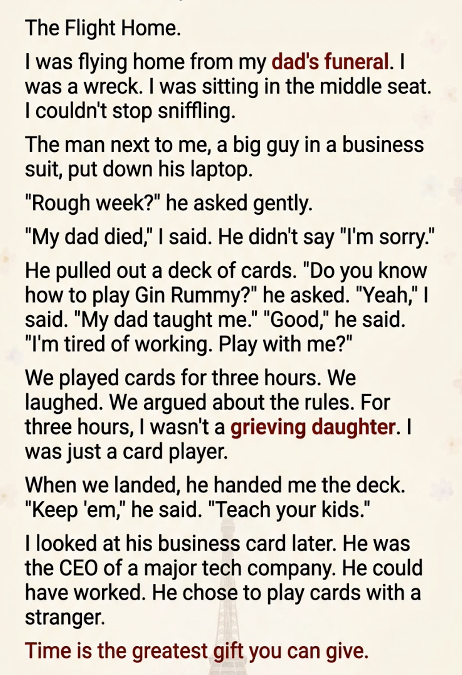
I was flying home from my father’s funeral.
I don’t remember much about the airport.
I don’t remember what I ate.
I don’t remember boarding the plane.
I only remember sitting in the middle seat, staring at nothing, trying not to cry.
My father was gone.
And I couldn’t stop sniffling.
The man sitting beside me was enormous.
He wore an expensive business suit and had a laptop open on the tray table.
For the first hour, he barely said a word.
Then he closed his laptop.
Turned toward me.
And asked gently,
“Rough week?”
I nodded.
“My dad died.”
I expected the usual response.
“I’m sorry.”
He didn’t say it.
Instead, he reached into his briefcase.
Pulled out a deck of playing cards.
Then he looked at me.
“Do you know how to play Gin Rummy?”
I almost laughed.
“Yeah.”
“My dad taught me.”
He smiled.
“Good.”
Then he shuffled the cards.
“I’m tired of working.”
He dealt me a hand.
“Play with me.”
So I did.
For the next three hours, we played Gin Rummy at 30,000 feet.
We argued about rules.
He accused me of cheating.
I accused him of making up rules.
He laughed.
I laughed.
At one point, I completely forgot that I was wearing my father’s old watch.
I forgot that I had spent the morning standing beside his coffin.
I forgot that my phone contained dozens of messages from relatives saying how sorry they were.
For three hours…
I wasn’t a grieving daughter.
I was just a card player trying to beat a stranger.
We talked between games.
He told me he’d been flying almost every week for years.
I told him about my father.
How Dad taught me Gin Rummy when I was little.
How he’d deliberately make terrible moves so I could win.
How he’d always pretend to be shocked when I beat him.
The stranger listened.
Really listened.
He didn’t try to give me advice.
He didn’t tell me that Dad was “in a better place.”
He simply played cards.
When the captain announced our descent, I suddenly felt sad again.
The three hours had gone too quickly.
We landed.
People stood up.
Opened overhead bins.
Reached for their luggage.
The man gathered his things.
Then he took the deck of cards and placed it in my hand.
“Keep them.”
I shook my head.
“I couldn’t.”
He smiled.
“Your dad taught you.”
“Now you teach your kids.”
I looked down at the cards.
Then back at him.
“Thank you.”
He nodded.
“You’re welcome.”
And that was it.
He disappeared into the crowd.
Later, while waiting for my luggage, I looked at his business card.
I nearly dropped it.
He was the CEO of a major technology company.
The kind of executive whose calendar was probably measured in minutes.
He had emails waiting.
Meetings scheduled.
People expecting answers.
He could have spent those three hours working.
Instead, he played cards with a stranger who was crying beside him on an airplane.
I never saw him again.
But I still have that deck.
Years later, when my children were old enough, I taught them Gin Rummy.
I told them about their grandfather.
How he taught me.
How he used to let me win.
And how, on the worst flight of my life, a complete stranger gave me something I didn’t know I needed.
Not money.
Not advice.
Not sympathy.
Time.
Three hours of his undivided attention.
Three hours when he could have been doing something “important.”
But he chose to sit beside a grieving stranger and play cards.
I’ve never forgotten that.
Because we spend our lives believing the greatest gifts are things we can buy, save, inherit, or give away.
They aren’t.
The greatest gift you can give another person is something you can never get back.
Your time.
And sometimes, giving someone three ordinary hours can become one of the most extraordinary memories they’ll carry for the rest of their life.