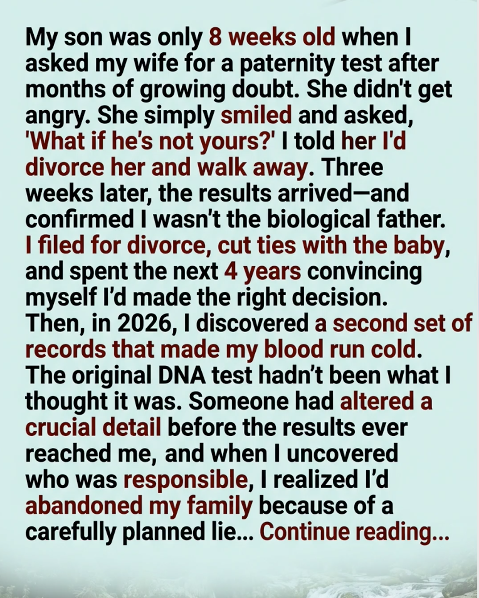
My son was only 8 weeks old when I asked my wife for a paternity test.
I hated myself for asking.
But for months, doubts had been growing in my mind.
I kept telling myself I was being paranoid.
Then one night, I finally asked.
My wife didn’t cry.
She didn’t get angry.
She simply looked at me and asked:
“What if he’s not yours?”
I stared at her.
“If he’s not mine, I’ll divorce you.”
She nodded slowly.
“And the baby?”
I swallowed.
“I’ll walk away.”
She didn’t argue.
She only said:
“Then get the test.”
Three weeks later, the results arrived.
I opened the envelope expecting the worst.
I was right.
The report said I was not the biological father.
I confronted my wife.
She cried.
But she didn’t give me the answer I wanted.
I filed for divorce.
I cut contact with the baby.
And for the next four years, I convinced myself I’d made the right decision.
I told myself DNA had given me the truth.
I told myself walking away had been painful…
but necessary.
Then, in 2026, I discovered something that made my blood run cold.
The original DNA test wasn’t what I thought it was.
It started with an email from the testing company.
It was an automated notice about archived records.
I almost deleted it.
Then I saw an old case number.
My case number.
Something about the wording bothered me.
So I called.
The representative put me on hold.
When she returned, her voice had changed.
“Sir, there’s an inconsistency in your file.”
“What kind?”
“The original report and the archived laboratory record don’t completely match.”
My stomach tightened.
“What does that mean?”
She hesitated.
“One of the identifiers appears to have been changed.”
I demanded a copy of the archived records.
When they arrived, I noticed something immediately.
The child’s sample had been assigned a laboratory identification number.
But the number on the final report was different.
One digit had been changed.
Just one.
I stared at the documents.
It looked like a clerical error.
Until I compared the dates.
The alteration had been made two days before my results were released.
Someone had changed the identification.
I called the testing company again.
“Who authorized the change?”
They wouldn’t initially tell me.
I hired an attorney.
The attorney requested the complete chain-of-custody records.
That was when we found something even more disturbing.
The original sample had never indicated that the child was unrelated to me.
The altered identifier had connected my report to a different sample.
A sample that belonged to another family.
I felt sick.
I asked the attorney:
“Can we prove who did it?”
He nodded.
“The audit trail should tell us.”
There was a digital record attached to the modification.
A username.
I recognized the name.
It belonged to a former employee at the laboratory.
But why would someone alter my test?
Then we discovered the connection.
The employee was related to my wife’s former employer.
And he hadn’t acted alone.
There were payment records.
Small amounts at first.
Then larger transfers.
My wife had sent money to an account connected to the employee’s relative.
I stared at the evidence.
“Did my wife know?”
The attorney looked at me.
“We need to ask her.”
I contacted my former wife.
She refused to speak to me at first.
Then I told her I had the original laboratory records.
She agreed to meet.
When she arrived, she looked exhausted.
I placed the documents on the table.
“You altered the DNA test.”
She started crying.
“No.”
“Someone did.”
She stared at the page.
Then whispered:
“I didn’t know the details.”
“What does that mean?”
She covered her face.
“I thought you would leave if you believed the baby wasn’t yours.”
I felt my chest tighten.
“You knew something was being changed?”
She nodded.
“Someone told me they could make the result come back negative.”
I stared at her.
“Why?”
“Because I was terrified.”
“Of what?”
“Of losing you.”
She admitted she’d been involved with another man briefly before we met.
She genuinely hadn’t known who the baby’s biological father was.
When I demanded the test, she panicked.
Someone connected to her former employer claimed they could manipulate the process so that the result would exclude me.
She agreed.
Then convinced herself she had no choice.
I asked the question that mattered most.
“Did you know I might walk away from our son?”
She started sobbing.
“I didn’t think it would actually happen.”
I couldn’t believe what I was hearing.
“You watched me leave.”
“I thought you’d come back.”
“You knew the test was manipulated.”
“Yes.”
“Then you let me believe my son wasn’t mine.”
She couldn’t answer.
I left that meeting with one thought repeating in my head.
My son was innocent.
He had spent four years growing up believing his father had abandoned him.
And I had spent those same four years believing I had protected myself from someone else’s child.
I’d been lied to.
But I’d also made a choice.
I had walked away without demanding a second test.
Without questioning the chain of custody.
Without asking whether the results could be wrong.
I couldn’t change that.
But I could change what happened next.
We arranged a new DNA test.
This time, it was handled independently.
The samples were collected under strict supervision.
The laboratory had no connection to the original testing company.
The result came back several weeks later.
99.9999% probability of paternity.
I stared at the report.
My son was mine.
Biologically.
And emotionally, I still had a chance to become his father again.
He was four now.
When I first saw him, he stood beside his mother holding a small toy car.
He looked at me cautiously.
I knelt down.
“Hi.”
He didn’t answer.
Then he asked:
“Are you my dad?”
I couldn’t speak for a moment.
“Yes.”
He looked at me.
“My mom said you didn’t want me.”
My heart shattered.
I shook my head.
“I was told something that wasn’t true.”
He didn’t understand.
He was four.
So I said the only thing he needed to hear.
“I’m sorry I wasn’t there.”
Rebuilding the relationship took time.
I couldn’t simply walk back into his life and expect him to call me Dad.
I started with small things.
Reading books.
Taking him for ice cream.
Going to the park.
Learning which dinosaur he liked best.
Being there.
Again and again.
Eventually, he started reaching for me when I arrived.
Then one afternoon, he ran toward me and shouted:
“Dad!”
I cried before he even reached me.
The legal investigation continued.
The laboratory employee was charged with falsifying records.
The financial trail connected my former wife to the scheme.
She faced consequences for her role.
But I refused to let the legal battle define my relationship with my son.
He wasn’t responsible for any of it.
One night, my son was sleeping on the couch.
I watched him for a few minutes.
Four years earlier, I had told myself I was walking away because the DNA proved he wasn’t mine.
Now I understood how dangerous certainty can be when you never question the evidence behind it.
The original report hadn’t been the truth.
It had been manipulated.
And someone had carefully engineered the lie so that I’d make the decision they wanted me to make.
I still regret those four years.
I probably always will.
My son missed his father.
I missed his first steps.
His first birthday.
His first day of preschool.
I can’t get those moments back.
But I can be there for the next ones.
And that’s what I’m doing.
My ex-wife once asked me:
“Do you hate me?”
I thought about it.
“I hate what you did.”
She started crying.
“I know.”
“But I’m not going to spend the rest of my life hating you.”
She nodded.
“Why?”
I looked toward my son playing in the next room.
“Because I already lost four years.”
“I’m not giving you another four.”
For four years, I believed a DNA test had told me the truth.
It hadn’t.
Someone had altered one crucial detail before the results ever reached me.
That single digit changed the course of three lives.
It turned a father into a stranger.
It turned a child into someone who thought he had been rejected.
And it allowed two adults to hide behind a lie.
But when the original records finally surfaced, the truth was undeniable.
The little boy I’d abandoned had been my son all along.
And the hardest part wasn’t discovering that the test had been manipulated.
It was realizing that I had spent four years believing a carefully prepared lie…
when one more question might have changed everything.