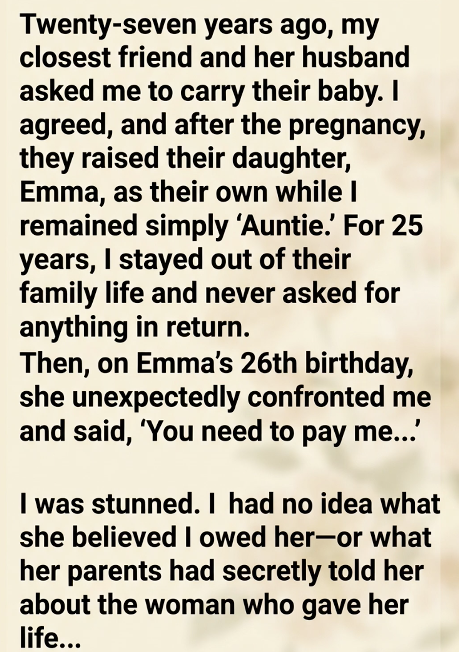
Twenty-seven years ago, my closest friend, Claire, asked me to do something that would change all of our lives.
She and her husband had spent years trying to have a child.
Nothing worked.
Eventually, their doctor explained that Claire couldn’t safely carry a pregnancy.
She was devastated.
One evening, she came to my house with her husband, Thomas.
Claire was crying before she even sat down.
Then she asked:
“Would you carry our baby?”
I didn’t hesitate.
“If it gives you the family you’ve always wanted, yes.”
She hugged me so tightly that neither of us could speak.
I thought I was helping two people I loved.
I had no idea I’d spend the next 27 years carrying a secret I didn’t understand.
—
The pregnancy was difficult.
But I carried the baby.
I went to every appointment.
I listened to her heartbeat.
I felt her kick.
And when she was born, I held her for only a few minutes before placing her in Claire’s arms.
Claire was crying.
Thomas was crying.
I smiled through my own tears.
Then Claire whispered:
“Thank you.”
I kissed the baby’s forehead.
“Love her.”
“I will.”
They named her Emma.
From that day forward, I became simply:
“Auntie.”
—
I never asked for money.
Never asked for recognition.
Never asked to be called her mother.
I respected the arrangement completely.
Claire and Thomas raised Emma.
I stayed in the background.
I attended birthdays when they invited me.
I sent Christmas presents.
I watched from a distance as Emma grew from a baby into a little girl, then a teenager.
She knew I was the woman who had carried her.
But Claire and Thomas were her parents.
I never tried to confuse that.
I thought we all understood the arrangement.
Apparently, we didn’t.
—
When Emma turned **26**, I received an invitation to her birthday dinner.
I almost didn’t go.
But I had known her entire life.
So I bought a present and went.
The evening was lovely at first.
Emma laughed.
Her parents looked proud.
Everyone toasted her.
Then, after dinner, Emma approached me.
Her expression was serious.
“Auntie, can we talk?”
“Of course.”
She led me into the hallway.
Then looked directly into my eyes and said:
**”You need to pay me.”**
I thought I’d misheard her.
“Pay you?”
“Yes.”
“For what?”
She folded her arms.
“For what you did to me.”
My stomach tightened.
“What exactly do you think I did?”
She stared at me.
Then said something that made my blood run cold.
**”You gave me life, but you took something from me at the same time.”**
—
I looked toward Claire.
She was standing across the room.
Her face had gone completely white.
Thomas wouldn’t look at me.
I turned back to Emma.
“What are you talking about?”
She took out a folder.
“I found these.”
Inside were copies of medical records.
Adoption documents.
Old legal correspondence.
And a letter written by Claire.
I recognized the handwriting.
Emma placed it in front of me.
“Read it.”
I opened the letter.
The first sentence made my hands shake.
**”Emma, there are things about your birth that Auntie doesn’t know.”**
I looked at Claire.
“What is this?”
She started crying.
—
I read further.
Claire had written that when she and Thomas first arranged the pregnancy, they had promised each other that Emma would never know how complicated the circumstances had been.
But apparently, Claire had been afraid Emma would someday feel different.
So she told her a story.
According to Claire’s version, I had carried Emma because I needed money.
She told Emma that I had been paid a large amount to give up the baby.
She also told her that I had signed documents agreeing never to contact her unless Emma wanted me to.
I stared at the letter.
None of it was true.
I had never demanded money.
I had never asked for payment.
I had never signed anything saying I couldn’t be part of Emma’s life.
I had simply respected Claire’s wishes.
—
Emma looked at me.
“Is it true?”
“No.”
She frowned.
“Then why would Mom write it?”
“I don’t know.”
She handed me another document.
It was a financial statement.
There was a large transfer made shortly before Emma was born.
The account belonged to Claire and Thomas.
The memo line said:
**”Surrogacy payment.”**
I stared at it.
“I never received this.”
Emma crossed her arms.
“Then where did it go?”
I looked at Claire.
She was crying.
“Claire?”
She couldn’t answer.
Thomas finally stepped forward.
“That money was supposed to be yours.”
I froze.
“What?”
He lowered his head.
“Your name was on the original agreement.”
—
I suddenly understood.
The money had existed.
But I had never known about it.
Claire and Thomas had received funding through an arrangement with a fertility organization.
Part of that money had been intended for my medical expenses and compensation.
But after the pregnancy, Claire had taken control of the funds.
She had convinced herself that because I had volunteered, I didn’t need it.
Then, over the years, she had become ashamed of keeping it.
Instead of admitting the truth, she created a different story.
One in which I had willingly accepted money.
One in which I had chosen to disappear.
One in which Emma could blame me instead of asking why her parents had kept the truth from her.
—
Emma looked stunned.
“Mom?”
Claire burst into tears.
“I was afraid you’d hate me.”
Emma stared at her.
“You told me Auntie sold me.”
“I was trying to protect you.”
“From what?”
“From feeling like your birth was complicated.”
Emma shook her head.
“You made me hate the wrong person.”
—
I sat down.
For 26 years, I’d protected my friend’s family.
I’d never asked what they told Emma.
I’d assumed they were protecting her too.
Instead, they’d built an entire story around my silence.
Emma looked at me.
“So you didn’t want money?”
“No.”
“You didn’t abandon me?”
“No.”
“You never signed away your right to know me?”
“No.”
She started crying.
“Then why did you stay away?”
I answered honestly.
“Because your mother asked me to.”
—
Claire sat down beside her daughter.
“I was scared.”
Emma looked at her.
“You were jealous.”
Claire began crying harder.
“I loved you so much.”
Emma replied:
“That doesn’t make lying okay.”
Silence filled the room.
Then Emma turned back toward me.
“I’m sorry.”
I shook my head.
“You were given a story. You believed it.”
“But I blamed you.”
“I know.”
“I treated you like you owed me something.”
I smiled sadly.
“You don’t owe me anything.”
—
Then Emma opened the final document.
It was a copy of the original agreement from 27 years earlier.
The first page listed me as the gestational carrier.
The second page contained my handwritten statement.
It said:
**”I am carrying this child because I love the parents and want to give them the family they have dreamed about.”**
No payment was listed as a condition.
No promise to disappear.
No demand for money.
Nothing.
I started crying when I saw my own handwriting.
I had forgotten I’d written it.
—
Thomas finally admitted that the money meant for me had been moved into an investment account.
Over the years, it had grown substantially.
The account was now worth more than **$300,000**.
He said:
“We should have given it to you years ago.”
I looked at him.
“Yes.”
Claire was crying.
“I was ashamed.”
I nodded.
“You should have told the truth.”
—
Emma looked at the account statement.
Then at me.
“Mom said you needed to pay me.”
I smiled sadly.
“Now you know what you really came to ask me.”
She wiped her eyes.
“I don’t want your money.”
“Good.”
She laughed through her tears.
“What I want is the truth.”
I reached for her hand.
“Then you have it.”
—
That night, Emma asked me questions about her birth.
I answered every one.
She asked if I was scared.
“Very.”
“If I cried?”
“Eventually.”
“Did you love me?”
I smiled.
“Of course.”
She started crying.
“I always wondered.”
“I know.”
—
Before I left, Emma hugged me.
It was the first time she’d ever hugged me like she wasn’t sure whether she was allowed to.
She whispered:
“I’m glad you were my Auntie.”
I held her tightly.
“You were worth every uncomfortable appointment, every sleepless night, and every mile I traveled.”
She laughed softly.
“Even without payment?”
I smiled.
“Especially without payment.”
—
The financial issue was eventually resolved legally.
The money originally intended for me was transferred into my name.
I didn’t keep all of it.
I used part of it for medical expenses and donated a portion to a fertility support organization.
But the money wasn’t what mattered.
What mattered was that Emma finally knew she hadn’t been unwanted.
She hadn’t been sold.
She hadn’t been abandoned.
And I hadn’t demanded anything from her.
—
For **27 years**, I stayed quietly in the background because I believed I was respecting the family I’d helped create.
Then, at Emma’s 26th birthday, she looked at me and said:
**”You need to pay me.”**
I thought she meant money.
She didn’t.
She meant that she believed I owed her an explanation for the life she’d been told was a lie.
And when I finally learned what her parents had told her about the woman who gave her life, I realized something painful:
I had spent 27 years protecting their secret…
while they had spent 26 years using my silence to create a different story.
Emma didn’t need my money.
She needed the truth.
And the greatest thing I could finally give her was the one thing she should have had from the beginning:
**the knowledge that she was never a debt, never a transaction, and never something I regretted bringing into the world.**