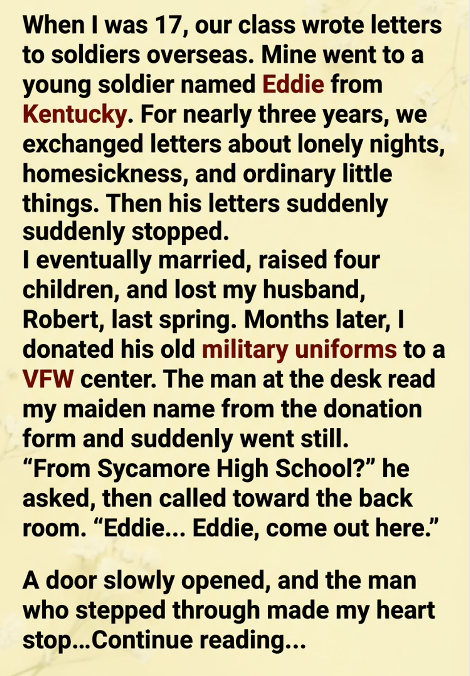
When I was **17**, our class wrote letters to soldiers serving overseas.
I didn’t know what to say.
So I wrote about ordinary things.
School.
My family.
The weather.
The little town I grew up in.
My letter went to a young soldier named **Eddie from Kentucky**.
A few weeks later, I received a reply.
Then another.
And another.
For nearly **three years**, Eddie and I exchanged letters.
We wrote about lonely nights.
Homesickness.
Dreams for the future.
Favorite songs.
Things we missed about home.
Nothing romantic.
At least, that’s what I told myself.
But his letters became some of the most important things in my life.
Then, without warning, they stopped.
—
I waited.
Weeks became months.
I wrote again.
No answer.
Eventually, I assumed something terrible had happened.
I never learned the truth.
Life moved forward.
I eventually married a wonderful man named Robert.
We raised four children together.
We built a home.
Had grandchildren.
Made memories.
And somewhere along the way, the memory of Eddie became a quiet chapter of my youth.
I never forgot him.
But I stopped expecting to ever hear from him again.
—
Robert died last spring.
After months of grief, I began sorting through his belongings.
He had kept his old military uniforms in the attic.
I couldn’t bring myself to throw them away.
So I packed them carefully and donated them to a local VFW center.
I filled out the donation form using my maiden name.
Then handed the box to the man behind the desk.
He looked down at the paperwork.
His expression suddenly changed.
He stared at my name.
Then looked up at me.
“From **Sycamore High School**?”
I froze.
“Yes.”
He didn’t say anything for several seconds.
Then turned toward the hallway and shouted:
**”Eddie… Eddie, come out here.”**
My heart started pounding.
I heard footsteps.
A door slowly opened.
An elderly man stepped into the room.
He looked older.
Gray hair.
A walking cane.
But the moment I saw his eyes…
I knew.
It was Eddie.
—
Neither of us spoke.
He stared at me.
Then whispered:
“Is it really you?”
I could barely breathe.
“Eddie?”
He smiled.
And suddenly I was 17 again.
Holding a letter in my hands.
Waiting for the mail.
Wondering whether someone far away was thinking about the same things I was.
He walked toward me slowly.
Then stopped.
“You came back.”
I laughed through my tears.
“I never knew where you went.”
He looked down.
“I never stopped writing.”
My heart stopped.
“What?”
He pointed toward the back room.
“I saved them.”
—
He took me into a small office.
There were boxes.
Dozens of them.
He opened one.
Inside were my letters.
All of them.
My handwriting.
My teenage thoughts.
My little stories.
The photographs I’d sent.
Birthday cards.
Even the ridiculous drawing of my family’s dog I’d mailed him one Christmas.
I started crying.
“You kept everything.”
He smiled.
“I couldn’t throw any of it away.”
—
I asked the question that had stayed with me for decades.
“Why did you stop writing?”
His expression changed.
Then he explained.
He had been seriously injured overseas.
The injury ended his military career.
He spent months recovering.
During that time, his letters and belongings were lost during a transfer between hospitals.
He tried to contact me afterward.
But the address he had for me was no longer valid.
He didn’t know where I’d moved.
Eventually, he assumed I’d built a new life.
So he stopped searching.
—
Then he looked at the uniforms I’d donated.
“Are these Robert’s?”
I nodded.
“He sounds like a good man.”
“He was.”
Eddie smiled.
“Then I’m glad you found someone who loved you.”
I looked at him.
“And you?”
He laughed softly.
“I never married.”
I stared at him.
“Never?”
“No.”
“Why?”
He looked embarrassed.
“I suppose I always thought I’d eventually hear from you.”
—
I felt a lump in my throat.
“Eddie…”
He shook his head.
“Don’t.”
“I had a good life.”
“I know.”
“I loved Robert.”
“I know.”
“I never forgot you either.”
He smiled.
“That’s enough.”
—
Then he reached into a drawer.
Pulled out one final envelope.
It was old.
Yellowed.
Still sealed.
My name was written on the front.
My maiden name.
I stared at it.
“You never sent this?”
He shook his head.
“I wrote it the night before I left the hospital.”
“Why didn’t you mail it?”
“Because I didn’t know where to send it.”
I opened it carefully.
The first line made my hands tremble.
**”If you never hear from me again, please know that your letters helped keep me alive.”**
I had to stop reading.
—
The letter continued:
*”I don’t know what will happen after this.”*
*”But somewhere in Kentucky there is a young man who believes someone in this world cares whether he comes home.”*
*”That person is you.”*
Tears filled my eyes.
Then I reached the final paragraph.
*”If life gives us another chance to meet, I’ll tell you what I couldn’t say at seventeen.”*
I looked at him.
“What couldn’t you say?”
He smiled.
“I loved you.”
I couldn’t speak.
—
We sat together for a long time.
We talked about our lives.
My children.
His years in the military.
Robert.
The town where we grew up.
The people we’d lost.
The things we’d become.
It wasn’t a love story in the way either of us had imagined at 17.
It was something quieter.
A friendship that had somehow survived nearly five decades of silence.
—
Before I left, Eddie gave me the box containing my letters.
I looked at him.
“I can’t take these.”
He smiled.
“You were always supposed to have them.”
I shook my head.
“No.”
“I think you should keep them.”
He raised an eyebrow.
“Why?”
“Because they’re proof that the girl I was mattered to someone.”
He smiled.
“She mattered more than you ever knew.”
—
I went home that evening carrying the letters I had written as a teenager.
I opened the first one.
My handwriting looked so young.
So innocent.
I remembered the girl who had written it.
She had no idea what her life would become.
She had no idea she’d marry.
Raise four children.
Lose her husband.
And one day walk into a VFW center and find a soldier from her youth waiting in the back room.
I thought Eddie had disappeared from my life almost 50 years ago.
He hadn’t.
He had simply been waiting somewhere I never knew to look.
And when the man at the VFW called:
**”Eddie… Eddie, come out here.”**
A door opened.
And suddenly, a part of my 17-year-old self came walking back into my life.
Sometimes the people we lose aren’t really gone.
**Sometimes life simply takes a very long time to bring them back.**