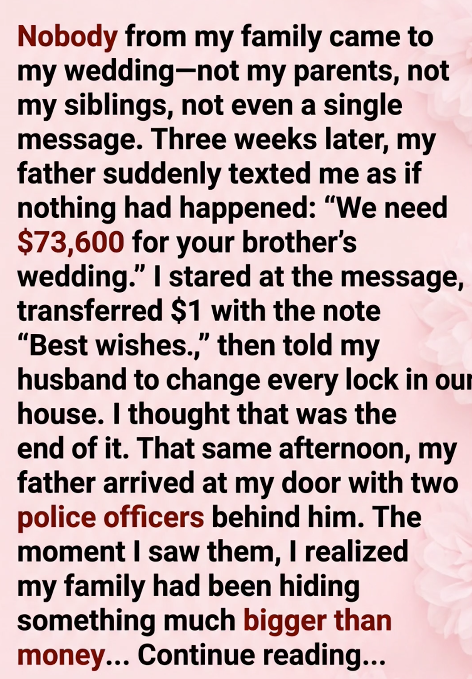
Nobody from my family came to my wedding.
Not my parents.
Not my siblings.
Not even a message.
I walked down the aisle surrounded by friends and my husband’s family, smiling through the disappointment and pretending it didn’t hurt.
For years, I’d wondered whether my family would ever truly accept me.
That day gave me my answer.
They didn’t.
So I stopped waiting for them.
—
Three weeks later, my phone buzzed.
A message from my father.
No apology.
No explanation.
Nothing about the wedding.
He simply wrote:
**”We need $73,600 for your brother’s wedding.”**
I stared at the screen.
I read it again.
Then I laughed.
I transferred exactly **$1**.
The note said:
**”Best wishes.”**
Then I put my phone down.
I turned to my husband.
“Change every lock.”
He looked surprised.
“Why?”
“Because I don’t want them showing up here.”
He nodded.
That afternoon, every lock on our house was replaced.
I thought that was the end of it.
I was wrong.
—
Around four o’clock, someone knocked on our door.
My husband looked through the security camera.
Then his expression changed.
“Your father is here.”
I walked toward the window.
Two police officers were standing behind him.
My stomach dropped.
I opened the door only after the officers identified themselves.
My father looked furious.
“You need to come with us.”
I stared at him.
“Why?”
One of the officers spoke calmly.
“We need to discuss a financial matter involving your family.”
My heart started pounding.
“What financial matter?”
My father immediately interrupted:
“Just come inside and talk.”
I looked at the officers.
Then at him.
And suddenly, I realized something.
This wasn’t about **$73,600**.
My family had been hiding something much bigger.
—
The older officer asked:
“Did your father recently request money from you?”
“Yes.”
“For your brother’s wedding?”
“Yes.”
“Did you send anything?”
“One dollar.”
He nodded.
Then asked:
“Did you know your name is attached to several financial accounts connected to your father’s business?”
I froze.
“My name?”
He pulled out a folder.
My father’s face went pale.
I opened the first document.
It was a bank statement.
My name was listed as a co-owner.
I had never opened that account.
Never signed anything.
Never seen it.
The officer said:
“We believe your identity may have been used without your knowledge.”
I stared at my father.
“What did you do?”
He looked away.
—
The second document was worse.
It showed several large loans.
My name appeared on them.
The total was more than **$420,000**.
I felt dizzy.
“I didn’t sign these.”
“We know.”
“Then why am I listed?”
The officer answered:
“That’s what we’re investigating.”
My father finally spoke.
“They were temporary.”
I looked at him.
“Temporary?”
“We were going to repay everything.”
I couldn’t believe it.
“So you used my name?”
He lowered his head.
“We needed a guarantor.”
I shook my head.
“You didn’t need a guarantor.”
“You needed someone you thought you could control.”
—
Then my father revealed why he had demanded the $73,600.
My brother’s wedding wasn’t the real expense.
The money was needed to cover an overdue payment on one of the loans.
If they didn’t pay, the bank would begin investigating the accounts.
And they were terrified that the investigation would reveal that my identity had been used.
The wedding was simply an excuse.
My father had expected me to transfer the money without asking questions.
—
I looked at the police officer.
“When did this start?”
“Several years ago.”
I stared at my father.
“Before I got married?”
He nodded.
“Yes.”
“Before I moved out?”
Another nod.
“Yes.”
My hands began shaking.
My own family had been using my identity for years while I thought they were simply asking me for help.
—
Then the officer asked:
“Did you ever sign any documents for your family?”
I shook my head.
“No.”
“Did you ever give your father copies of your identification?”
I thought about it.
Years earlier, he’d asked for a copy of my driver’s license.
He said he needed it for an insurance form.
I’d trusted him.
Now I understood.
That was how they’d started.
—
My father began crying.
“I’m your father.”
I stared at him.
“That doesn’t give you permission to steal my identity.”
He looked at me.
“We were desperate.”
“You weren’t desperate when you ignored my wedding.”
“You weren’t desperate when you stopped answering my calls.”
“You were only desperate when you needed my name.”
He had no answer.
—
The investigation expanded.
Bank records were reviewed.
Loan applications were examined.
Several signatures had clearly been forged.
Digital records showed that documents had been submitted using my personal information from devices in my parents’ home.
My brother eventually admitted he knew about the loans.
My mother denied involvement.
But investigators found messages between the three of them discussing how to make sure I would “always help.”
—
The police didn’t arrest my father that day.
They needed more evidence.
But they placed restrictions on the accounts and told me to contact every creditor immediately.
I did.
Then I changed every password.
Froze my credit.
Closed old accounts.
And hired an attorney.
For the first time in my life, I stopped treating my family like people who deserved automatic trust.
—
A few weeks later, my father called.
He sounded broken.
“I’m sorry.”
I didn’t answer.
“I know I hurt you.”
I finally said:
“You didn’t just hurt me.”
“You put my entire future at risk.”
“I could have lost my house.”
“I could have destroyed my credit.”
“You could have ruined the life I built after leaving.”
He started crying.
“I was trying to help your brother.”
I shook my head.
“You were protecting the family’s secret.”
—
My brother’s wedding never happened.
The money he had demanded from me never went anywhere.
The investigation uncovered too much.
The family business collapsed.
The fraudulent accounts were closed.
And I was eventually cleared of the debts after the evidence confirmed I had never authorized them.
It took months.
But I got my life back.
—
I never went back to the old family home.
I never attended another family gathering.
And I never regretted changing the locks.
Because that day taught me something I should have understood years earlier:
Sometimes the people who share your blood can still become the people you need the strongest boundaries from.
My father thought I would panic when two police officers arrived at my door.
He thought I’d give him the money.
He thought I’d protect the family.
Instead, I finally saw the truth.
The **$73,600** was never really about my brother’s wedding.
It was about buying time.
Buying silence.
And keeping a much larger secret from coming to light.
When the police arrived, I thought they were there because my family had reported me.
Then I saw the folder.
And realized something far more frightening:
**My family hadn’t come to ask me for money.**
**They had spent years using my name to survive—and that afternoon, the truth finally came to collect.**