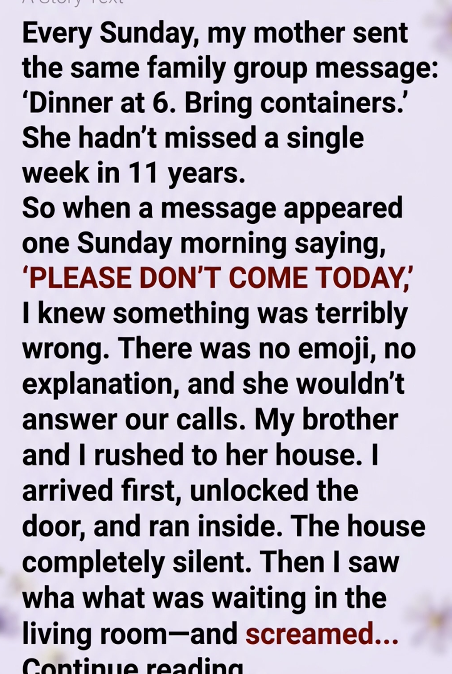
Every Sunday for 11 years, my mother sent the same message to our family group chat:
“Dinner at 6. Bring containers.”
That was it.
No recipe.
No details.
No questions.
It didn’t matter whether it was snowing, raining, or someone was out of town.
Sunday dinner happened.
Mom always cooked enough food to feed an army.
Roast chicken.
Lasagna.
Stew.
Casseroles.
Whatever she made, everyone went home with leftovers.
It had become our family tradition.
Then one Sunday morning, at exactly 9:14 a.m., my phone buzzed.
The message was from Mom.
“PLEASE DON’T COME TODAY.”
I stared at it.
No emoji.
No explanation.
No “love you.”
Just those four words.
I immediately called her.
No answer.
Again.
Nothing.
I called my brother.
He’d already seen the message.
“I’m going over there.”
“I’m coming.”
My brother lived nearly forty minutes away.
I lived fifteen minutes from Mom.
So I got there first.
Her car was in the driveway.
The front door was locked.
I tried my key.
It opened.
“Mom?”
Nothing.
The house was completely silent.
Normally, the kitchen would already smell like garlic, onions, and whatever she was cooking.
That morning, there was no smell.
No radio.
No television.
No footsteps.
Just silence.
I walked through the hallway.
“Mom?”
Still nothing.
Then I reached the living room.
And screamed.
There were dozens of boxes covering the floor.
Not ordinary boxes.
Cardboard moving boxes.
Every one of them had a family member’s name written on it.
Mine.
My brother’s.
My cousins’.
Even the names of grandchildren.
I froze.
Then I noticed something in the center of the room.
A huge dining table had been moved aside.
Underneath it was an enormous pile of envelopes.
Each one had a date written on the front.
Every date was a Sunday.
For eleven years.
I picked one up.
It was addressed to me.
My hands began shaking.
Then I heard a noise behind me.
I spun around.
My mother was standing in the doorway.
She looked exhausted.
But she was smiling.
“You’re early.”
I nearly collapsed.
“Mom!”
I ran to her.
“Why didn’t you answer the phone?”
She hugged me.
“I’m sorry.”
“What is all this?”
She looked at the boxes.
Then sighed.
“It’s time you all knew.”
My brother arrived a few minutes later.
He stared at the living room.
“What happened?”
Mom motioned for us to sit down.
“I’ve been preparing.”
“For what?”
“For when I wouldn’t be here anymore.”
My throat tightened.
“You mean…?”
She shook her head.
“Not today.”
“But soon enough.”
Then she pointed toward the boxes.
“I’ve been saving things.”
“What things?”
“Everything that mattered.”
She opened the first box.
Inside were family photographs.
Hundreds of them.
Birthday parties.
Christmas mornings.
Graduations.
Babies.
Vacations.
Photographs we’d forgotten existed.
Mom had labeled each one.
The date.
The location.
Who was in the picture.
And sometimes a short description.
My brother found one from when we were children.
He started laughing.
“You kept this?”
Mom smiled.
“Of course.”
Then she opened another box.
Inside were handwritten recipes.
Some belonged to Grandma.
Others to Mom.
Each had notes in the margins.
“Daniel likes extra garlic.”
“Sarah can’t eat walnuts.”
“Make this one when the grandchildren visit.”
I started crying.
“Mom, why?”
She smiled.
“Because one day, you’ll all be making these without me.”
Then she pointed toward the stack of envelopes.
“Those are letters.”
“Letters to who?”
“You.”
She looked at me.
“To all of you.”
She explained that she’d started writing them eleven years earlier.
Not because she thought she was dying.
Because she realized time was passing faster than she’d expected.
Every Sunday after dinner, she wrote something about that week.
A memory.
A lesson.
A story about our family.
Something she wanted each of us to remember.
Then she sealed the letters and stored them away.
She intended to give them to us someday.
I picked up the envelope with my name.
It was dated eleven years earlier.
I looked at her.
“Why didn’t you ever give it to me?”
She smiled sadly.
“Because I wasn’t finished.”
“You weren’t finished writing?”
“No.”
“I wanted one letter for every year.”
I stared at the stack.
There were 572 letters.
One for nearly every Sunday over eleven years.
My mother had been writing to us the entire time.
Then my brother noticed something.
“Mom.”
“What’s that?”
He held up a folder.
There was a bank logo on it.
“What is this?”
Mom sighed.
“I suppose you should know that too.”
We opened it.
Inside were account statements.
My mother had been putting money aside every week.
Not huge amounts.
Small amounts.
Whatever she could manage.
Over eleven years, it had grown into a substantial emergency fund.
She had created separate accounts for her grandchildren.
And another for each of us.
We stared at her.
“Why didn’t you tell us?”
She shrugged.
“Because I didn’t want anyone fighting over money.”
Then she told us why she had sent the strange message that morning.
The night before, she had received the results of a medical test.
She had expected it to be routine.
It wasn’t.
She didn’t want to tell us over the phone.
She wanted us together.
But she was scared.
So she sent the message:
“PLEASE DON’T COME TODAY.”
She hadn’t meant “don’t come.”
She meant:
“Don’t come expecting dinner.”
“Come because I need to talk to you.”
I laughed through my tears.
“Mom, that is a terrible way to say that.”
She smiled.
“I know.”
Then she led us into the kitchen.
For the first time in eleven years, there was no food cooking.
Instead, there were three chairs around the table.
Mom sat down.
Then she said:
“I don’t know how much time I have.”
My brother reached for her hand.
“Whatever it is, we’ll handle it.”
She nodded.
“I know.”
“That’s why I finally want you to have these.”
She pointed toward the living room.
Everything.
The photographs.
The recipes.
The letters.
The boxes.
The memories.
She had spent eleven years preparing a legacy that had nothing to do with money.
We spent the entire day reading.
Some letters made us laugh.
Some made us cry.
One described the first Sunday after my father died.
Another talked about the day my brother got his first job.
There was one about my wedding.
One about each grandchild.
And one that simply said:
“Today I watched my children laugh together in my kitchen. If I never accomplish another thing, that is enough.”
I had to stop reading.
By evening, nobody wanted to leave.
For the first time in years, Sunday dinner wasn’t about food.
It was about us.
Mom ordered pizza.
We sat around the table.
We ate straight from the boxes.
No fancy dishes.
No containers.
No leftovers.
Just family.
And somehow, that became the most important Sunday dinner we’d ever had.
Mom’s health turned out to be more serious than she’d hoped.
She underwent treatment.
There were good days and difficult ones.
But she didn’t stop writing.
Neither did our family.
We continued Sunday dinners.
Sometimes Mom cooked.
Sometimes we did.
And every week, someone brought containers.
The tradition never disappeared.
It simply changed.
Years later, after Mom eventually passed away peacefully, the last box was opened.
It contained one final letter.
There was no date.
It simply said:
“When you read this, I won’t be there to remind you.”
Then:
“Don’t stop coming on Sundays.”
“Bring containers.”
I started crying before I even reached the end.
The final line said:
“Fill them with food if you can.”
“But always fill the house with each other.”
I still have the original group chat message.
Eleven years of:
“Dinner at 6. Bring containers.”
And one message that terrified all of us:
“PLEASE DON’T COME TODAY.”
I thought something terrible had happened.
I drove to Mom’s house expecting the worst.
Instead, I found boxes containing eleven years of memories.
Hundreds of letters.
Family recipes.
Photographs.
And proof that my mother had spent years preparing to leave us something more valuable than an inheritance.
She was leaving us instructions for how to remember her.
How to stay close.
How to keep showing up.
And how to keep the family together after she was gone.
That night, we finally understood why she had never missed a Sunday in eleven years.
The dinner had never really been about the food.
It was about making sure we kept coming back to the same table.