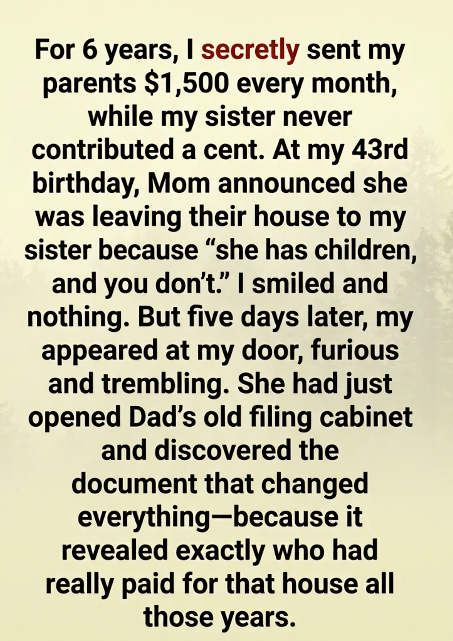
For six years, I secretly sent my parents $1,500 every month.
My sister never contributed a cent.
Not once.
She always had an excuse.
“Kids are expensive.”
“Maybe next month.”
“We’re barely getting by.”
I understood.
She had three children, and I knew raising a family wasn’t easy.
So I never pressured her.
Instead, I quietly helped our parents.
Every month, on the same day, I transferred $1,500 into their account.
I paid their property taxes when money was tight.
I paid for repairs.
I replaced their broken air conditioner.
When Dad needed surgery, I covered the remaining hospital bill.
They never asked me to do any of it.
I offered.
They were my parents.
I didn’t keep records because I wanted praise.
I didn’t tell my sister.
I didn’t even tell my friends.
It was simply something I did.
For six years.
Then came my forty-third birthday.
My parents invited everyone over for dinner.
My sister arrived with her husband and three children.
There was cake.
Flowers.
A big family meal.
I thought it would be a normal birthday.
Until Mom stood up.
She tapped her glass.
“I have an announcement.”
Everyone became quiet.
Mom smiled at my sister.
“We’ve decided that the house will belong to her.”
My sister’s face lit up.
“What?”
Mom laughed.
“It’s yours.”
My sister hugged her.
Then Mom looked at me.
“You understand, don’t you?”
I smiled.
“Of course.”
She continued.
“She has children. She needs the house more than you do.”
My sister looked at me.
I could see the satisfaction in her eyes.
Dad remained silent.
I didn’t argue.
I didn’t remind them about the $1,500 every month.
I didn’t mention the taxes.
I didn’t mention the repairs.
I didn’t say anything about the medical bills.
I simply smiled.
“Happy for you.”
Then I went home.
I didn’t cry.
I wasn’t even angry.
I was simply tired.
For six years, I’d been helping because I loved my parents.
But suddenly, I realized something.
They had never seen my help as sacrifice.
They had seen it as something I owed them.
Five days later, my sister appeared at my door.
She looked furious.
And terrified.
I opened the door.
“What happened?”
She pushed past me.
“You knew.”
I frowned.
“Knew what?”
She was holding a folder.
Her hands were shaking.
“Dad’s filing cabinet.”
“What about it?”
“I found something.”
She dropped the folder on my kitchen table.
Inside was a document.
A property purchase agreement.
I looked at it.
Then I froze.
The buyer’s name was mine.
I stared at my sister.
“What is this?”
She shook her head.
“I don’t know.”
I read the document again.
It was dated six years earlier.
The house had been purchased in my name.
My parents were listed as occupants.
I looked at the amount.
Then I looked at my sister.
“I didn’t buy this house.”
“Yes, you did.”
“No.”
“You paid for it.”
My heart started pounding.
Then she pulled out another document.
Bank records.
Monthly transfers.
Exactly $1,500.
Every month.
For six years.
But these weren’t simply payments to my parents.
They were labeled:
MORTGAGE CONTRIBUTION.
I stared at the records.
My father had been depositing my monthly payments into an account that was being used to pay the mortgage.
I had never known the house had a mortgage.
I thought Dad had owned it outright.
My sister sat down.
“Do you understand?”
I nodded slowly.
“The house isn’t theirs.”
She looked at me.
“It’s yours.”
I couldn’t speak.
Then she said something that made me realize how much worse the situation was.
“Mom knew.”
I looked at her.
“How?”
“Dad wrote it down.”
She opened another letter.
It was in Dad’s handwriting.
He had written:
The house was purchased for both daughters.
I read further.
But only one of them has consistently helped us maintain it.
My sister looked away.
I continued reading.
Dad explained that when he and Mom decided to move into the house, they didn’t have enough money to make the purchase comfortably.
I had offered to help.
I didn’t know I was helping buy the property.
Dad had suggested that my monthly contribution be treated as a family loan.
But over the years, he changed his mind.
He wanted the house to eventually belong to me.
The filing cabinet contained the documents proving it.
Then I found the final page.
It was a signed declaration.
This house is to remain the property of my daughter, Sarah.
I stared at it.
My sister started crying.
“I didn’t know.”
“I know.”
“She told me it was hers.”
“I know.”
“She said Dad wanted me to have it.”
I looked at her.
“Did Dad ever tell you that?”
She shook her head.
“No.”
I sat down.
For years, I had believed I was simply helping my parents with their expenses.
I hadn’t realized I was paying for the house.
Then my sister said,
“Why didn’t you tell me?”
I looked at her.
“About what?”
“That you were sending them money.”
I laughed quietly.
“Because it wasn’t your business.”
She looked hurt.
“I would have helped.”
I didn’t answer.
We both knew that wasn’t true.
Then she asked,
“Why did Mom say the house was mine?”
“I don’t know.”
But I suspected.
My sister had children.
My mother had always been softer with her.
She believed my sister needed more.
And because I was unmarried and childless, she assumed I needed less.
She had turned my independence into a reason to take from me.
That evening, I called my father.
He was in the hospital recovering from a minor illness.
I asked him about the documents.
There was a long silence.
Then he said,
“I was afraid this would happen.”
“What?”
“Your mother changed her mind.”
I closed my eyes.
“She told everyone the house belonged to my sister.”
“I know.”
“Why didn’t you stop her?”
“I tried.”
“Dad.”
“I thought the documents would protect you.”
I looked at the folder.
“They do.”
He sighed.
Then he said,
“You never asked for anything.”
I started crying.
“I didn’t help you because I wanted the house.”
“I know.”
“I did it because you were my parents.”
“I know.”
His voice broke.
“And that’s why I wanted you to have it.”
I didn’t know what to say.
My father had always been quiet.
He rarely expressed his feelings.
But that night, he told me something I’d never heard before.
“I knew your mother was unfair to you.”
I swallowed.
“Then why didn’t you say anything?”
“Because every time I did, she said you didn’t need us.”
I looked down.
I had spent years being punished for being independent.
My sister was considered deserving because she had children.
I was considered fortunate because I didn’t.
But nobody had asked whether I needed anything.
Nobody had asked how much I was sacrificing.
Nobody had asked why I kept giving.
The following week, my parents held a family meeting.
My mother was furious when she learned I’d discovered the documents.
“This is ridiculous.”
Dad looked at her.
“No.”
She turned toward him.
“You promised her nothing.”
“I promised her the truth.”
Mom became defensive.
“She doesn’t have children.”
Dad’s voice was quiet.
“That doesn’t make her less of a daughter.”
The room went silent.
My sister looked at Mom.
“You told me the house was mine.”
“I thought it should be.”
“You didn’t tell me she paid for it.”
Mom said nothing.
My sister started crying.
“I’ve spent five days thinking she stole something from me.”
She looked at me.
“But you were the one who paid for it.”
I nodded.
She wiped her eyes.
“I feel horrible.”
I said,
“You didn’t know.”
“But I should have.”
Maybe she should have.
But I didn’t blame her for something she had never been told.
What hurt more was the fact that my mother knew.
Dad eventually transferred the property legally into my name.
The paperwork took several weeks.
My sister helped me pack up some of my parents’ belongings when they eventually moved into a smaller place.
One afternoon, while we were cleaning the old house, she stopped.
“Can I ask you something?”
“Sure.”
“Do you hate me?”
I looked at her.
“No.”
“Why not?”
“Because you didn’t make Mom’s decision.”
She nodded.
“I was so happy when she told me I was getting this place.”
“I know.”
“I thought it proved she loved me more.”
I smiled sadly.
“She doesn’t love you more.”
“She treated me like she did.”
“Yes.”
My sister sat down.
“I wish I’d known what you were doing.”
I laughed.
“You would have hated me for telling you to pay $1,500 a month.”
She smiled.
“Probably.”
Then she became serious.
“I want to start contributing.”
“To what?”
“To Mom and Dad.”
I looked at her.
“You don’t have to pay me.”
“I’m not paying you.”
She smiled.
“I’m finally going to help them.”
I nodded.
“That would make Dad happy.”
She hugged me.
It was the first time we’d hugged in years without resentment between us.
Eventually, my parents moved into a smaller home.
I continued helping them.
But this time, I set boundaries.
I no longer paid for everything.
My sister contributed too.
Not because she owed anyone.
Because she finally understood that family support had to go both ways.
As for the house, I kept it.
Not as revenge.
Not as proof that I had won.
I kept it because Dad had intended it to be mine.
I renovated it slowly.
The kitchen.
The floors.
The backyard.
I turned the spare bedroom into an office.
And every month, when I paid the bills, I remembered those six years of sending $1,500.
At the time, I thought I was simply helping my parents survive.
I never imagined those payments were building something for me.
But the biggest lesson wasn’t about the house.
It was about being taken for granted.
Sometimes the person who gives the most is the person everyone assumes needs the least.
Because they’re responsible.
Because they don’t complain.
Because they don’t ask for help.
People look at someone who has built a stable life and assume that person has no sacrifices.
They don’t see the quiet transfers.
The unpaid weekends.
The bills nobody knows about.
The emergencies you handle alone.
My mother looked at me and saw a daughter without children.
My father looked at me and saw the daughter who always helped.
My sister looked at me and saw the sister who didn’t need anything.
But Dad’s filing cabinet told a different story.
It proved that for six years, I had been quietly paying for the roof over my parents’ heads.
And when my mother announced that the house would go to my sister because “she has children, and you don’t,” I didn’t argue.
I didn’t need to.
Because five days later, the truth was sitting inside a folder on my kitchen table.
My name was on the deed.
My money was on the bank records.
And my father’s final note made everything clear.
“A person’s worth in this family should never be measured by how many children they have. Remember who stood beside us when nobody else did.”
I still think about that sentence.
Because I never helped my parents expecting an inheritance.
I helped them because I loved them.
And in the end, my father made sure that love wasn’t forgotten.
My sister once told me that the house was her legacy because she had children.
She was wrong.
The house wasn’t anyone’s reward for having children.
It was simply a home.
And my father wanted it to go to the daughter who had quietly helped keep it standing.
Six years.
Seventy-two payments.
$108,000.
I had never counted.
I never needed to.
But Dad had.
And he made sure I would never have to wonder whether he noticed.