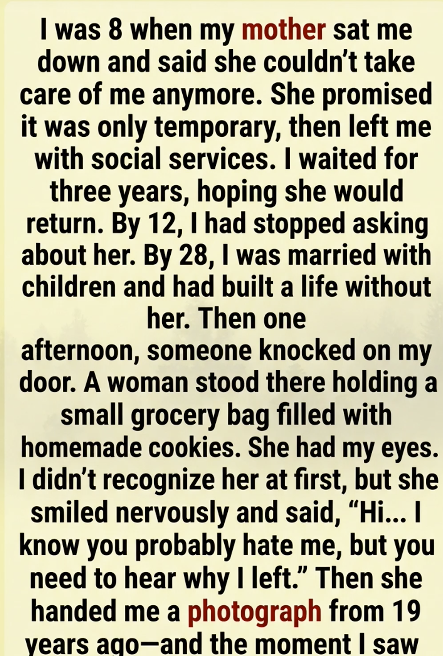
I was eight years old when my mother sat me down and told me she couldn’t take care of me anymore.
I remember the exact chair we were sitting in.
It was an old brown chair in our tiny living room.
I remember the smell of her perfume.
I remember the rain tapping against the window.
And I remember her holding both of my hands.
“Sweetheart, this is only temporary.”
I didn’t understand.
“What does temporary mean?”
“It means I’ll come back.”
“When?”
“Soon.”
I believed her.
Children believe their parents.
That’s what makes abandonment so confusing.
My mother took me to social services the next morning.
She packed a small suitcase for me.
Three shirts.
Two pairs of pants.
My favorite stuffed rabbit.
And a photograph of the two of us.
She hugged me outside the building.
“Wait for me.”
I cried.
“Promise?”
She kissed my forehead.
“I promise.”
Then she walked away.
I watched until I couldn’t see her anymore.
I waited.
One day passed.
Then a week.
Then a month.
I kept asking when Mom was coming.
The social workers always told me they didn’t know.
At first, I believed she was coming back.
I saved every birthday card I received because I thought she might return before the next one.
I kept my suitcase under my bed.
Just in case.
At nine, I still waited.
At ten, I started asking less.
At eleven, I stopped asking.
By twelve, I had stopped expecting her.
I eventually entered foster care.
I moved between three homes before being adopted by a wonderful couple named David and Susan.
They never tried to replace my mother.
They simply loved me.
They helped me with school.
They attended my soccer games.
They stayed up when I was sick.
They taught me that family wasn’t always about biology.
Sometimes it was about who stayed.
By twenty-eight, I was married.
I had two children.
A daughter and a son.
We lived in a small house in a quiet neighborhood.
I had built a good life.
I rarely thought about my mother anymore.
At least, that’s what I told myself.
Then one afternoon, someone knocked on my door.
I opened it.
A woman stood there holding a small grocery bag.
Inside were homemade cookies.
She looked nervous.
Older.
Tired.
But there was something familiar about her face.
Her eyes.
I stared at her.
She smiled.
“Hi.”
I didn’t recognize her.
She swallowed.
“I know you probably hate me.”
My heart stopped.
Then she said,
“But you need to hear why I left.”
I knew immediately.
My hands went cold.
“Mom?”
She nodded.
I couldn’t speak.
She held out the grocery bag.
“I made these.”
I stared at it.
Cookies.
Something about the normality of it made the moment even more surreal.
“You can’t just show up.”
“I know.”
“After twenty years?”
“I know.”
“Why?”
She started crying.
“I’ve wanted to come back for years.”
“Then why didn’t you?”
She reached into her coat.
She pulled out a photograph.
It was old.
The edges were worn.
The date on the back was nineteen years earlier.
She handed it to me.
I looked at it.
And my entire body went numb.
My mother was standing beside a man.
I knew him.
I had seen that face before.
In my childhood photographs.
In an old picture I’d found in my adoptive parents’ attic.
My biological father.
A man I’d always believed had abandoned us.
I looked at my mother.
“Where did you get this?”
She shook her head.
“That’s not the question.”
“What happened?”
She pointed at the photograph.
“That man is the reason I left.”
I stared at her.
“What do you mean?”
She stepped inside.
I closed the door.
For the first time in twenty years, my mother sat in my living room.
She looked around.
There were photographs of my children everywhere.
She touched one.
“You have a family.”
“Yes.”
She smiled sadly.
“I always hoped you would.”
I sat across from her.
“Tell me.”
She took a deep breath.
“When you were eight, I was terrified.”
“Of Dad?”
“Yes.”
I froze.
My biological father had disappeared before I was born.
My mother had always told me he didn’t want us.
“He wasn’t just irresponsible,” she said.
“He was dangerous.”
She explained that my father had been involved in a criminal business.
He owed money to people who weren’t afraid to hurt others.
When my mother tried to leave him, he threatened her.
Then he threatened me.
She reported him.
The police became involved.
But there wasn’t enough evidence to arrest him.
So she made a desperate decision.
She left me with social services.
Not because she didn’t want me.
Because she believed it was the only place he couldn’t find me.
I stared at her.
“You promised you’d come back.”
“I tried.”
“How?”
She pulled another envelope from her bag.
Inside were letters.
Dozens of them.
Birthday letters.
Christmas letters.
Letters for my first day of high school.
Letters for my eighteenth birthday.
Letters for my wedding.
She had written them over the years.
But none had been delivered.
“Why?”
“Because I was being watched.”
She explained that after leaving me, she went into hiding.
She changed her name.
Moved between cities.
Worked under the table.
Every time she considered contacting me, she feared my father would discover where I was.
Then, three years after she left me, something happened.
My father was arrested.
My mother thought it was finally safe.
She tried to contact social services.
But she discovered that I had entered foster care.
Then I’d been adopted.
She didn’t know where I was.
She searched.
For years.
But because of the adoption records, she couldn’t legally access my information.
I stared at her.
“Why didn’t you contact the police?”
“I did.”
“Then why didn’t they help?”
“Because I didn’t know your new name.”
I looked at the photograph again.
My father was standing beside her.
He looked younger.
Angrier.
I turned it over.
There was writing on the back.
If anything happens to me, take her somewhere safe.
I looked at my mother.
“Who wrote that?”
“Your father.”
I couldn’t breathe.
“What?”
“He gave it to me.”
“Why?”
“Because he knew the people he was involved with were going to come after us.”
I felt sick.
“He cared about me?”
“He did.”
“But he abandoned us.”
“He was afraid.”
I shook my head.
“You both left me.”
My mother began crying.
“I know.”
“I waited.”
“I know.”
“I thought you didn’t want me.”
“I wanted you more than anything.”
“Then why didn’t you come?”
She couldn’t answer.
Because there was no answer that could repair twenty years.
She simply said,
“I was trying to keep you alive.”
I looked away.
I wanted to believe her.
But another part of me was furious.
“Do you know what it feels like to be eight years old and think your mother chose to leave?”
She nodded.
“No.”
“You don’t know.”
She lowered her head.
“No. I don’t.”
I cried.
She cried.
Neither of us knew what to say.
Then she reached into the bag again.
There was another photograph.
This one was taken a few months after she left me.
It showed my mother standing outside the foster agency.
She was crying.
On the back she had written:
I saw her today. I couldn’t go inside.
I stared at it.
“You came back?”
“Yes.”
“When?”
“Three months after I left you.”
“Why didn’t you take me?”
She looked at me.
“Because your father found me.”
My blood went cold.
“He was outside.”
She explained that she had seen me through a window.
She had almost walked inside.
Then she saw my father across the street.
She ran.
“He knew where you were.”
I closed my eyes.
For twenty years, I had imagined my mother simply walking away.
The truth was much worse.
She had walked away because she believed staying could put me in danger.
Then she had tried to return.
And every time she got close, she became afraid that I’d be found.
I asked,
“What happened to him?”
She took a breath.
“He died.”
“When?”
“Seven years ago.”
I stared at her.
“Does anyone know?”
“His family.”
“Why didn’t you come then?”
She smiled sadly.
“Because by then you had a life.”
I looked at her.
“You could have found me.”
“I tried.”
She handed me a folder.
Inside were documents from a private investigator.
My mother’s attempts to locate me.
Addresses.
Names.
Old adoption records.
She had spent years searching.
But she had never found me until recently.
“How did you find me?”
She smiled.
“Your wedding announcement.”
I froze.
“You saw that?”
“Yes.”
“You knew where I lived?”
“Eventually.”
“Why wait?”
“Because I was afraid you would hate me.”
I laughed through my tears.
“You were right.”
She nodded.
“I know.”
We sat in silence.
Then my daughter walked into the room.
“Mom?”
She stopped when she saw the stranger.
I looked at my mother.
“This is your grandmother.”
My daughter stared.
Then she smiled.
“Really?”
My mother started crying.
“Yes.”
My daughter ran toward her.
My mother hugged her like she was holding something fragile.
For a moment, I couldn’t watch.
It was too emotional.
My mother had missed my childhood.
She had missed my graduation.
My first job.
My wedding.
My children’s births.
But now she was holding her granddaughter.
I realized something.
The past couldn’t be repaired.
But the future wasn’t gone.
That evening, my mother stayed for dinner.
She told my children stories about me when I was little.
Things I didn’t remember.
How I used to sleep with my stuffed rabbit.
How I hated peas.
How I once tried to cut my own hair.
My children laughed.
I listened.
For the first time, I was hearing about the little girl I’d been.
And I was hearing it from the woman who had known her first.
Before she left, my mother gave me the grocery bag.
“Keep the cookies.”
I smiled.
“Why?”
“Because I didn’t know what else to bring.”
I laughed.
It was the first time we’d laughed together in twenty years.
Then she handed me the photograph.
“Keep this too.”
I looked at my biological father.
“I don’t know what to think about him.”
“You don’t have to.”
She paused.
“You can hate him.”
“I don’t.”
“You can forgive him.”
“I don’t know if I can.”
“You don’t have to.”
I looked at her.
“What about you?”
“What about me?”
“Do you forgive yourself?”
She looked away.
“No.”
I took her hand.
“You should.”
She shook her head.
“I left my daughter.”
“You saved me.”
“I don’t know if I saved you.”
“You tried.”
She started crying again.
“Trying wasn’t enough.”
“Maybe not.”
I squeezed her hand.
“But you’re here now.”
That was the beginning.
Not a magical reconciliation.
Not an instant forgiveness.
A beginning.
My mother moved into a small apartment nearby.
We started having lunch once a week.
Then dinner.
She came to my children’s school events.
She learned their favorite foods.
She told me stories about my childhood.
I learned about her life.
Her fears.
Her mistakes.
Her regrets.
And slowly, I stopped seeing her only as the woman who had left me.
I began seeing her as a frightened young mother who had made an impossible decision.
That didn’t erase the pain.
But it gave the pain a different meaning.
A year after she returned, we visited the social services building where she’d left me.
It had been renovated.
The old entrance was gone.
We stood outside.
My mother took my hand.
“I’ve thought about this place every day for twenty years.”
I looked at her.
“So have I.”
She started crying.
“I am sorry.”
“I know.”
“Do you forgive me?”
I thought about it.
“Yes.”
She covered her face.
But I continued.
“Not because what happened was okay.”
She nodded.
“Because I don’t want to spend the rest of my life being eight years old.”
She looked at me.
“What do you mean?”
“I spent twenty years waiting for you.”
I paused.
“I’m done waiting.”
She cried.
I hugged her.
And for the first time, I didn’t feel like a child who had finally gotten her mother back.
I felt like an adult who had decided to stop letting the past control her future.
Years have passed since that afternoon.
My mother is still part of our lives.
She is a grandmother now.
My children adore her.
She keeps photographs of them everywhere.
Sometimes I catch her staring at me.
I know she still sees the eight-year-old girl she left behind.
And sometimes I see that little girl too.
But now, when I think about that day, I don’t picture my mother walking away.
I picture her coming back.
Again and again.
Even when she was afraid.
Even when she couldn’t reach me.
She never stopped looking.
The old photograph she brought me remains in a frame on my desk.
My mother is standing beside my father.
Both of them are young.
Both look terrified.
And beneath the photograph is a sentence my mother wrote years ago:
“I didn’t leave because I didn’t love you. I left because I loved you enough to let you live somewhere he couldn’t reach you.”
For most of my life, I believed my mother abandoned me.
Now I understand something more complicated.
She made a terrible choice.
She hurt me.
She left a wound that took decades to heal.
But she also spent twenty years carrying the weight of that decision.
And when she finally stood at my door with a grocery bag full of homemade cookies, she wasn’t asking me to forget.
She was asking me to hear the truth.
I did.
And the truth didn’t erase my childhood.
It simply gave me permission to stop blaming the little girl who spent three years waiting for her mother to come home.
That little girl wasn’t unwanted.
She was loved.
She was protected.
And, finally, she was found.
Sometimes the people who leave aren’t running away from you.
Sometimes they’re running from the danger they believe is chasing you.
And sometimes, after twenty years, they finally find their way back home.