The first time my husband said, “I never asked to be a father,” our son was lying between us in a hospital bed.
He was three years old.
His little body was connected to wires, tubes, and monitors.
I was holding his hand.
My husband was staring at his phone.
I remember looking at him and thinking:
How can someone look at their own child and feel nothing?
Our son, Noah, had been sick for almost a year.
At first, doctors thought it was a stubborn infection.
Then they thought it was an autoimmune disorder.
Then came the tests.
The specialists.
The scans.
The genetic panel.
The consultations with doctors whose names I could barely pronounce.
Finally, they gave us the diagnosis.
Noah had a rare, progressive neurological disease.
There was no cure.
The doctors didn’t know exactly how quickly it would progress.
They only knew that his condition was life-limiting.
The word terminal was eventually used.
I hated that word.
It sounded like a sentence.
Noah didn’t understand any of it.
He still wanted dinosaur pajamas.
He still wanted strawberry yogurt.
He still wanted me to sing the same song every night before bed.
And I did.
Every night.
While his father slept.
My husband, Daniel, had never been particularly involved.
Before Noah got sick, I told myself Daniel was simply overwhelmed.
After all, we were both exhausted.
But once the diagnosis came, something changed.
I became Noah’s full-time caregiver.
I handled every appointment.
Every medication.
Every feeding.
Every hospital trip.
Every phone call.
Every insurance form.
Every night when Noah woke crying because his body hurt.
Daniel continued going to work.
He complained about the inconvenience.
One afternoon, I asked him to pick Noah up from daycare.
He sighed.
“I have work.”
“I’m at the hospital with him.”
“Then ask someone else.”
“There is no one else.”
He stared at me.
“You always make everything my problem.”
I couldn’t believe what I was hearing.
“Daniel, he’s your son.”
He looked away.
“I never asked to be a father.”
I stood there silently.
Those words changed something inside me.
But I stayed.
Because Noah needed both of us.
Or at least I thought he did.
One night, I came home from the hospital carrying Noah.
He was asleep against my shoulder.
I was exhausted.
I put him in bed.
Then I sat on the edge of our mattress and whispered,
“Daniel, please.”
He didn’t move.
“Just hold him for ten minutes.”
Nothing.
“Please. My arms are shaking.”
He rolled over.
“I have work tomorrow.”
“He’s your son.”
“I know.”
“Then act like it.”
He pulled the blanket over his head.
I picked Noah up again.
And that night, I sat in the rocking chair until sunrise.
Three weeks later, everything changed.
It happened on a Tuesday.
Noah had been unusually tired all day.
He barely ate.
He didn’t want to play.
By evening, his forehead was hot.
I checked his temperature.
101.8°F.
I gave him the medication the doctor had prescribed.
I called the pediatrician.
They told me to monitor him.
I stayed beside him.
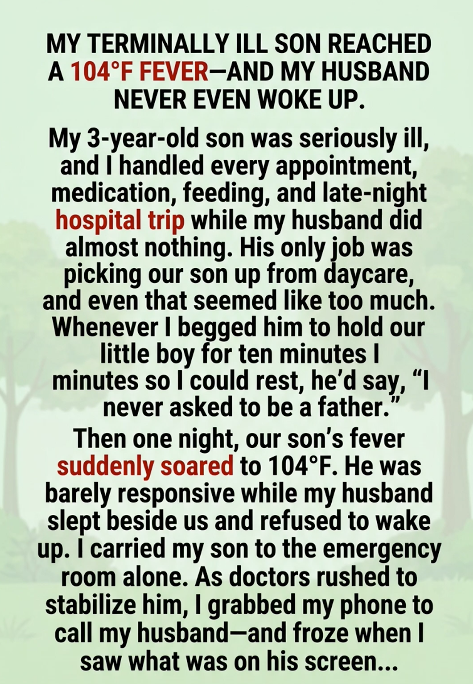
At midnight, his temperature reached 103°F.
I called the hospital.
They told me to come in if he became difficult to wake, had trouble breathing, or his condition worsened.
At 1:47 a.m., I checked him again.
104°F.
My hands went cold.
“Noah?”
His eyes barely opened.
“Mommy?”
“I’m here.”
He was breathing strangely.
I grabbed my phone.
“Daniel!”
Nothing.
He was lying beside me.
Completely still.
“Daniel, wake up.”
Nothing.
I shook his shoulder.
“Daniel!”
He groaned.
“What?”
“Noah’s fever is 104.”
He opened one eye.
“Call the doctor.”
“I am.”
“Then go.”
I stared at him.
“You’re coming with me.”
He turned away.
“I have work.”
My voice broke.
“He can barely stay awake.”
“Then take him.”
I couldn’t believe it.
“You’re his father.”
He pulled the blanket over his head.
“I said take him.”
So I did.
I wrapped Noah in a blanket.
Grabbed the medical bag.
Grabbed the medication list.
Grabbed his hospital folder.
And carried my three-year-old son out of the house alone.
The emergency department was already crowded.
The moment the nurse saw his temperature and medical history, everything changed.
“Room three.”
“Get the doctor.”
“Start monitoring.”
“IV access.”
“Let’s get a second set of vitals.”
People rushed around us.
Noah cried weakly.
I held his hand.
“Mommy’s here.”
A doctor asked me questions.
When had the fever started?
What medications had he taken?
Was he vomiting?
Was he breathing normally?
Had he been exposed to anyone sick?
I answered everything.
Then they began treatment.
Fluids.
Medication.
Cooling measures.
Blood tests.
More tests.
I stood beside the bed.
I realized my phone was still in my hand.
I needed to call Daniel.
I unlocked it.
Then froze.
There was a notification on his phone.
Because somewhere in the chaos, I had accidentally picked up his phone instead of mine.
I stared at the screen.
At first, I thought it was a message.
Then I saw the sender.
Dr. Rebecca Hall.
The preview said:
“You can’t keep doing this. Eventually she will find out.”
My heart stopped.
I opened the message.
There were dozens.
I scrolled.
My hands began shaking.
Rebecca was one of the specialists involved in Noah’s care.
I knew her.
She had spoken to me several times.
She was always compassionate.
But the messages between her and Daniel were strange.
Very strange.
Then I saw a message from Daniel.
“I can’t tell her yet.”
Rebecca replied:
“You promised you would.”
Another message:
“She’s already carrying too much.”
Then:
“If she finds out what happened, she’ll never forgive me.”
I stopped breathing.
What had happened?
I kept scrolling.
Then I saw a photo.
It was a photograph of Noah sleeping in a hospital bed.
Underneath it, Daniel had written:
“He’s getting worse.”
Rebecca replied:
“I know.”
Then Daniel:
“I should have told her months ago.”
I felt sick.
Was Daniel having an affair with Noah’s doctor?
Was that why he had become so distant?
Was there another life I didn’t know about?
I scrolled further.
Then I found a message that made my entire body go numb.
Daniel: “I was the one who made the decision.”
Rebecca: “You didn’t know the diagnosis yet.”
Daniel: “But I knew something was wrong.”
Rebecca: “You can’t keep blaming yourself.”
I stared at the screen.
Then another message appeared.
Daniel: “If I had taken him seriously that night, maybe none of this would have happened.”
My knees nearly gave out.
A nurse caught my arm.
“Are you okay?”
I looked at her.
“I don’t know.”
Then I saw the date.
The messages weren’t recent.
They had started almost eleven months earlier.
Before Noah’s official diagnosis.
Before the specialists.
Before I knew anything was seriously wrong.
I kept reading.
And slowly, the truth began emerging.
Daniel hadn’t been sleeping through Noah’s illness because he didn’t care.
He had been drowning in guilt.
The night Noah first became sick, Daniel had been alone with him.
Noah had developed a high fever.
Daniel thought it was nothing.
He gave him medicine.
Then went to sleep.
By morning, Noah was barely responsive.
I had rushed him to the hospital.
Daniel told me it was my fault because I had insisted Noah was sick.
I had believed him.
But the medical records showed something different.
Daniel had delayed calling for help.
He had lied to me about what happened that night.
Rebecca had discovered the truth because she was reviewing Noah’s medical history.
She confronted Daniel.
And Daniel confessed.
But there was something else.
Something far worse.
The doctors believed Noah’s disease might have been recognized earlier.
Not cured.
Not prevented.
But treated earlier.
And that could have changed the course of his condition.
Daniel had been carrying that knowledge for nearly a year.
He had been secretly meeting Rebecca because he was trying to understand what he could do.
He had been paying for additional testing.
He had been contacting specialists.
He had even sold his motorcycle to help cover expenses.
But none of that excused what he had done.
He had watched me carry our son alone.
He had watched me collapse from exhaustion.
And he had never told me the truth.
I stared at the phone.
Then I saw the final message.
It was from Daniel.
Sent only two hours earlier.
“If he gets worse tonight, I need to tell her everything.”
I closed my eyes.
Then someone touched my shoulder.
I turned.
Daniel was standing there.
I had no idea how he’d gotten to the hospital.
He looked terrified.
His eyes were red.
He looked at the phone in my hand.
And immediately knew.
“You found it.”
I stared at him.
“You knew something was wrong with Noah before I did.”
He lowered his head.
“Yes.”
“You lied to me.”
“Yes.”
“You let me think you didn’t care.”
His eyes filled with tears.
“I thought you hated me already.”
I laughed bitterly.
“You thought I hated you?”
“I knew what I had done.”
“What did you do?”
He couldn’t answer.
I stepped closer.
“What happened that night?”
He finally spoke.
“I was watching him.”
I waited.
“He told me his head hurt.”
“Then what?”
“I gave him medicine.”
“And?”
“He fell asleep.”
Daniel’s voice cracked.
“I thought he was okay.”
“You didn’t call me?”
“No.”
“You didn’t call a doctor?”
“No.”
“You didn’t take him to the hospital?”
“No.”
“Why?”
He looked at me.
“Because I was tired.”
Those words destroyed me.
“I wanted one night where I wasn’t responsible for something.”
He covered his face.
“I went to sleep.”
I stepped back.
“And when you woke up?”
“He was barely breathing.”
My heart shattered.
“I panicked.”
He continued.
“I called the hospital.”
“Why didn’t you tell me?”
“Because I was afraid.”
“Afraid of what?”
“That you’d never forgive me.”
I stared at him.
“You were right.”
He nodded.
“I know.”
Then the doctor came out.
“We’ve stabilized him.”
I immediately turned.
“How is he?”
“His fever is coming down.”
I nearly collapsed with relief.
“He’s still very sick,” she continued. “But we’ve got him responding.”
I closed my eyes.
For the first time that night, I breathed.
Daniel stood behind me.
He didn’t touch me.
He didn’t ask for forgiveness.
He simply stood there.
And for once, he didn’t make the situation about himself.
The next morning, Noah opened his eyes.
“Mommy?”
I leaned over him.
“I’m here.”
He smiled weakly.
“Daddy?”
I looked toward the door.
Daniel was standing there.
He looked at Noah.
Then tears rolled down his face.
He walked toward the bed.
He reached for Noah’s hand.
Noah squeezed his finger.
“Daddy.”
Daniel broke.
“I’m sorry, buddy.”
Noah didn’t understand.
He just smiled.
I watched them.
And I realized something.
Forgiveness wasn’t the same as forgetting.
And love wasn’t the same as trust.
Daniel had made a terrible mistake.
But he had also spent months trying to make things right without having the courage to tell me.
That didn’t erase his failure.
It only made the truth more complicated.
Over the next few weeks, Noah remained in the hospital.
His condition stabilized.
He still had his disease.
There was no miracle cure.
But the doctors adjusted his treatment.
And this time, Daniel was there.
He learned every medication.
Every warning sign.
Every appointment.
He learned how to operate the feeding equipment.
He learned how to recognize changes in Noah’s breathing.
He learned how to hold his son.
One afternoon, I walked into the hospital room and saw Daniel sitting in the chair.
Noah was asleep against his chest.
Daniel was crying silently.
I stood in the doorway.
He looked up.
“I finally understand,” he whispered.
“What?”
“He doesn’t need a perfect father.”
I said nothing.
“He needs a father who shows up.”
I nodded.
“Yes.”
“I can’t change what I did.”
“No.”
“But I can change what I do next.”
I looked at my son sleeping in his arms.
“Then do it.”
Daniel nodded.
He did.
He quit his job.
He became Noah’s full-time caregiver alongside me.
He attended every appointment.
He learned everything he could about the disease.
He apologized to me without demanding forgiveness.
He apologized to Noah even though Noah was too young to understand.
And slowly, something changed.
Not immediately.
Not magically.
But slowly.
Daniel became a father.
Not because someone forced him to.
Because he finally understood what being one meant.
Months later, Noah came home.
We decorated his room with stars.
Daniel painted a dinosaur on the wall.
It wasn’t very good.
Noah loved it.
One night, I walked past the bedroom and heard Daniel singing.
The same song I’d sung every night for three years.
I stood in the hallway listening.
When he finished, Noah whispered,
“Again.”
Daniel laughed.
“Again?”
“Again.”
So he sang it again.
And again.
And again.
I stood there crying.
Not because everything was fixed.
It wasn’t.
Our marriage wasn’t magically repaired.
Some wounds don’t disappear just because someone apologizes.
But for the first time, I wasn’t carrying everything alone.
A year later, Noah had another serious episode.
This time, Daniel woke before I did.
He checked Noah’s temperature.
He recognized the warning signs.
He called the doctor.
He prepared the medication.
He packed the hospital bag.
And when I woke up, he was already holding our son.
“It’s okay,” he whispered to Noah.
“Daddy’s here.”
I watched him.
And for the first time, I believed him.
Noah’s disease eventually progressed.
There were more hospital visits.
More difficult days.
More moments when we were afraid.
But there were also birthdays.
Christmas mornings.
Pancakes.
Laughter.
Dinosaur movies.
Little victories.
And one day, when Noah was five, he looked at his father and asked,
“Daddy, were you scared when I was sick?”
Daniel swallowed.
“Yes.”
“Why?”
“Because I love you.”
Noah smiled.
“I love you too.”
I looked away so they wouldn’t see me crying.
Daniel never asked me to forget what happened.
He never expected me to pretend those months didn’t exist.
He simply spent the rest of his life proving that the man who once said, “I never asked to be a father,” was no longer the man standing in our home.
And the phone I accidentally picked up that terrible night?
I still have it.
Not because I want to remember the betrayal.
But because it reminds me of something else.
Truth can hurt.
Sometimes it destroys the version of your life you thought you understood.
But sometimes truth is also the thing that forces people to stop hiding.
To take responsibility.
To change.
And to finally show up.
My son never needed a perfect father.
He needed someone who would wake up when he cried.
Someone who would hold him when he was scared.
Someone who would carry him when he couldn’t walk.
Someone who would stay.
And eventually, his father learned how.
As for me, I learned something too.
I had spent years believing that loving someone meant carrying everything for them.
It doesn’t.
Sometimes love means putting the weight down and saying:
“You carry this with me.”
And when Noah’s fever reached 104°F that night, I thought I was going to lose my son.
Instead, I found the truth.
And that truth changed everything.