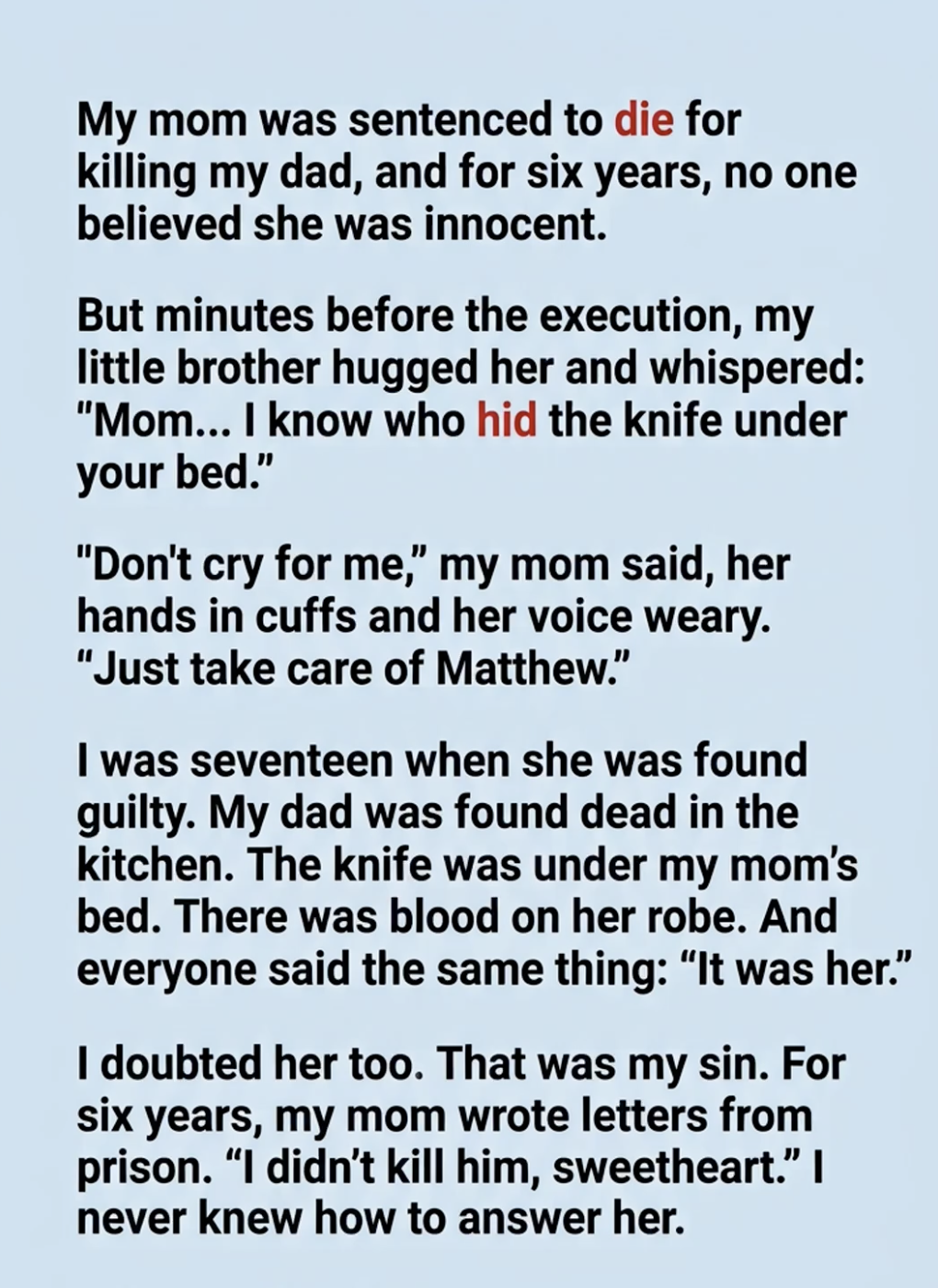
My mother was sentenced to die for killing my father.
For six years, almost everyone believed she was guilty.
I did too.
That was the part I hated myself for most.
I was seventeen when my father was murdered.
My little brother Matthew was only eleven.
We had been at home that night.
I remember the rain.
I remember the power flickering.
I remember my mother screaming.
And I remember finding my father on the kitchen floor.
There was blood everywhere.
The murder weapon was a kitchen knife.
It was found beneath my mother’s bed.
There was blood on her robe.
And suddenly, the story seemed obvious.
The police arrested her before sunrise.
Neighbors talked.
Relatives whispered.
People who had known my mother for twenty years suddenly claimed they’d always thought she was “unstable.”
The newspapers called it a domestic murder.
The prosecutor called it a crime of rage.
The jury took less than four hours to convict her.
My mother received the death penalty.
She never stopped saying the same thing.
“I didn’t kill your father.”
But I didn’t believe her.
Not completely.
How could I?
The evidence was overwhelming.
The knife.
The blood.
Her fingerprints were on the kitchen counter.
Her robe had blood on it.
There were no signs of forced entry.
And my parents had been arguing more often during the months before his death.
So when my mother looked at me through the glass during our first prison visit and said,
“Sweetheart, you have to believe me.”
I couldn’t say yes.
I couldn’t say no.
I just cried.
She reached for the phone.
“I didn’t do it.”
I whispered,
“I don’t know what to believe.”
Her face broke.
But she nodded.
“I understand.”
That was the last time I ever saw her expect me to defend her.
After that, she stopped asking.
Every few months, she wrote me a letter.
Most were short.
She asked about school.
Matthew.
My graduation.
Whether I was eating enough.
And at the bottom of almost every letter was the same sentence.
I didn’t kill him.
I never knew how to answer.
So eventually, I stopped answering at all.
Matthew was different.
He believed her.
He was eleven when Dad died.
Twelve when Mom was convicted.
Thirteen when her appeals began.
Fourteen when everyone stopped talking about the case.
Fifteen when he started having nightmares.
Sixteen when he began asking questions nobody wanted to answer.
“Why was the knife under Mom’s bed?”
“I don’t know.”
“Why was there blood on her robe?”
“I don’t know.”
“Why did Dad’s watch disappear?”
I looked at him.
“What?”
He shook his head.
“Never mind.”
I should have asked.
I didn’t.
For six years, we lived with the verdict.
Mom remained on death row.
Matthew and I grew up without her.
I went to college.
He finished high school.
We built separate lives around the same empty space.
Then, six years after my father’s death, the execution date was set.
November 18.
My mother would be executed at 9:00 p.m.
The state had rejected her final appeal.
There would be no more delays.
No more hearings.
No more chances.
Matthew was nineteen by then.
I was twenty-three.
We drove to the prison together.
The entire ride was silent.
When we arrived, my mother was brought into a small visitation room.
She looked older.
Much older.
Her hair had turned gray.
Her face was thinner.
But when she saw us, she smiled.
“My babies.”
I started crying immediately.
Matthew didn’t.
He walked straight to the glass.
Mom picked up the phone.
Matthew picked up his.
“I love you,” she said.
“I love you too,” he answered.
She looked at me.
“And you?”
I could barely speak.
“I love you, Mom.”
She smiled.
Then she said,
“That’s enough.”
We had thirty minutes.
We talked about ordinary things.
The weather.
My job.
Matthew’s apartment.
A neighbor’s dog.
Anything except death.
When the guard came to say our time was almost over, my mother closed her eyes.
“Don’t cry for me.”
I shook my head.
“I can’t help it.”
She smiled.
“Take care of Matthew.”
Then she looked at him.
“You take care of your sister too.”
Matthew nodded.
But he wasn’t looking at her.
He was staring at the floor.
Then suddenly he stepped closer to the glass.
“Mom.”
“Yes?”
His voice trembled.
“I know who hid the knife.”
My mother froze.
So did I.
“What?”
Matthew looked directly at her.
“I know who put the knife under your bed.”
My mother whispered,
“Matthew…”
“I know.”
He looked at me.
“I figured it out three months ago.”
My heart began pounding.
“What are you talking about?”
He turned back toward Mom.
“Don’t say anything.”
She looked frightened.
“Matthew, listen to me—”
“No.”
He shook his head.
“You told us for six years that you didn’t do it.”
“Yes.”
“I believe you now.”
The guard stepped toward us.
“Time.”
Matthew ignored him.
He leaned closer to the glass.
“Mom…”
His voice broke.
“I know who killed Dad.”
My mother closed her eyes.
A tear ran down her cheek.
Then Matthew whispered a name.
My name.
My blood turned cold.
I stared at him.
“What?”
He looked at me.
“I didn’t mean you.”
He swallowed.
“I mean someone you trusted.”
Then he said the name.
Uncle Richard.
Our father’s younger brother.
I couldn’t breathe.
Richard?
That made no sense.
He had been the one who comforted us after Dad’s death.
He attended every court hearing.
He hugged me at the funeral.
He told me our mother deserved whatever punishment the court gave her.
He had even paid for some of my college expenses.
Why would he kill his own brother?
Matthew pulled a folded piece of paper from his pocket.
“I found this in Dad’s old desk.”
I stared at it.
“What is it?”
“A bank statement.”
I looked at the paper.
There were several large withdrawals.
All made during the six months before Dad’s death.
And every withdrawal had been authorized by someone with access to my father’s business account.
Richard.
My uncle had been taking money.
A lot of it.
Matthew continued.
“Dad found out.”
I stared at the numbers.
“How do you know?”
“Because I found the second document.”
He handed me another paper.
It was a letter.
Written by my father.
It was dated three days before his murder.
Richard,
I know what you’ve been doing.
You have until Friday to return the money.
After that, I’m going to the police.
I felt sick.
The date was two days before Dad died.
Matthew whispered,
“Dad was going to expose him.”
“But the knife?”
Matthew nodded.
“That’s where it gets worse.”
He explained what he had discovered.
Our uncle had been at our house the night Dad died.
He had told police he’d left around eight.
But a neighbor had later mentioned seeing his car outside our house after nine.
That witness had never been interviewed.
Matthew had found the neighbor through an old newspaper archive.
Then he found something else.
A photograph.
Taken accidentally at a restaurant across the street.
It showed Richard’s car parked outside our house.
At 9:17 p.m.
Dad had died at approximately 9:30.
My hands were shaking.
“But why would the police blame Mom?”
Matthew looked at me.
“Because he made sure they would.”
He explained.
Richard knew my mother had argued with Dad that evening.
He knew she had gone upstairs after the argument.
He knew her robe was hanging in the bedroom.
And he knew the police would immediately suspect her if they found the murder weapon beneath her bed.
But there was one thing he hadn’t anticipated.
Mom had cut her hand earlier that evening while washing a broken glass.
The blood on her robe wasn’t Dad’s.
It was hers.
She had bandaged the cut before the murder.
But when she heard the scream and ran downstairs, she’d grabbed Dad.
His blood mixed with the blood already on her robe.
The police assumed all of it came from him.
Richard had taken the knife from the kitchen.
Killed Dad.
Carried it upstairs.
Placed it beneath Mom’s bed.
Then left.
But there was something else.
Matthew found a tiny trace of Dad’s blood on the inside handle of Richard’s car.
It had been overlooked because the police never had reason to search it.
My stomach turned.
“How did you find all this?”
Matthew looked at me.
“Because I never stopped believing Mom.”
I began crying.
He reached for my hand.
“I did.”
I whispered.
“I know.”
“I should have believed her.”
“You were seventeen.”
“I still should have.”
Matthew shook his head.
“You were scared.”
Then he looked at the clock.
The execution was less than an hour away.
We ran.
We found the prison attorney.
We showed him everything.
The attorney immediately contacted the emergency appeals court.
Police were notified.
Richard was located at his house.
He was arrested before he could leave.
The execution was halted at 8:47 p.m.
My mother was still alive.
Barely.
When the prison guard came to tell us, I collapsed into Matthew’s arms.
My mother wasn’t executed.
She was transferred to a hospital.
The evidence was overwhelming.
Richard eventually confessed.
Not immediately.
At first, he denied everything.
Then investigators found the missing financial records.
The neighbor’s statement.
The photograph.
The blood evidence.
And finally, the original murder weapon was tested again with newer forensic technology.
There was DNA beneath the handle.
Richard’s.
He eventually admitted that he had killed my father after Dad threatened to expose years of embezzlement.
He had planted the knife under my mother’s bed because he knew everyone would believe she was capable of killing her husband.
“She had the motive,” he said.
“But you had the plan.”
That was the prosecutor’s response.
Richard received a life sentence.
My mother’s conviction was vacated.
She was released six years after she had been sentenced to die.
The day she walked out of prison, Matthew and I were waiting.
She stopped when she saw us.
For a moment, none of us moved.
Then I ran to her.
I wrapped my arms around her.
“I am so sorry.”
She held me tightly.
“You don’t have to be.”
“I didn’t believe you.”
She closed her eyes.
“I know.”
“I should have.”
She pulled back and looked at me.
“You were a child.”
I shook my head.
“I was your daughter.”
“And you’re here now.”
Then she hugged me again.
That was the moment I finally understood what forgiveness felt like.
It wasn’t forgetting.
It wasn’t pretending the six years hadn’t happened.
It wasn’t erasing the letters I never answered.
It was simply choosing not to let the worst thing that ever happened to us become the only thing we remembered.
Mom came home.
But home was different.
Everything had changed.
The house had been sold years earlier.
My father was gone.
Richard was in prison.
Six years had disappeared.
We couldn’t get them back.
So we stopped trying.
We made new memories.
Mom learned how to use a smartphone.
She became obsessed with gardening.
Matthew teased her about overwatering everything.
I cooked Sunday dinners.
Sometimes we talked about Dad.
Sometimes we didn’t.
Sometimes Mom cried.
Sometimes I did.
And sometimes we laughed so loudly that the neighbors probably thought we’d lost our minds.
A year after her release, I found a box in the attic.
Inside were all the letters Mom had written me from prison.
I had never opened most of them.
There were dozens.
I sat on the floor and began reading.
The first said:
Sweetheart,
I know you don’t believe me.
But I am innocent.
The next said:
Please take care of Matthew.
Another:
Don’t let this make you hate your father.
Another:
Whatever happens, don’t let what happened to me destroy your life.
I kept reading.
Near the bottom of the box, I found one written only weeks before her scheduled execution.
I opened it.
My darling girl,
If you’re reading this, then perhaps I didn’t get another chance to tell you.
I never blamed you.
Not once.
You were seventeen. You lost your father. You were frightened. Everyone around you told you I was guilty.
I could never ask a frightened child to be braver than the adults around her.
I only wanted you to live.
I pressed the letter to my chest.
And cried.
Matthew found me sitting there.
“What happened?”
I handed him the letter.
He read it.
Then sat beside me.
After a long silence, he said,
“You know what saved her?”
“What?”
“My questions.”
I smiled through tears.
“Yes.”
He looked at me.
“And your mistake?”
I frowned.
“What?”
“You stopped asking questions.”
That sentence stayed with me.
Because he was right.
The evidence had looked convincing.
The story had been simple.
Too simple.
A dead husband.
An angry wife.
A bloody robe.
A knife under her bed.
Everyone wanted an answer.
And once they had one, they stopped looking.
Matthew hadn’t.
He kept digging.
He kept questioning.
He kept believing that the truth was worth finding, even when everyone else had stopped searching.
Years later, Mom asked me something.
We were sitting on the porch.
She was watering her plants.
“Do you still think about that night?”
“Sometimes.”
“So do I.”
She looked at me.
“Do you regret not believing me?”
I thought about it.
“Yes.”
She nodded.
“Me too.”
“You regret something?”
She smiled sadly.
“I regret that you ever had to choose.”
I reached for her hand.
“You’re my mother.”
“And you’re my daughter.”
We sat there quietly.
Then she laughed.
“You know what I learned in prison?”
“What?”
“Never hide a knife under your bed.”
I laughed.
She laughed too.
It was the first time we’d ever joked about it.
And somehow, that made the memory hurt a little less.
My mother lost six years of her life.
My father lost his.
Our family lost years we could never recover.
But the truth eventually found its way home.
And I learned something I wish I’d understood when I was seventeen:
Sometimes the most dangerous lie isn’t the one someone tells you.
It’s the one everyone else believes so completely that you stop looking for the truth yourself.
My mother had spent six years insisting she was innocent.
My little brother spent six years refusing to stop asking why.
And in the end, the difference between a woman dying for a crime she didn’t commit and a mother coming home to her children was one stubborn nineteen-year-old who refused to accept an easy answer.
That night before the execution, Matthew didn’t just save our mother.
He saved the truth.
And every time I think about the words he whispered through that glass, I remember the lesson that changed our family forever:
When everyone tells you the story is over, sometimes that’s exactly when you need to start asking questions.