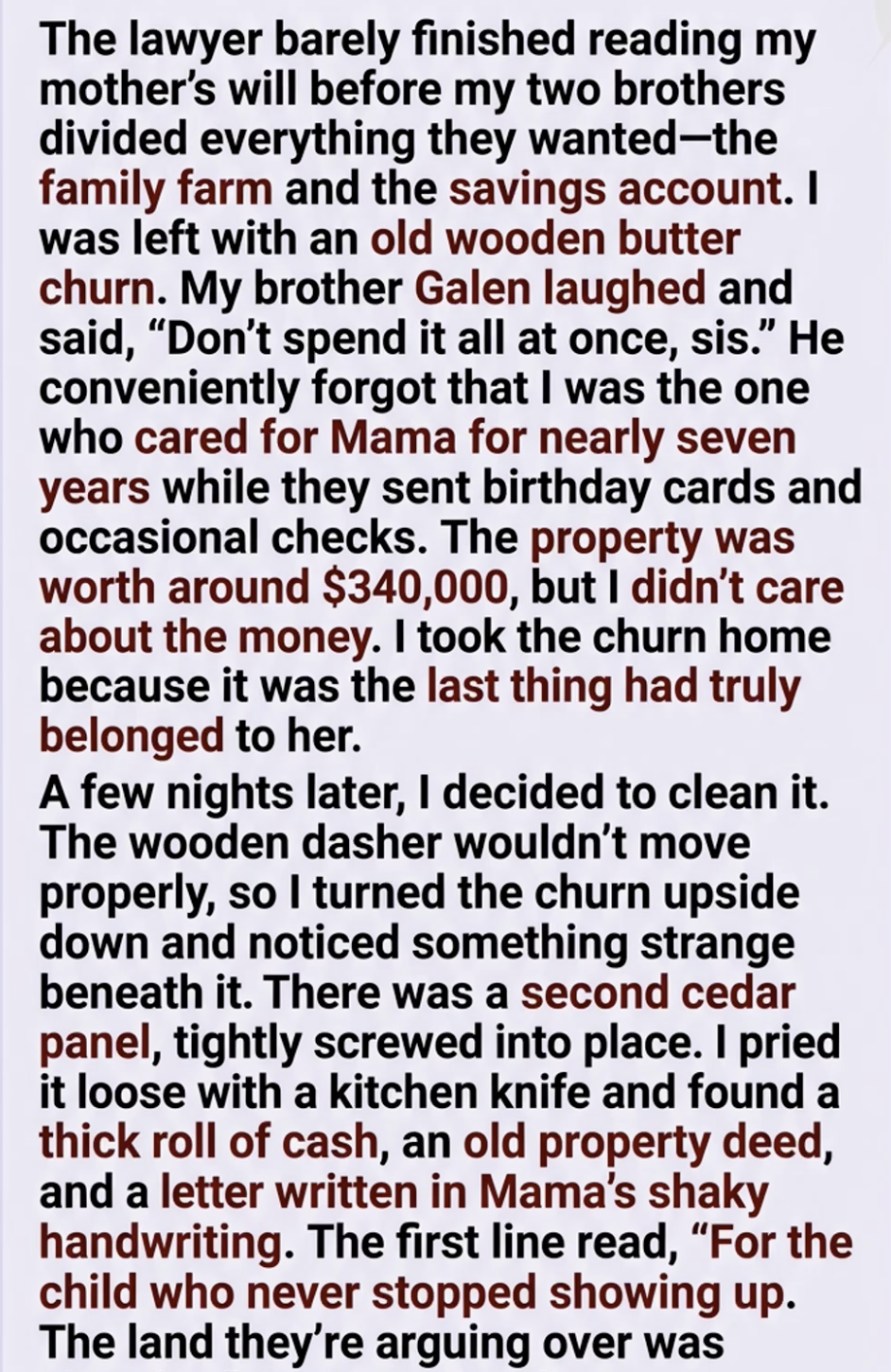
The lawyer barely finished reading my mother’s will before my two brothers started dividing up her life as if it were a list of things at a yard sale.
Galen wanted the farm.
Richard wanted the savings account.
Neither of them asked what Mama had wanted.
Neither of them asked what she had left behind emotionally.
They only wanted numbers.
The family farm was worth around $340,000.
The savings account held just over $86,000.
Between them, my brothers were about to walk away with more than $400,000.
And me?
I got an old wooden butter churn.
Galen actually laughed.
“Don’t spend it all at once, sis.”
Richard smiled.
“I guess Mama knew you liked sentimental things.”
I looked at the churn sitting beside the lawyer’s desk.
It was scratched and faded.
One side had a small crack near the bottom.
The metal handle was slightly rusted.
To anyone else, it was worthless.
To me, it was priceless.
I remembered sitting beside Mama when I was little, watching her make butter in that very churn.
She used to let me turn the handle.
I hated how heavy it was.
She would laugh and say, “Keep going, sweetheart. Good things take work.”
Years later, when Mama became ill, I was the one who kept turning up.
For nearly seven years, I took her to appointments.
I cooked.
I cleaned.
I handled her medications.
I slept on the couch when she was too sick to be alone.
I learned which foods she could tolerate and which ones made her nauseous.
I sat beside her through long nights when she couldn’t sleep.
My brothers visited when they could.
Galen lived three hours away.
Richard lived in another state.
They called on birthdays.
They sent Christmas cards.
Occasionally, they mailed a check.
And I never complained.
Not once.
Mama never asked me to sacrifice my life for her.
I simply couldn’t imagine doing anything else.
When she died, I was holding her hand.
Her last words were barely a whisper.
“Thank you for showing up.”
I didn’t understand then why she had said those particular words.
But I remembered them.
After the funeral, my brothers immediately started discussing the farm.
“I’ll take care of the taxes,” Galen said.
Richard shook his head.
“You don’t even live here.”
They argued for nearly an hour.
I sat quietly.
Finally, the lawyer opened Mama’s will.
The farm went to Galen.
The savings account went to Richard.
Some personal items were divided between them.
And the butter churn went to me.
I didn’t fight.
I didn’t ask for the farm.
I didn’t ask for the money.
I just took the churn.
As I carried it to my car, Galen followed me outside.
“Seriously?” he said.
“What?”
“You’re not even going to challenge this?”
I shook my head.
“No.”
He laughed.
“You spent seven years taking care of her, and she left you a butter churn.”
I looked at him.
“She left me something that mattered.”
He shrugged.
“Whatever makes you feel better.”
I drove home.
For the first few days, I kept the churn on the kitchen counter.
I couldn’t bring myself to put it away.
Every time I looked at it, I remembered Mama’s hands.
One evening, I decided to clean it.
It had been sitting in storage for years, and there was dust packed into every little groove.
I removed the metal handle and wiped the wood.
Then I tried moving the wooden dasher.
It wouldn’t turn properly.
Something was catching underneath.
I turned the churn upside down.
That’s when I noticed something strange.
The bottom wasn’t one solid piece of wood.
There was a second cedar panel.
It was almost perfectly fitted into the base.
And it had been tightly screwed into place.
My heart began beating faster.
I found an old kitchen knife and carefully worked around the edges.
After several minutes, one of the screws finally loosened.
Then another.
When the panel came away, I stared into the hidden compartment.
There was a thick roll of cash.
Several old documents.
A property deed.
And an envelope.
My hands began shaking before I even opened it.
Mama’s handwriting was unmistakable.
The first line read:
“For the child who never stopped showing up.”
I sat down.
I read the next sentence.
“The land they’re arguing over was already yours.”
I stopped breathing.
I read it again.
Then again.
The deed was dated nineteen years earlier.
It transferred ownership of a specific portion of the farm to me.
Not the entire property.
But the most valuable section.
Nearly thirty acres.
The land included the farmhouse, the old barn, and the road frontage that had become extremely valuable after a highway expansion project.
The deed had been legally recorded.
My name was on it.
I looked at the cash.
There was $48,000.
But the letter explained that the money wasn’t the real surprise.
Mama had known that my brothers would assume the farm belonged to them.
She knew they would argue over it.
So years earlier, after talking with an attorney, she had transferred the portion of the property where I had spent most of my childhood.
The remainder of the farm could go to Galen.
But the land that included the farmhouse was mine.
The letter continued.
“I didn’t tell your brothers because I knew they would pressure you.”
My eyes filled with tears.
“They love you, but they have always believed that whoever speaks the loudest deserves the most.”
Then came the part that hurt the most.
“You never asked me for anything.”
I wiped my eyes.
“That is why I want you to have something that nobody can take from you by making you feel guilty.”
I folded the letter against my chest.
For several minutes, I simply cried.
Not because of the money.
Not because of the land.
Because Mama had seen me.
She had noticed every ordinary thing I had done.
The grocery trips.
The sleepless nights.
The hospital waiting rooms.
The meals.
The laundry.
The little things nobody thanked me for because they had become routine.
Mama had noticed.
And she had planned for me.
The next morning, I called the attorney whose name appeared on the deed.
His name was Harold Bennett.
When I explained what I’d found, he was silent for a moment.
Then he said something that made my heart pound.
“I’ve been expecting your call.”
I sat up straight.
“What?”
“Your mother told me that one day you would find that compartment.”
“She did?”
“Yes.”
He explained that Mama had hired him nineteen years earlier.
She had been worried that her health would eventually decline and that family arguments might follow.
So she legally separated ownership of the property.
The land I had inherited through the hidden deed was mine.
The remaining acreage belonged to the estate.
Galen had inherited that remaining property through the will.
Richard had inherited the cash account.
But neither of them had inherited my thirty acres.
And the $48,000 wasn’t hidden illegally.
It was money Mama had withdrawn from a separate account over several years.
She had placed it there specifically for me.
Harold told me something else.
“Your mother made me promise not to tell you unless you discovered the documents yourself.”
“Why?”
“Because she wanted you to know you weren’t helping her because you expected a reward.”
I closed my eyes.
That sounded exactly like Mama.
The following Monday, I asked Harold to meet me at the farm.
Galen was already there.
So was Richard.
They were standing near the barn, arguing about whether to sell or lease the property.
When they saw me, Galen frowned.
“What are you doing here?”
I held up the deed.
“I came to see what Mama left me.”
Richard laughed.
“You mean the churn?”
I handed the document to Harold.
He opened it.
Galen’s smile disappeared.
“What is that?”
Harold looked at both of them.
“This is a recorded deed transferring approximately thirty acres of this property to your sister.”
Silence.
Richard stepped forward.
“That’s impossible.”
“No,” Harold said calmly. “It’s quite possible. It’s also legally valid.”
Galen grabbed the paper.
He read it.
Then read it again.
His face changed.
“This was done nineteen years ago?”
“Yes.”
“You knew?”
Harold nodded.
“I represented your mother.”
Galen looked at me.
“You knew about this?”
“I found it two nights ago.”
Richard’s voice became sharp.
“Why would she hide this from us?”
I looked at him.
“I think Mama knew exactly why.”
Neither brother spoke.
Then Galen pointed toward the farmhouse.
“So you get the house too?”
“Yes.”
“And thirty acres?”
“Yes.”
“And that money?”
I didn’t answer.
Harold did.
“The cash was separately documented as a gift.”
Galen’s face reddened.
“You’ve got to be kidding me.”
I looked at my brothers.
“You already received what Mama left you.”
Galen shook his head.
“She tricked us.”
“No,” I said quietly.
“She protected me.”
That sentence ended the argument.
For the first time, neither of them had anything to say.
Later that afternoon, Richard asked me why Mama hadn’t simply told everyone about the deed.
I thought about it.
Then I answered honestly.
“Because she knew you two would spend your energy fighting over what was hers instead of asking what she wanted.”
He looked away.
I didn’t say anything else.
A week later, Galen came to the farmhouse alone.
He stood on the porch for several minutes before knocking.
When I opened the door, he looked different.
Less confident.
More tired.
“Can I come in?”
I stepped aside.
He sat at the kitchen table.
For a while, neither of us spoke.
Finally, he said,
“I didn’t realize how much you did.”
I looked at him.
“What changed?”
He stared at his hands.
“I found Mama’s old calendar.”
My throat tightened.
He continued.
“It had your name written on almost every page.”
Doctor.
Pharmacy.
Groceries.
Physical therapy.
Hospital.
Galen swallowed.
“I thought you were just helping her.”
“I was.”
“No,” he said. “You were her whole support system.”
I didn’t know what to say.
Then he pulled something from his pocket.
It was one of Mama’s old birthday cards.
He had kept it unopened for years.
“I found this in my drawer,” he said.
I looked at the envelope.
“Why didn’t you open it?”
He smiled sadly.
“I don’t know.”
He handed it to me.
Inside, Mama had written:
“I hope someday you understand that your sister’s love for me isn’t an accusation against you. It’s simply something beautiful she gave freely.”
Galen’s eyes filled with tears.
“I wish I’d understood that sooner.”
I reached across the table.
He took my hand.
We sat there quietly.
Not everything was fixed.
It couldn’t be.
Years of resentment don’t disappear because someone finally says sorry.
But something changed.
Richard came two weeks later.
He didn’t apologize immediately.
Instead, he asked if he could help repair the barn.
I laughed.
“You don’t know how to repair a barn.”
“I can learn.”
So we learned.
The three of us eventually decided not to sell the remaining farm.
We divided responsibilities.
Galen managed the acreage he inherited.
Richard handled the financial side.
And I kept the farmhouse and the thirty acres Mama had given me.
I also kept the butter churn.
I restored it carefully.
The scratches remained.
I left them there.
I wanted every mark to stay.
One spring morning, I planted a small garden beside the farmhouse.
Then I placed the butter churn beneath the kitchen window.
It wasn’t worth much money.
But it had become the most valuable thing Mama could have given me.
Because it had taught me something I didn’t understand when I was a child.
Sometimes the people who seem to receive the least are actually the ones who were seen the most.
My brothers inherited land.
They inherited money.
I inherited a piece of Mama’s heart.
And eventually, they learned that the difference wasn’t measured in dollars.
It was measured in something far harder to replace.
Time.
The time I gave her.
The time she noticed.
And the love that survived long after the last page of her will had been read.
Mama’s final gift wasn’t the land.
It wasn’t the cash.
It wasn’t even the deed.
It was the quiet message hidden beneath an old wooden butter churn:
“I saw you. I knew what you gave. And you were never forgotten.”
And somehow, that was worth more than anything my brothers had fought over.