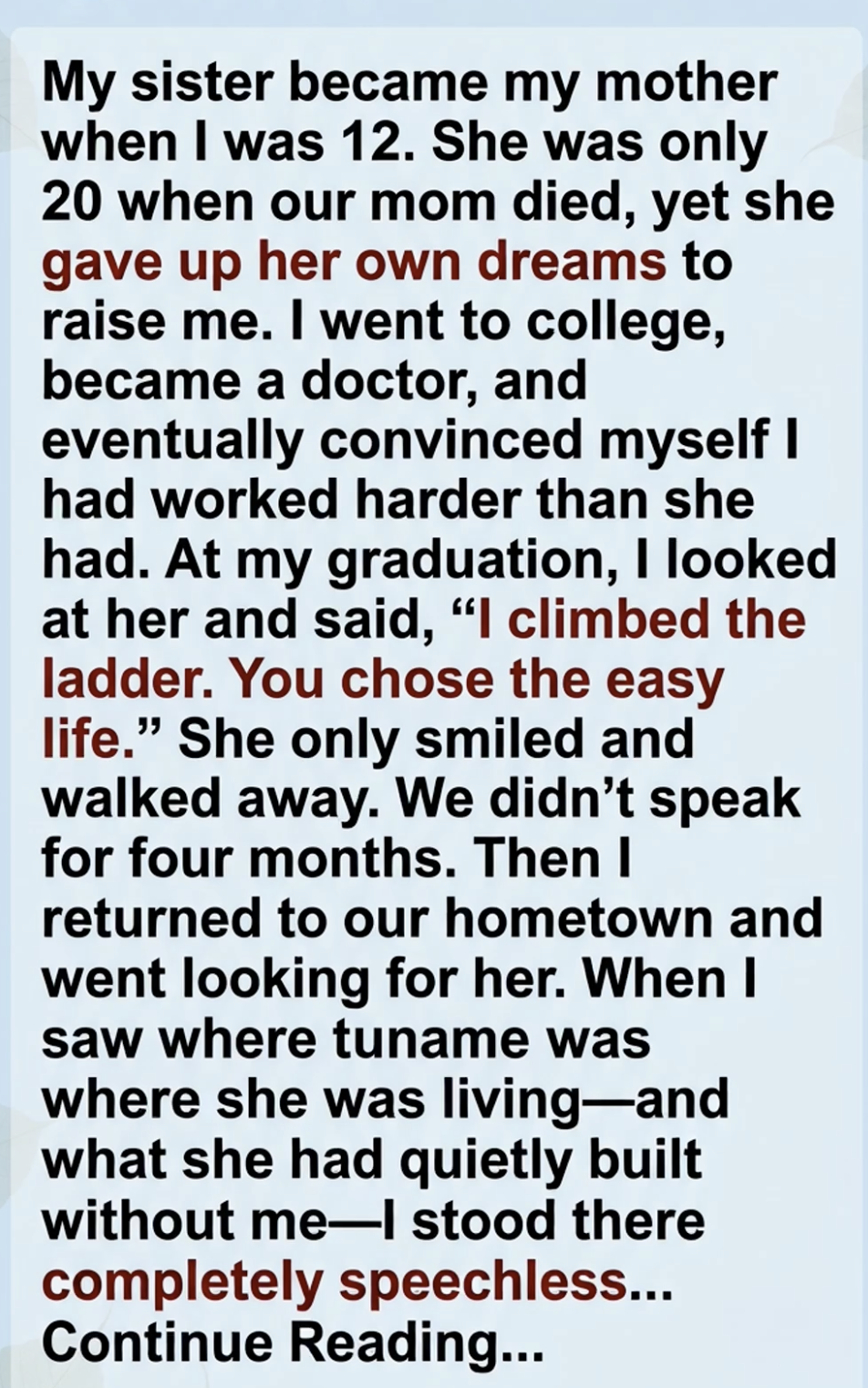
My sister became my mother when I was twelve.
She was only twenty.
That was the age when most people were deciding what college to attend, what career to pursue, who they wanted to become.
My sister was deciding how to keep a twelve-year-old boy fed.
Our mother died suddenly.
One week she was complaining about being tired.
The next week, we were standing beside her grave.
Our father had already been gone for years.
There was no aunt nearby.
No grandparent who could take us in.
No savings large enough to make the decision easy.
Social services asked my sister whether she had somewhere to go.
She looked at me.
Then she said,
“I’ll take care of him.”
Nobody asked what that would cost her.
I didn’t either.
I was twelve.
All I knew was that my sister had become the person who made breakfast.
The person who packed my lunch.
The person who signed school forms.
The person who sat beside me when I had nightmares.
She learned how to braid my hair badly when I had a school play.
She learned how to stretch grocery money.
She learned how to say no to herself so often that eventually she stopped noticing she was doing it.
Her name was Emily.
She was twenty when she became my guardian.
I was twelve.
And for the next several years, she gave me everything she had.
She worked mornings at a grocery store.
Then she worked evenings at a diner.
On weekends, she cleaned offices.
Sometimes she came home after midnight.
I would pretend to be asleep because I knew she was tired.
She would quietly check my blanket anyway.
Then she’d go to the kitchen and wash dishes.
I remember once waking up at 2 a.m. and seeing her sitting at the table with a stack of bills.
She had fallen asleep with a calculator in her hand.
I didn’t understand what I was seeing.
I only knew that she had somehow made everything work.
When I graduated high school, I told her I wanted to become a doctor.
She didn’t hesitate.
“Then become one.”
“I don’t know if we can afford medical school.”
She smiled.
“We’ll figure it out.”
I didn’t realize what “we’ll” meant.
I thought it meant money.
I didn’t understand that it meant sacrifice.
Emily worked more.
She took out loans.
She sold the little car she’d bought for herself.
She moved us into a smaller apartment.
When I needed textbooks, she bought them.
When I needed an application fee, she paid it.
When I needed money for my first college deposit, she emptied the small savings account she’d built for herself.
I asked her once what she had been saving for.
She smiled.
“Nothing important.”
Years later, I realized she had been saving for a life.
Her life.
But I never asked.
College was difficult.
Medical school was worse.
There were nights when I called her exhausted.
She always answered.
“You can do this.”
When I failed an exam, she said,
“One bad test doesn’t decide your future.”
When I wanted to quit, she said,
“Then quit tomorrow. Tonight, sleep.”
She never made me feel like I owed her.
That was part of the problem.
Because when someone never asks for credit, it’s easy to forget how much they gave.
I became a doctor.
My first hospital position was prestigious.
My salary was more than Emily had ever made in an entire year.
I bought a nice apartment.
I bought a new car.
I started wearing expensive suits.
People called me successful.
And slowly, something ugly happened inside me.
I began believing I had done it alone.
I looked at my life and saw the long nights studying.
The exams.
The residency.
The years of exhaustion.
The sacrifices I had made.
I forgot hers.
Emily still lived in our hometown.
She had never gone to college.
She had never built a prestigious career.
She worked as an administrative assistant at a community center.
At least, that’s what I thought.
Whenever I visited, I felt strangely uncomfortable.
I had become a doctor.
She was still there.
I began interpreting our lives as a comparison.
Mine had moved forward.
Hers had stayed behind.
I didn’t say it out loud.
Not until my medical school graduation.
Emily had traveled several hours to attend.
She wore the same simple blue dress she’d owned for years.
I had just received my diploma.
My friends were taking photographs.
My professors were congratulating me.
Emily stood at the edge of the crowd, smiling.
I walked toward her.
She hugged me.
“I knew you’d do it.”
I looked at her.
Something inside me wanted to prove that I had earned everything myself.
Maybe I was proud.
Maybe I was insecure.
Maybe I had become so obsessed with success that I couldn’t see what success had cost her.
I said,
“I climbed the ladder.”
She smiled.
Then I added the sentence that I would regret for the rest of my life.
“You chose the easy life.”
Her smile disappeared.
Only for a second.
Then she looked at me.
“Did I?”
I shrugged.
“You could have gone to college.”
She nodded.
“I could have.”
“You could have built a career.”
“Yes.”
“You could have done more.”
She looked at me for a long time.
Then she said,
“I suppose I could have.”
She didn’t argue.
She didn’t remind me about the grocery store.
Or the diner.
Or the bills.
Or the nights she slept three hours.
She didn’t remind me that she had given me the opportunities she never got.
She simply hugged me.
Then she whispered,
“Congratulations, Doctor.”
And walked away.
We didn’t speak for four months.
At first, I expected her to call.
She didn’t.
I told myself she was being stubborn.
Then I told myself she was angry.
Eventually, I told myself I didn’t need her.
My career became busier.
My life became louder.
But something was missing.
One night, I found an old photograph in a drawer.
It was from my first day of medical school.
Emily was standing beside me.
She looked exhausted.
But she was smiling.
I stared at the photograph.
Then I noticed something behind her.
A suitcase.
Her suitcase.
She had been leaving the next morning for a job interview in another city.
I suddenly remembered.
She had canceled the interview.
She said she wanted to make sure I had enough money for my first semester.
I had completely forgotten.
That night, I couldn’t sleep.
The next morning, I bought a plane ticket home.
I didn’t call her first.
I wanted to surprise her.
When I arrived in our hometown, I drove to the address I remembered.
She wasn’t there.
A neighbor told me she had moved.
“Where?”
The woman smiled.
“You haven’t heard?”
I shook my head.
She gave me an address.
I drove there.
It was on the edge of town.
I expected a small apartment.
Instead, I found a large brick building.
There was a sign outside.
THE EMILY HARRIS CENTER FOR YOUNG WOMEN
I stopped the car.
I stared at it.
Then I walked inside.
A receptionist looked up.
“Can I help you?”
“I’m looking for Emily Harris.”
She smiled.
“She’s in the back.”
I followed her down a hallway.
Then I heard Emily’s voice.
“Make sure everyone gets a notebook before the workshop starts.”
I stopped.
She was standing in a bright room surrounded by young women.
There were computers.
Books.
Desks.
A small kitchen.
A childcare room.
A wall covered with photographs.
Emily turned.
Our eyes met.
She froze.
“Daniel?”
I couldn’t speak.
I looked around.
“What is this?”
She smiled awkwardly.
“It grew.”
“Grew?”
She nodded.
“Remember the apartment where I used to work after you went to bed?”
“Yes.”
“I started helping teenagers there.”
She explained.
Years earlier, after I left for college, Emily had begun volunteering with young women who had dropped out of school or were aging out of foster care.
She helped them find jobs.
She helped them apply to colleges.
She taught budgeting.
She helped them prepare résumés.
She found temporary housing for some.
Eventually, she started a small nonprofit.
Then local businesses began donating.
Then a foundation.
Then grants.
Eventually, she bought an abandoned building and renovated it.
The center now provided scholarships, job training, childcare, counseling referrals, and emergency assistance.
Hundreds of young women had passed through its doors.
I stared at her.
“You built all this?”
She shrugged.
“With help.”
“How?”
She smiled.
“I started with what I knew.”
“What did you know?”
She looked at me.
“How to take care of someone who needed a chance.”
I couldn’t breathe.
I looked at the photographs on the wall.
Young women graduating.
Young women receiving certificates.
Young mothers holding babies.
College acceptance letters.
Job offers.
Then I saw a photograph of Emily standing beside a group of teenagers.
Underneath it was a quote:
“Nobody should have to choose between surviving today and building tomorrow.”
I started crying.
Emily noticed.
“Daniel…”
“I was wrong.”
She looked away.
“I know.”
I walked toward her.
“I was horrible.”
“You were hurtful.”
“I thought you didn’t accomplish anything.”
She smiled sadly.
“You were looking at the wrong scoreboard.”
That sentence destroyed me.
I sat down.
She sat beside me.
“I thought because I became a doctor and you didn’t go to college, I had worked harder.”
She didn’t interrupt.
“I thought you chose the easy life.”
Emily looked at me.
“You didn’t climb the ladder alone.”
I lowered my head.
“I know.”
“No.”
She touched my shoulder.
“You need to know.”
She pointed around the room.
“Every time you thought I was standing still, I was building something.”
I looked at her.
“What about your dreams?”
She smiled.
“I had dreams.”
“Did you give them up?”
“For a while.”
My chest tightened.
“But eventually,” she continued, “I realized my dream had changed.”
“What was it?”
She looked at the young women in the room.
“To make sure another twelve-year-old doesn’t lose everything because there isn’t an adult willing to stay.”
I cried harder.
Emily didn’t.
She had already made peace with the past.
I hadn’t.
Then she said something that I will never forget.
“Daniel, I never needed you to repay me.”
“I know.”
“I never wanted you to feel guilty.”
“I know.”
“I just wanted you to remember.”
I looked at her.
“Remember what?”
“That you didn’t get here alone.”
For the first time in my life, I understood the difference between gratitude and debt.
Emily didn’t want my money.
She didn’t want my success.
She didn’t want me to give up my career.
She wanted me to recognize that the person I had become was partly built from sacrifices I hadn’t made myself.
I apologized.
Not once.
For hours.
She eventually laughed.
“You’ve always been dramatic.”
I laughed through my tears.
“I learned from you.”
She shook her head.
“No. You learned from medicine.”
Then she smiled.
“You learned kindness from me.”
We hugged.
And for the first time in four months, it felt like being twelve again.
Except now I understood what I hadn’t understood then.
My sister had not chosen the easy life.
She had chosen me.
And she had paid for that choice with years she could never get back.
Over the next year, our relationship changed completely.
I began volunteering at her center.
I offered free medical screenings.
I helped young women understand health insurance.
I arranged internships at the hospital.
But Emily wouldn’t let me turn her center into a charity project.
“This isn’t yours,” she reminded me.
“I know.”
“Then don’t take over.”
I smiled.
“I’ll follow your lead.”
She raised an eyebrow.
“That’s new.”
We both laughed.
The center continued growing.
And I eventually discovered something even more humbling.
Emily had quietly created a scholarship fund named after our mother.
The first scholarship had been funded with money from her own savings.
The same savings I had once assumed didn’t exist.
The money she had once told me was “nothing important.”
I asked her why she never told me.
She smiled.
“You were busy becoming a doctor.”
I shook my head.
“I should have been paying attention.”
“You are now.”
That was enough for her.
Years later, I stood at another graduation.
This time, I wasn’t receiving a diploma.
I was standing beside Emily.
A young woman from her center had just graduated from nursing school.
She ran across the stage and hugged Emily.
“Thank you for believing in me.”
Emily cried.
I looked at my sister.
And I finally understood.
I had spent years thinking success was measured by how high you climbed.
Emily had taught me that sometimes success is measured by how many people you help climb with you.
I had become a doctor.
She had become the reason dozens of young women believed they could become anything at all.
I had built a career.
She had built a place where other people could build theirs.
I had spent years believing she had stayed behind.
But she hadn’t.
She had been walking beside me the entire time.
I was simply too busy looking upward to notice.
One evening, we sat together outside the center.
The sun was setting.
I asked her,
“Do you ever regret it?”
“Regret what?”
“Giving up those years for me.”
She thought for a moment.
Then she smiled.
“I regret that I thought I had to give up everything.”
I looked at her.
“But I don’t regret you.”
I reached for her hand.
“I don’t deserve you.”
She squeezed it.
“Maybe not.”
I laughed.
She laughed too.
Then she leaned back in her chair.
“You know what your problem was?”
“What?”
“You thought the ladder was the whole world.”
I smiled.
“And what’s the whole world?”
She looked at the young women leaving the center.
“Who you bring with you.”
I never forgot that.
Because my sister didn’t choose the easy life.
She chose the difficult one when I was twelve.
She chose to work when she could have gone to college.
She chose responsibility when she could have chosen freedom.
She chose my future when she was still trying to figure out her own.
And when I finally became successful, she didn’t ask me to thank her.
She simply walked away when I insulted her.
Not because she stopped loving me.
Because she knew I needed to learn something no medical school could teach.
Success doesn’t erase the people who helped you get there.
And sometimes the person standing beside you at the bottom of the ladder isn’t falling behind.
They may be the reason you were able to climb at all.
I spent four months thinking my sister had walked away from me.
The truth was much harder.
She had spent twenty years walking beside me.
And I had been too proud to look down and see her.