When my daughter called me in early December, I could hear the disappointment in her voice.
“Mom, I don’t think the kids are going to make it home for Christmas.”
My heart sank.
My grandchildren lived several states away, and Christmas had always been the one time of year when our whole family tried to be together.
“What happened?”
She sighed.
“The flights are too expensive. I checked three times. It’s just not possible this year.”
“How much?”
There was a pause.
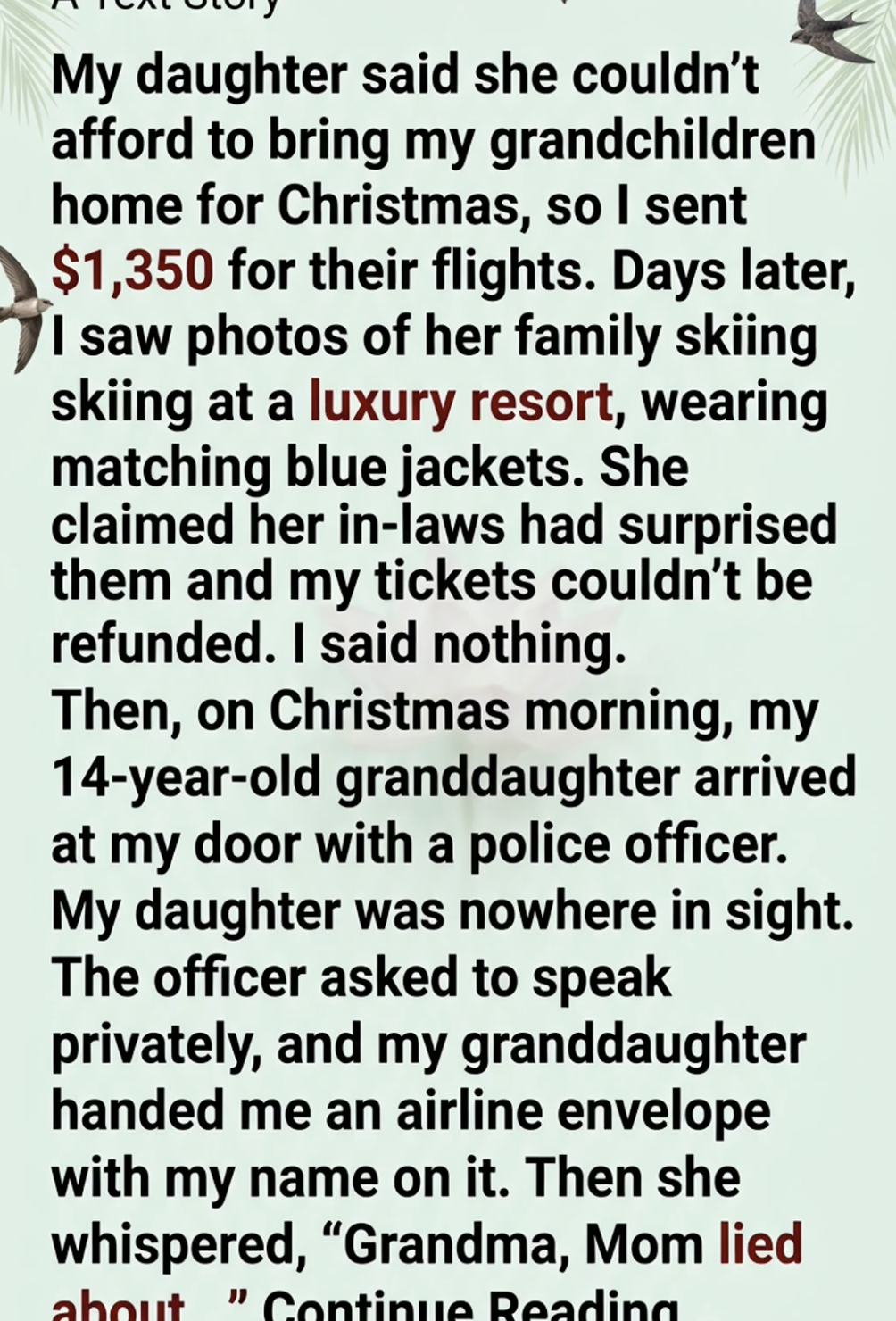
“About $1,350 for all three of them.”
I didn’t hesitate.
“I’ll send it.”
“Mom, no. You don’t have to.”
“I know I don’t have to.”
I smiled.
“I want my grandchildren home for Christmas.”
She thanked me repeatedly.
That afternoon, I transferred the money.
She promised to book the tickets immediately.
I spent the next two weeks decorating the house.
I bought my granddaughter Lily her favorite peppermint chocolates.
For twelve-year-old Noah, I found the model airplane he’d been asking about.
For little Sophie, I bought a pink winter coat because she had outgrown hers.
I even put fresh sheets on the guest beds.
Then, four days before Christmas, I saw the photograph.
It was posted by my daughter’s mother-in-law.
The picture showed my daughter’s entire family standing in front of a huge mountain lodge.
They were wearing matching blue ski jackets.
Behind them were snow-covered mountains.
The caption read:
Best surprise Christmas vacation ever!
I stared at the photograph.
My daughter.
Her husband.
My three grandchildren.
All smiling.
All wearing expensive-looking ski clothes.
At a luxury ski resort.
I checked the date.
They had arrived two days earlier.
I called my daughter.
She answered immediately.
“Mom!”
“Where are you?”
Silence.
Then she said,
“Colorado.”
“I can see that.”
Another silence.
“My in-laws surprised us,” she finally said.
“With a ski vacation?”
“Yes.”
I looked at the photograph again.
“And the flights I paid for?”
“They weren’t refundable.”
“You used the money for flights.”
“Yes.”
“But you’re not flying home.”
“I told you. The tickets couldn’t be refunded.”
I felt something inside me go very still.
“Then why didn’t you tell me?”
“We didn’t know about the trip until after.”
I knew she was lying.
But I didn’t argue.
I simply said,
“Okay.”
She sounded relieved.
“Mom, don’t be upset.”
“I’m not.”
“You understand, right?”
“Yes.”
I hung up.
I didn’t ask for the money back.
I didn’t accuse her.
I didn’t even tell my husband.
I simply put the Christmas presents back in the closet.
Something about the photograph bothered me more than the money.
My grandchildren had been looking forward to Christmas at my house.
And yet, nobody had thought to tell me they weren’t coming.
I assumed I’d hear from them after the ski trip.
I was wrong.
Christmas Eve passed quietly.
Then, at 7:18 Christmas morning, someone knocked on my front door.
I expected a neighbor.
Instead, I saw a police officer standing on my porch.
Beside him was Lily.
My fourteen-year-old granddaughter.
She was wearing a coat over pajamas.
Her face was pale.
And she was carrying a small envelope.
“Grandma?”
I opened the door immediately.
“Lily, what happened?”
She stepped inside.
The officer followed.
“Ma’am, I’m Officer Reynolds. I’d like to speak with you privately.”
My stomach tightened.
“Is she okay?”
“She is physically safe.”
That was all he said.
I looked at Lily.
“Where’s your mother?”
Lily shook her head.
“She’s not here.”
“What do you mean?”
“She left us.”
My heart stopped.
The officer gently said,
“Before we explain everything, your granddaughter asked to give you something.”
Lily handed me the envelope.
My name was written across the front.
Grandma
I opened it.
Inside was an airline receipt.
Then another document.
Then another.
I stared at the first page.
It was a confirmation for three round-trip airline tickets.
The dates were for December 21 through December 29.
The destination was my city.
The total cost was $1,347.
I looked at Lily.
“These are the tickets I paid for.”
She nodded.
“Mom lied.”
My hands started shaking.
“She told you they couldn’t be refunded.”
“They weren’t canceled.”
“What?”
Lily looked at the officer.
He nodded.
“Go ahead.”
She swallowed.
“Mom sold them.”
I stared at her.
“What?”
“She sold the tickets online.”
I looked down at the documents again.
The airline confirmation had a transfer record attached.
The tickets had been transferred to another passenger.
The original purchase was in my daughter’s name.
The money had been recovered through the resale.
She hadn’t lost the $1,350.
She had turned it into cash.
Then Lily whispered,
“That’s not the worst part.”
I sat down.
“What is?”
She pulled another folded piece of paper from her coat.
“Mom told us we were going to Colorado because Grandma wouldn’t let us come for Christmas.”
I felt my chest tighten.
“What?”
“She said you didn’t want us there.”
I looked at the officer.
He said quietly,
“Your granddaughter contacted her school counselor yesterday.”
I looked back at Lily.
“Why?”
She began crying.
“Because Mom told us we weren’t allowed to tell anyone.”
“Tell anyone what?”
Lily wiped her eyes.
“That she had taken our passports.”
I stared at her.
“Why?”
“So we couldn’t leave.”
The room suddenly felt cold.
I stood up.
“Lily, where are your brothers and sister?”
“They’re at the resort.”
“With your mother?”
She shook her head.
“No.”
My heart dropped.
“Then with whom?”
“My uncle.”
“Your mother’s brother?”
“Yes.”
“Where is your mother?”
“I don’t know.”
Officer Reynolds stepped forward.
“We believe your daughter left the resort last night.”
“Left the children?”
“Yes.”
“Why?”
He looked at Lily.
She answered instead.
“Because she got caught.”
“Caught doing what?”
Lily hesitated.
Then she handed me another piece of paper.
It was a bank statement.
My daughter’s name was on it.
So was mine.
I didn’t understand.
Then I saw the transaction.
Two weeks earlier, my daughter had transferred $1,350 from an account connected to my family trust.
I stared at the date.
It was the same day I had sent her the money for the flights.
“That’s my money.”
Lily nodded.
“Mom had been taking money from you for months.”
My mouth went dry.
“How much?”
The officer answered.
“Approximately $18,000 that we’ve been able to document so far.”
I sat back down.
Eighteen thousand dollars.
The Christmas flights weren’t an isolated lie.
They were part of something much bigger.
Lily started talking.
Slowly.
Carefully.
Her mother had been struggling financially for more than a year.
She had hidden credit-card debt.
She had missed mortgage payments.
She had borrowed money from friends.
Then she discovered that I was willing to help when it involved my grandchildren.
So she started inventing emergencies.
School fees.
Medical bills.
Sports registrations.
Airfare.
Winter clothes.
She always made it about the children.
And I always helped.
Lily looked at me with tears in her eyes.
“She told us never to tell you because you’d think she was a bad mother.”
I reached for her hand.
“You didn’t do anything wrong.”
“She said if I told you, you’d take us away.”
The officer looked at me.
“That appears to have been part of the pressure she put on the children.”
I couldn’t speak.
Then Lily said something that broke my heart.
“Grandma, I didn’t want the ski trip.”
“Why?”
“Because I knew you were waiting for us.”
I pulled her into my arms.
She cried against my shoulder.
“I wanted to come home.”
I held her tighter.
“You are home.”
At that moment, my phone rang.
It was my daughter.
I looked at the screen.
Officer Reynolds said,
“You don’t have to answer.”
I did anyway.
“Where are you?”
Her voice was frantic.
“Mom, please listen to me.”
“Where are my grandchildren?”
“They’re safe.”
“Where are you?”
“I had to leave.”
“Why?”
Silence.
Then she said,
“Because everything got out of control.”
I closed my eyes.
“You lied to me.”
“I was going to pay you back.”
“You lied to your children.”
“I was desperate.”
“You sold their plane tickets.”
“I needed the money.”
“You told Lily I didn’t want her.”
She began crying.
“I didn’t mean it.”
“Where are the children?”
“At my brother’s.”
“Why did you leave them?”
“I couldn’t take care of everything anymore.”
The words landed heavily.
I didn’t yell.
I didn’t insult her.
I simply said,
“You should have asked for help.”
“I was ashamed.”
“You should have told me the truth.”
“I was afraid you’d judge me.”
I looked at Lily.
Then at the police officer.
“You were afraid I’d judge you, so you taught your daughter to lie to me?”
My daughter sobbed.
I hung up.
The investigation continued over the next several days.
We learned that the ski trip had been arranged partly by my daughter’s mother-in-law.
But the story my daughter told me was false.
Her in-laws had offered the resort stay months earlier because they wanted all the grandchildren together.
My daughter had agreed.
She then realized she could use the Christmas airfare as another source of cash.
The tickets had been purchased.
Then resold.
The money disappeared into overdue accounts and personal expenses.
My daughter had also told her children that I had refused to let them visit because she wanted to prevent them from questioning the missing money.
The police did not treat it as a simple family disagreement.
There were financial records.
There were messages.
There were transfers.
And there were children who had been placed in the middle.
My daughter eventually returned.
She was ashamed.
She apologized.
But apologies didn’t erase what had happened.
For the first time in my life, I stopped solving her problems for her.
I told her I would help my grandchildren.
I would make sure they had food, clothes, school supplies, and a safe place to stay.
But I would no longer hand her money without knowing exactly where it was going.
We arranged counseling for the children.
Lily eventually told me that the hardest part wasn’t learning her mother had taken money.
It was believing, for even a moment, that her grandmother didn’t want her.
That sentence stayed with me.
Because that’s what manipulation often does.
It doesn’t just steal money.
It makes innocent people question the love around them.
Months later, I took Lily and her siblings on a real Christmas trip.
Nothing extravagant.
Just a small mountain cabin.
We made hot chocolate.
We built a terrible snowman.
We played cards beside the fireplace.
And on Christmas morning, Lily handed me a tiny wrapped box.
Inside was a silver keychain shaped like an airplane.
She smiled.
“So you never forget.”
I laughed.
“I don’t think I’ll ever forget this Christmas.”
She hugged me.
Then she whispered,
“I’m glad I told you.”
I kissed the top of her head.
“Me too.”
I eventually forgave my daughter.
But forgiveness didn’t mean pretending nothing happened.
She had to rebuild trust one decision at a time.
She went through financial counseling.
She repaid what she could.
She apologized directly to her children.
And slowly, over time, she became more honest.
Our relationship changed.
It wasn’t the relationship we’d had before.
But perhaps that wasn’t necessarily a bad thing.
Before, I had thought being a good mother meant always rescuing my daughter.
Now I understood something different.
Sometimes helping someone means giving them money.
Sometimes it means giving them a second chance.
And sometimes it means refusing to protect them from the consequences of their own choices.
The $1,350 I sent for Christmas flights was gone.
But it taught me something worth far more.
I had spent years believing my daughter needed my money.
What my grandchildren needed was something else entirely.
They needed an adult who would believe them when they told the truth.
And on Christmas morning, when my granddaughter showed up at my door with a police officer and an airline envelope, she wasn’t bringing me a financial problem.
She was bringing me the truth.
And for the first time, I understood that sometimes the child who asks for help isn’t the one who needs saving.
Sometimes she’s the one brave enough to save everyone else from another lie.