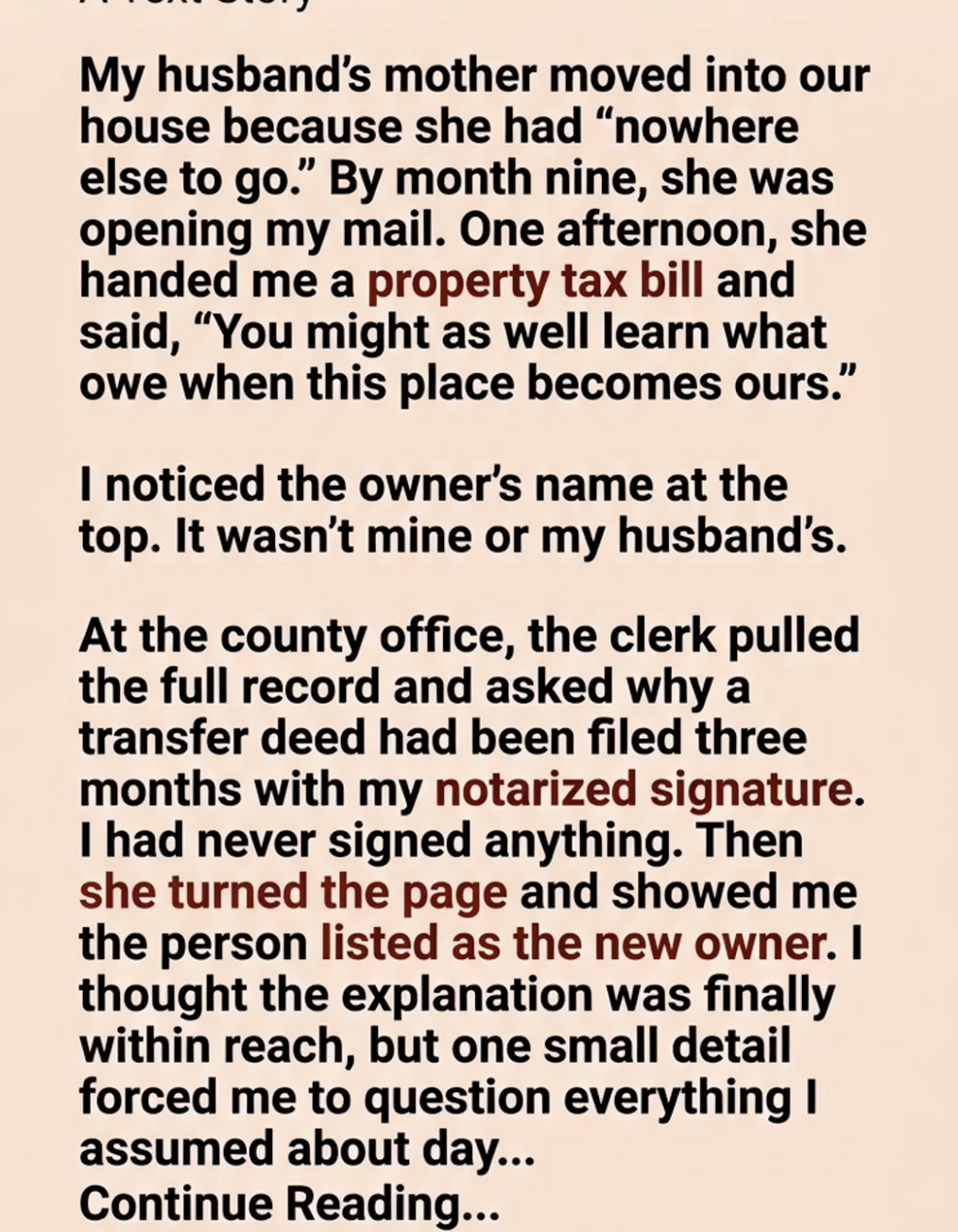
My husband’s mother moved into our house because she had “nowhere else to go.”
At first, I tried to be understanding.
She was seventy-one, recently widowed, and my husband, Daniel, insisted that letting her stay with us was the right thing to do.
“It’ll only be a few months,” he promised.
“Until she gets back on her feet.”
I believed him.
I even cleared out the guest room, bought a new mattress, and moved my sewing supplies into the basement so she could have the larger closet.
For the first few weeks, everything seemed fine.
Then the little things started.
She began commenting on what I bought at the grocery store.
She complained that I used too much electricity.
She moved my dishes into different cabinets because she said her way was “more practical.”
When I asked her not to go into our bedroom, she laughed.
“Daniel is my son,” she said. “I don’t need permission to walk through a house my son lives in.”
I let it go.
I thought peace was more important.
Then three months became six.
Six became nine.
By month nine, my mother-in-law, Carol, wasn’t acting like a guest anymore.
She was acting like the owner.
She opened my mail.
Not accidentally.
She would sit at the kitchen table with envelopes spread out in front of her and sort through everything that came into the house.
One afternoon, I walked into the kitchen and found her holding a property tax bill.
She looked up at me without the slightest embarrassment.
“You might as well learn what you owe when this place becomes ours.”
I froze.
“What did you say?”
She smiled.
“You heard me.”
She slid the bill across the table.
I picked it up.
And that’s when I noticed the owner’s name at the top.
It wasn’t mine.
It wasn’t Daniel’s.
It was someone I’d never heard of.
Margaret Ellis.
My first thought was that it had to be some kind of county mistake.
Our house had been ours for years.
Daniel and I had purchased it together before we got married.
I remembered signing the closing documents.
I remembered the mortgage.
I remembered the first property tax bill.
Everything.
So I looked at Carol.
“Who is Margaret Ellis?”
Her smile disappeared.
Then she said something that made my stomach tighten.
“You really don’t know?”
“Know what?”
She stood up, took the tax bill back, and tucked it beneath her arm.
“Ask your husband.”
That was the moment I knew this wasn’t about an innocent misunderstanding.
That evening, I waited until Daniel came home.
He walked through the door carrying groceries, kissed my cheek, and asked what was for dinner.
I didn’t answer.
I placed the tax bill on the counter.
“Who’s Margaret Ellis?”
His hand stopped halfway to the refrigerator.
For three seconds, he didn’t move.
Then he said, “Where did you get that?”
“Your mother gave it to me.”
He looked toward the hallway.
“She shouldn’t have shown you that.”
My heart started pounding.
“Why?”
Daniel rubbed his forehead.
“It’s complicated.”
I almost laughed.
Every time someone says something is complicated, it usually means the truth is worse than the explanation.
“Then explain it.”
He sat down.
“I was going to tell you.”
“When?”
“Soon.”
“Daniel.”
He sighed.
“Margaret was my grandmother.”
I stared at him.
“Your grandmother died twenty-two years ago.”
“I know.”
“Then why is she listed as the owner of our house?”
He didn’t answer.
I felt cold.
“What did you do?”
“Nothing.”
“Then what did your mother do?”
His eyes shifted away.
And that was enough.
The next morning, I went to the county records office myself.
I brought my driver’s license, copies of our mortgage documents, and every piece of paperwork I had relating to the house.
A clerk named Susan sat behind the counter.
I explained that I believed there might be an unauthorized transfer involving my property.
She typed the address into her system.
Then she frowned.
“There’s something unusual here.”
My hands tightened around my purse.
“What?”
She printed a record and placed it in front of me.
“This property was transferred three months ago.”
My mouth went dry.
“Transferred to whom?”
She pointed to the name.
Margaret Ellis.
I stared at it.
“That’s impossible.”
Susan looked at me.
“Why?”
“Because Margaret Ellis has been dead for more than twenty years.”
The clerk stopped typing.
“She’s deceased?”
“Yes.”
Susan pulled another document.
Then another.
Finally, she said quietly, “Ma’am, there’s a transfer deed filed three months ago.”
She turned the page toward me.
And there it was.
A deed transferring my house.
My house.
The house where I had slept every night for nearly a decade.
The house I had paid for.
The house where I had built my entire adult life.
And at the bottom was a signature that looked disturbingly familiar.
My notarized signature.
Except I had never signed it.
I stared at the page.
“I didn’t do this.”
Susan studied me carefully.
“Did you have a power of attorney?”
“No.”
“Did you authorize anyone to sign for you?”
“No.”
“Have you ever used this notary?”
I shook my head.
“Never.”
She flipped to the next page.
“Then you may have a serious problem.”
My voice barely came out.
“Who is the new owner?”
Susan looked at the document.
Then she looked at me.
And for the first time, she seemed genuinely uncomfortable.
“The current owner isn’t Margaret Ellis.”
“Then who?”
She turned the page.
My husband’s name appeared.
Daniel Ellis.
I couldn’t breathe.
My husband had somehow become the owner of the house without my knowledge.
But there was something even stranger.
The deed didn’t say he had purchased it.
It said the property had been transferred to him through the estate of Margaret Ellis.
That was impossible because Margaret had died decades earlier.
I looked at Susan.
“How could this even be filed?”
She shook her head.
“That’s what we need to determine.”
Then she pointed at another line.
“There’s a probate reference attached to this transfer.”
“Probate?”
“Yes.”
I remembered Daniel telling me a few months earlier that he had been handling “some old family paperwork.”
I had never questioned it.
Why would I?
He was my husband.
We shared everything.
Or so I thought.
Susan printed the probate reference and told me where the case had been filed.
Before I left the county office, she said something that stayed with me.
“Don’t confront anyone until you understand exactly what happened.”
I nodded.
And for the first time in nine years of marriage, I decided not to tell my husband where I was going next.
I went to the courthouse.
The probate file was old.
Very old.
But there had been a recent filing.
Someone had reopened Margaret Ellis’s estate.
The person who filed it was…
Carol Ellis.
My mother-in-law.
I sat there staring at the document.
Carol had somehow reopened an estate belonging to a woman who had been dead for twenty-two years.
And three months later, my house had been transferred.
I kept reading.
Then I found something that made my hands shake.
The filing claimed Margaret had owned the property as part of an “unresolved family interest.”
But the attached document wasn’t a normal will.
It was a handwritten letter.
Dated twenty-three years earlier.
And it contained my husband’s name.
I read it twice.
The letter said Margaret had once purchased the property for her son, Daniel’s father.
But after his death, she had intended to leave the property to Daniel when he became an adult.
There was only one problem.
The property had never actually belonged to Margaret when Daniel’s father died.
It belonged to someone else.
Someone whose name I recognized immediately.
My own father.
I felt like the floor had disappeared beneath me.
My father had died eleven years earlier.
Before he died, he had given Daniel and me the house.
Not sold it.
Given it.
He had purchased it years earlier as an investment property and later transferred it to us when we married.
I had seen the deed.
I remembered my father telling me, “It’s yours. Both of you. Build your life there.”
So how could Margaret’s estate claim it?
I kept reading.
And then I found the missing piece.
The original deed from my father had been recorded correctly.
But three months earlier, someone had filed a second document claiming the earlier deed was invalid because my father had supposedly transferred the property years before his death.
The signature on that document was also forged.
And the person who had supposedly witnessed the transfer?
A notary named Evelyn Price.
I recognized the name.
She was a former employee at a small accounting office where Carol had worked.
I left the courthouse and called an attorney.
His name was Michael Grant.
I handed him everything.
He spent nearly two hours going through the documents.
Finally, he looked at me.
“This isn’t a simple family dispute.”
“I know.”
“Someone created a paper trail.”
“For what?”
“To make an illegal transfer look legitimate.”
I swallowed.
“Who?”
He didn’t answer immediately.
Instead, he asked, “Where was your husband when these documents were filed?”
I gave him the dates.
He compared them.
Then he looked up.
“Your husband was in town.”
My stomach dropped.
“But that doesn’t prove anything.”
“No.”
He closed the folder.
“But there’s another issue.”
“What?”
“Your signature was notarized.”
“I never signed it.”
“I believe you.”
“Then how did they notarize it?”
He slid a document toward me.
“The notary claims you appeared in person.”
I stared at the statement.
Then I saw the date.
Three months earlier.
I had been at work that entire day.
I had time-stamped emails.
Security footage.
A company attendance record.
I couldn’t have been there.
Michael leaned back.
“Someone impersonated you.”
I whispered, “Why?”
“Because whoever did this wanted the transfer to appear voluntary.”
Then he asked the question I had been avoiding.
“Does your husband have access to your identification?”
I thought about it.
My driver’s license.
Old passport copies.
Tax documents.
Our safe.
Our filing cabinet.
My answer was yes.
Michael didn’t react.
But his silence told me everything.
I went home that evening.
Carol was sitting in my living room watching television.
She looked at me.
“Have a nice day?”
I put my purse down.
“Very.”
She smiled.
“Good.”
I walked toward the kitchen.
Then she said, “You should stop worrying about things you don’t understand.”
I turned around.
“What did you mean when you said this place would become yours?”
Her face changed.
For the first time, the confidence disappeared.
“Who told you that?”
“You did.”
She stood.
“I was talking about the future.”
“No.”
I shook my head.
“You were talking about a transfer.”
She didn’t answer.
Then Daniel came through the front door.
He saw us standing there.
He looked at his mother.
Then at me.
And something passed between them.
A silent conversation.
One they thought I couldn’t see.
I said quietly, “I went to the county office.”
Daniel’s face went pale.
“I know about the deed.”
Carol sat down.
Daniel closed the door.
“Listen to me.”
“No.”
I held up my hand.
“You listen to me.”
I told him about the forged signature.
The fake notary appearance.
The reopened probate case.
The old letter.
The fraudulent transfer.
He didn’t deny any of it.
Instead, he said six words.
“I didn’t know she would do that.”
I stared at him.
“She?”
He looked at his mother.
Carol began crying.
Not angry crying.
Not manipulative crying.
Real crying.
And suddenly I wasn’t sure what I was looking at anymore.
Carol whispered, “I was trying to protect my son.”
“From what?”
She looked at Daniel.
“From losing everything.”
Daniel finally spoke.
“Mom found out about my debts.”
My stomach tightened.
“What debts?”
He looked down.
“Business debts.”
“How much?”
He didn’t answer.
“How much, Daniel?”
“About $214,000.”
I felt dizzy.
He had never told me.
The business I thought was doing well was drowning.
Creditors had been calling.
His company had tax problems.
He had personally guaranteed several loans.
And someone had convinced Carol that the only way to protect him was to put the house in his name before anyone could come after it.
But there was still something that didn’t make sense.
“Why use your grandmother’s estate?”
Carol wiped her eyes.
“Because the original ownership history was complicated.”
“No.”
I looked directly at her.
“That isn’t the real reason.”
Silence.
Then Daniel said, “Mom thought your father had transferred the house to Margaret years ago.”
“But he hadn’t.”
“I know that now.”
“And you?”
He looked at me.
“I believed her.”
That hurt more than the forged signature.
He hadn’t needed to know the law.
He only needed to know me.
He only needed to ask.
Instead, he had let his mother build an entire legal fiction around our home.
Michael immediately filed an emergency objection to the transfer.
The county placed a hold on any further conveyance.
The notary was investigated.
And three weeks later, investigators discovered something none of us had expected.
The person who had appeared before the notary wasn’t Carol.
It wasn’t Daniel.
It was a woman named Tessa Morgan, a former administrative assistant who had worked for Daniel’s company.
She admitted she had been given my identification copies.
She had been told the transfer was “temporary” and that the house would be transferred back once Daniel’s business recovered.
But she wasn’t the mastermind.
The money trail led directly to Carol.
She had paid Tessa $2,500.
And Carol had received the documents from someone else.
Her own attorney.
A man who had been helping her “reconstruct” Margaret’s estate.
He was later disbarred after investigators discovered he had prepared similar fraudulent documents in other family property disputes.
Carol had been manipulated too.
But that didn’t erase what she had done.
She had chosen to believe that protecting her son mattered more than respecting me.
And Daniel had chosen silence.
The fraudulent transfer was eventually voided.
The original deed from my father was restored.
The house remained legally ours.
But our marriage was no longer the same.
Carol moved out.
Daniel’s business was eventually sold to settle the debts.
And I refused to become responsible for a single dollar of them.
For several months, Daniel and I lived in separate rooms.
We went to counseling.
Not because I owed him another chance.
Because I needed to understand whether the man I married still existed beneath all the fear and secrecy.
One evening, he sat across from me at the kitchen table.
The same table where his mother had once spread out my mail.
He placed a folder in front of me.
“What is that?”
“The truth.”
Inside were copies of every debt.
Every loan.
Every mistake.
Every document he had hidden.
He looked exhausted.
“I should have told you.”
“Yes.”
“I thought I could fix it.”
“You couldn’t.”
“I know.”
He took a breath.
“And I let my mother convince me that protecting me meant taking something from you.”
I looked at him.
“That’s exactly what happened.”
He nodded.
“I’m sorry.”
I didn’t immediately forgive him.
Some wounds don’t close because someone says sorry.
But over time, he began rebuilding trust through actions instead of promises.
He sold what he didn’t need.
Paid his creditors.
Opened separate business accounts.
Gave me full access to the financial records.
And, most importantly, he stopped allowing his mother to make decisions about our marriage.
A year later, we moved.
Not because we had to.
Because I wanted a new beginning.
We sold the house after the legal dispute was fully resolved and divided the proceeds according to the actual ownership documents.
I bought a smaller home in my own name.
Daniel moved in later, after we had spent months rebuilding our relationship.
The first night we slept there, he said something quietly.
“I never realized how much a house could teach you about marriage.”
I smiled sadly.
“A house doesn’t belong to whoever says they own it.”
He looked at me.
“No.”
“It belongs to whoever has the legal right to it.”
I paused.
“And trust works the same way.”
He nodded.
Years later, I still keep one copy of that fraudulent deed in a locked drawer.
Not because I’m afraid.
Because I want to remember the lesson.
The day my mother-in-law handed me that property tax bill, I thought the mystery was about who owned my house.
It wasn’t.
The real mystery was how much of my marriage had been built on things I had never been told.
And when the county clerk turned that page and showed me the name of the new owner, I thought I had finally found the answer.
I hadn’t.
The answer was buried deeper.
Sometimes the person trying to take your home isn’t really fighting over bricks and walls.
They’re fighting over control.
And sometimes the most important thing you can discover isn’t who owns the house.
It’s who you can still trust when the doors are locked and the truth finally comes inside.