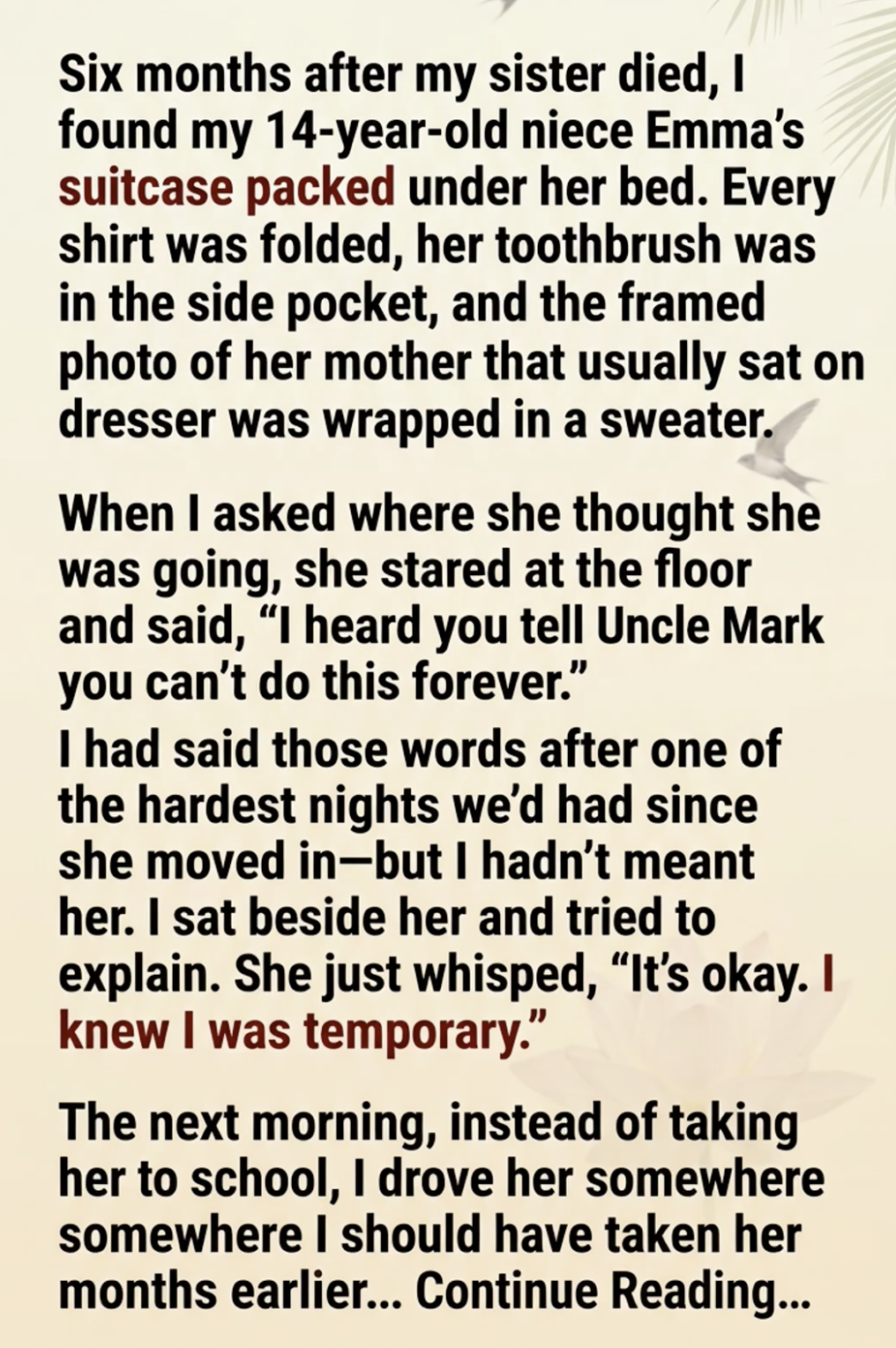
Six months after my sister died, I found my fourteen-year-old niece Emma’s suitcase packed under her bed.
Every shirt was folded.
Her toothbrush was in the side pocket.
Her favorite jeans were rolled tightly enough to fit around the edges.
And the framed photograph of her mother that usually sat on her dresser had been wrapped carefully in one of her old sweaters.
I stood in the doorway staring at it.
My first thought was that she was planning to run away.
My second was worse.
Maybe she was planning to leave because of me.
“Emma?”
She appeared in the hallway.
She stopped when she saw the suitcase.
For a moment, neither of us said anything.
Then I asked, “Where are you going?”
She stared at the floor.
“I don’t know.”
“Why is your suitcase packed?”
She shrugged.
I walked toward her.
“Emma, talk to me.”
Her voice was barely audible.
“I heard you.”
“Heard me what?”
“Talking to Uncle Mark.”
My stomach tightened.
“When?”
“Last Thursday.”
I remembered.
That night.
The worst night we’d had since Emma moved in.
She had gotten a message from school saying she was failing two classes. Then she had locked herself in the bathroom for almost an hour. When she finally came out, she wouldn’t speak.
Later, after she’d gone to bed, I sat at the kitchen table with my brother Mark.
I had been exhausted.
I had been crying.
I had said something I immediately regretted.
“I don’t know how long I can do this forever.”
I had meant the grief.
The court paperwork.
The school meetings.
The arguments.
The feeling that every day was another emergency.
I hadn’t meant Emma.
Not for one second.
But Emma hadn’t heard the whole conversation.
She had only heard those words.
“I can’t do this forever.”
I sat down beside her.
“Emma, I wasn’t talking about you.”
She didn’t look at me.
“I know.”
“No, you don’t.”
She swallowed.
“It’s okay.”
“It isn’t.”
She finally looked at me.
Her eyes were red.
“I knew I was temporary.”
Those four words broke something inside me.
“Who told you that?”
“Nobody.”
She looked down again.
“I just knew.”
I reached for her hand.
She let me hold it, but she didn’t squeeze back.
“You are not temporary.”
She nodded like she was agreeing with something she didn’t believe.
I spent the rest of the night trying to convince her.
But I realized something.
Words weren’t enough.
Emma had spent six months living in my house, sleeping in my spare bedroom, eating at my table, going to my appointments, and calling me Aunt instead of Mom.
But I had never actually sat down and told her what my sister had asked me to do.
Because I thought there would be time.
There was always supposed to be more time.
The next morning, instead of taking Emma to school, I drove her somewhere I should have taken her months earlier.
We went to the courthouse.
She looked at me as I parked.
“Why are we here?”
“Because there are things you deserve to know.”
She stared at the building.
“Am I in trouble?”
“No.”
“Did I do something?”
“No.”
“Then why are we here?”
I turned off the engine.
“Because six months ago, your mother trusted me with something.”
Emma went completely still.
I took a folder from my bag.
Inside was a copy of my sister’s will.
Emma’s name appeared on the first page.
But that wasn’t what I wanted her to see.
I opened to the final section.
My sister had named me Emma’s guardian.
Not temporarily.
Not until I got tired.
Not until someone else came along.
She had written:
“If I am unable to raise Emma, I want my sister to become her permanent guardian. I know she will understand that Emma needs more than a roof. She needs to know she belongs somewhere.”
Emma read the sentence twice.
Then she looked at me.
“She said that?”
“Yes.”
“Before she got sick?”
“Yes.”
“She knew?”
“She knew she might not recover.”
Emma’s eyes filled.
My sister had been diagnosed with cancer eighteen months before she died.
She had fought harder than anyone I’d ever known.
And during those final months, I had been so focused on helping her survive that I hadn’t understood what she was trying to prepare me for.
There was another document.
A letter.
I handed it to Emma.
It was addressed to her.
My sister had written it six weeks before she died.
Emma unfolded it with shaking hands.
She read silently.
Then she covered her mouth.
“What does it say?” I asked.
She shook her head.
“I can’t.”
So I didn’t make her.
We sat in the courthouse parking lot for nearly twenty minutes.
Finally, she handed it back.
“You read it.”
I looked at the letter.
My sister had written:
“Emma, if you’re reading this, I couldn’t stay as long as I promised.
I know everyone will tell you you’re loved. Believe them, even when grief makes it difficult.
And if Aunt Sarah becomes the person raising you, please don’t ever think you’re a burden.
She has a big heart, but she also has a habit of trying to carry everything alone.
If she ever says she can’t do something, ask her what she means.
Don’t assume she means she can’t love you.
Because she can.
And she will.
I stopped reading.
Emma was crying.
“So Mom knew you?”
I laughed through my tears.
“She knew me better than anyone.”
Emma wiped her cheeks.
“Did she really want me to stay with you?”
“She wanted you to have a home.”
“With you?”
“With me.”
She looked at the suitcase sitting in the back seat.
“I thought you were going to send me away.”
“I know.”
“I’m sorry.”
“Don’t apologize.”
“But I packed.”
“You packed because you were scared.”
She nodded.
“And I should have made sure you never had to be scared about that.”
We went inside the courthouse.
That day, we finalized something I should have handled months earlier.
Permanent guardianship.
Emma wasn’t being “kept” in my house.
She wasn’t a temporary responsibility.
She wasn’t waiting for someone to decide what would happen to her.
She was home.
But there was another reason I had brought her there.
Something my sister had arranged that I didn’t know about.
A small trust.
My sister had taken out a life insurance policy and established a protected account for Emma.
It wasn’t enormous.
About $187,000.
The money was intended for education, medical expenses, housing, and other needs until Emma became an adult.
I had known there was insurance.
I hadn’t known about the trust.
My sister had apparently spent months setting everything up.
There was also a letter from the trustee.
It said:
“Please make sure Emma understands that this money is not a replacement for her mother. It is simply her mother’s way of continuing to protect her.”
Emma stared at the paperwork.
“Mom did all this?”
“Yes.”
“Why didn’t you tell me?”
“I didn’t know.”
She looked at me.
“And you never took any of it?”
I shook my head.
“Not a dollar.”
She was quiet.
Then she asked something that hurt more than anything else.
“Was I expensive?”
I felt my chest tighten.
“What?”
“Taking care of me.”
“Emma.”
“I’m serious.”
She looked embarrassed.
“School stuff. Food. Clothes. The house. Everything.”
I put the paperwork down.
“You are not a bill.”
She looked at me.
“You’re not an expense.”
“But—”
“No.”
I reached across the table.
“Your mother didn’t leave me a responsibility.”
I paused.
“She left me you.”
Emma started crying again.
This time, she leaned into me.
And for the first time since she had moved in, she let herself be held like a child.
Not like a teenager trying desperately to be independent.
Not like someone waiting to be sent somewhere else.
Just a fourteen-year-old girl who had lost her mother.
We went home that afternoon.
The suitcase was still in the back seat.
I carried it upstairs.
Emma stood in the doorway of her room.
“What are you doing?”
“I’m unpacking.”
“You don’t have to.”
“I know.”
I opened the suitcase.
She watched as I took out the clothes she had folded so carefully.
One shirt.
Then another.
Then the toothbrush.
Finally, I pulled out the photograph of her mother.
I placed it back on the dresser.
Emma stared at it.
“Mom looks happy.”
“She was.”
“When?”
“That day.”
Emma smiled faintly.
“She always made me wear that stupid dress.”
“You hated it.”
“I hated the collar.”
I laughed.
She laughed too.
It was the first time I had heard her laugh without guilt in months.
That night, I cooked dinner.
Nothing special.
Chicken, potatoes, and green beans.
But halfway through the meal, Emma looked at me.
“Can I ask you something?”
“Anything.”
“Are you still going to be my guardian when I’m eighteen?”
I smiled.
“Being your guardian legally might end.”
She looked nervous.
“But?”
“But being your aunt doesn’t.”
She nodded.
Then she asked:
“What about when I’m twenty-five?”
“Still your aunt.”
“Thirty?”
“Unfortunately.”
She smiled.
“Forty?”
“By then you’ll probably be annoyed with me.”
“I already am sometimes.”
“Good. That means we’re family.”
She laughed.
A few weeks later, Emma started therapy.
Not because something was wrong with her.
Because something terrible had happened to her.
There was a difference.
I started therapy too.
I learned that grief doesn’t always look like crying.
Sometimes grief looks like anger.
Sometimes it looks like silence.
Sometimes it looks like packing a suitcase under your bed because you’re convinced you’re going to be abandoned before someone has the chance to abandon you.
And sometimes grief looks like an exhausted woman sitting at a kitchen table saying the wrong sentence at the wrong time.
I couldn’t undo what Emma had heard.
But I could change what happened afterward.
So I did.
I started telling her things.
If I was frustrated, I told her why.
If I was tired, I said, “I’m tired, but I’m not leaving.”
If I needed help, I asked for it.
If I was having a bad day, I didn’t disappear behind closed doors.
And every once in a while, when Emma looked uncertain, I reminded her.
“You belong here.”
At first she would roll her eyes.
“I know.”
But I kept saying it.
Because sometimes children need to hear something more than once before they believe it.
Three years later, Emma graduated from high school.
She had turned into a completely different person.
Confident.
Funny.
Still stubborn.
Still terrible at putting laundry away.
But happy.
After the ceremony, she hugged me.
Then she whispered:
“Mom would be proud.”
I held her tighter.
“I think she is.”
Emma smiled.
“I know.”
That evening, when we got home, she went upstairs.
A few minutes later, she came back down carrying something.
The same suitcase.
The one she had packed at fourteen.
She placed it in front of me.
I looked at her.
“What is this?”
She opened it.
Inside were the clothes she had packed that night.
Not all of them.
Some had been outgrown.
But the old green sweater was still there.
And inside it was the framed photograph of her mother.
I looked at Emma.
“Why did you keep this?”
She smiled.
“Because I wanted to remember how scared I was.”
I didn’t understand.
“Why?”
“Because I want to remember that I was wrong.”
She closed the suitcase.
“I wasn’t temporary.”
“No.”
She shook her head.
“I was home.”
Then she hugged me.
And I realized something my sister had understood long before I did.
You don’t become someone’s family simply because paperwork says so.
You become family in the small moments.
Packing lunches.
Waiting outside doctor’s offices.
Sitting through nightmares.
Arguing about homework.
Making pancakes on Sunday mornings.
Listening when they don’t want advice.
Showing up when they’re angry.
And most importantly, reminding them that they don’t have to earn their place in your life.
Emma had once believed she was temporary because she heard me say I couldn’t do it forever.
She had mistaken exhaustion for rejection.
I had mistaken love for something that could be communicated once and understood forever.
We were both wrong.
Because raising a child isn’t promising that you’ll never get tired.
It’s promising that when you do get tired, you won’t make the child carry the weight of your exhaustion.
My sister couldn’t stay.
But she had left behind the one thing she trusted me with most.
Her daughter.
And six months after her death, when I found that packed suitcase under Emma’s bed, I thought I was looking at the beginning of another loss.
Instead, it became the moment I finally understood what my sister had asked me to do.
Not simply keep Emma safe.
Not simply give her a room.
Not simply raise her until she was old enough to leave.
She had asked me to give her something grief had tried to steal from her.
A place where she never had to wonder whether she belonged.
A place where “forever” wasn’t a promise made only when life was easy.
A place she could finally call home.