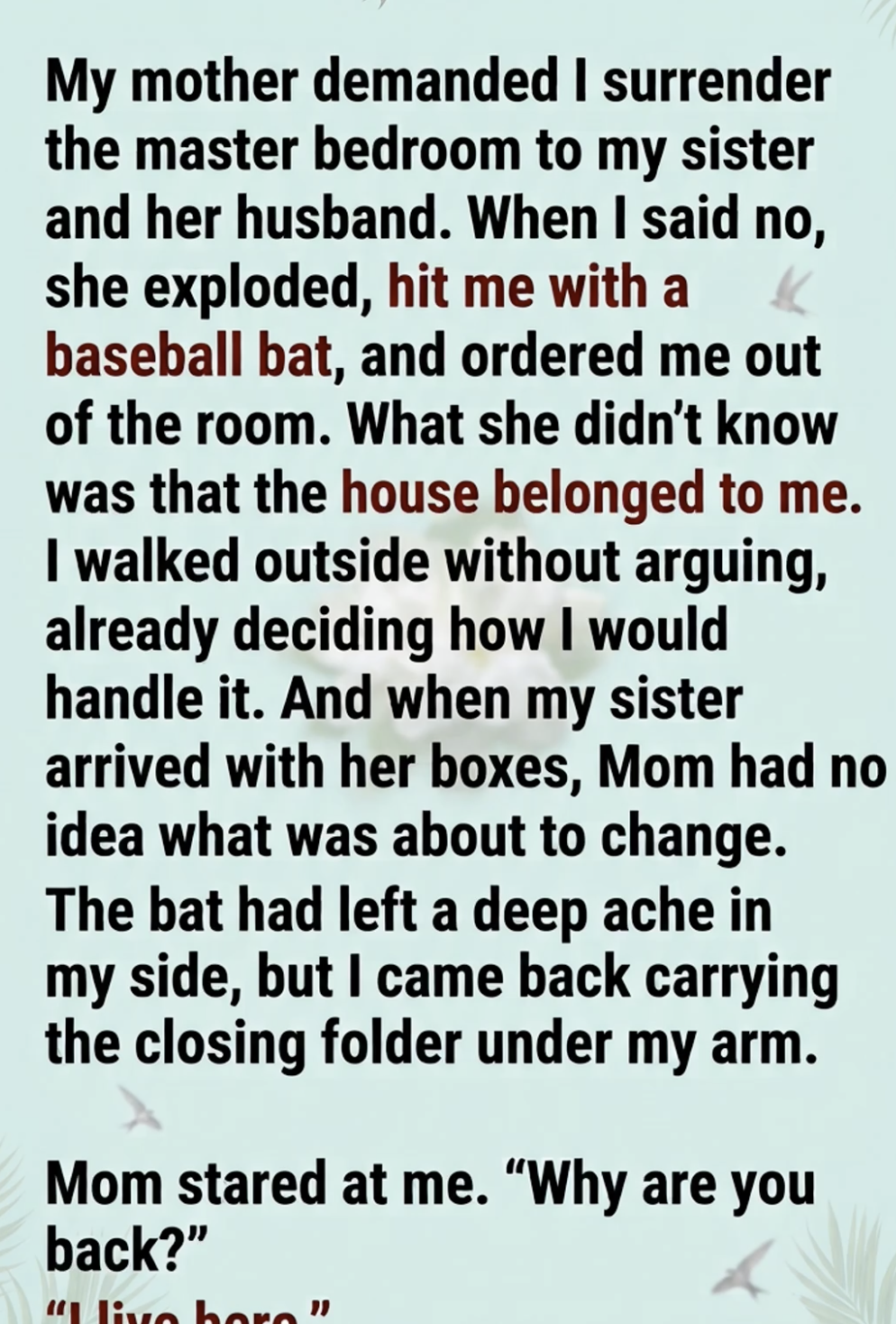
The bat had left a deep ache in my side, but I came back carrying the closing folder under my arm.
Mom stared at me from the front doorway.
“Why are you back?”
I looked past her into the house.
The house I had bought.
The house I had paid for.
The house where she had lived for almost three years because I had invited her to stay after Dad died.
“I live here.”
Her face went blank.
Behind her, my sister Rachel was standing beside a stack of cardboard boxes.
Her husband, Kevin, was carrying another one through the hallway.
Rachel looked from me to Mom.
“What’s going on?”
Mom stepped outside and lowered her voice.
“You need to leave.”
I almost laughed.
“You hit me with a baseball bat.”
“You wouldn’t listen.”
“You told me to give Rachel my bedroom.”
“She needs it.”
“Why?”
“Because she’s married.”
I stared at her.
“And I’m not?”
Mom’s expression hardened.
“You have the smaller room. Rachel and Kevin need the master.”
There it was.
The logic that had apparently justified everything.
My sister was married, so she deserved the biggest bedroom.
I was single, so I deserved whatever was left.
Except there was one small detail Mom had forgotten.
This wasn’t her house.
It wasn’t Rachel’s.
It wasn’t Kevin’s.
It was mine.
I had bought it four years earlier.
I had put down the entire down payment.
I had paid the mortgage.
I had paid the property taxes.
And when Dad died, I had let Mom move in because I didn’t want her living alone.
I never charged her rent.
I never asked for utilities.
I never asked her to contribute to repairs.
I thought I was giving my mother a home.
Somewhere along the way, she decided I had given her ownership.
And now she had swung a baseball bat at me because I wouldn’t surrender my bedroom.
I looked at Rachel.
“Did Mom tell you this was her house?”
Rachel hesitated.
“She said we’d be staying here.”
“For how long?”
She looked at Mom.
“I thought… permanently.”
I nodded slowly.
“Of course you did.”
Mom stepped forward.
“Don’t start making this ugly.”
I held up the folder.
“It already got ugly when you hit me.”
Her eyes dropped to the folder.
“What’s that?”
“The closing documents.”
She frowned.
“For what?”
“For this house.”
Silence.
I opened the folder.
My name was printed across the deed.
My name was on the mortgage.
My name was on the property tax records.
My name was on every document that mattered.
Mom stared at the pages.
Then she looked at me.
“You bought this?”
“Four years ago.”
“But your father—”
“Dad was already gone.”
“You never told me.”
“I did.”
“No, you didn’t.”
“I told you when I moved you in.”
Mom shook her head.
“You said it was our family home.”
“No.”
I looked directly at her.
“I said it was my home, and you were welcome to live with me.”
Her face reddened.
“You can’t just throw your mother out.”
“I’m not.”
I looked at Rachel and Kevin.
“But I can tell people who don’t own my house that they can’t move into it.”
Kevin slowly put down the box he was carrying.
“Wait.”
Rachel looked confused.
“Mom told us you were giving us the master bedroom.”
“I wasn’t.”
Mom snapped, “Don’t listen to her.”
Rachel’s face changed.
“Mom.”
“What?”
“Is this actually her house?”
Mom didn’t answer.
That silence was the answer.
Rachel looked at me.
“Why didn’t you tell me?”
“Because I didn’t know you were moving in.”
“I thought Mom arranged everything.”
“She apparently did.”
Kevin looked uncomfortable.
“Rachel, maybe we should go.”
Mom turned on him.
“Don’t you dare.”
He stepped back.
“I don’t want to be in the middle of this.”
“You already are.”
Mom pointed toward the hallway.
“Those boxes stay.”
I took a breath.
“Then they’ll need to leave too.”
Mom laughed bitterly.
“You think you can control everything because your name is on a piece of paper?”
“No.”
I looked at the bat leaning against the wall.
“I think ownership gives me certain rights.”
Her eyes followed mine.
The room became silent.
Then Mom said something I never expected.
“I hit you because you were being selfish.”
I stared at her.
“That’s your explanation?”
“You were refusing to help your sister.”
“I was refusing to give her my bedroom.”
“Same thing.”
“No.”
I shook my head.
“It’s not.”
Rachel started crying.
“Mom, stop.”
Mom looked at her.
“You’re taking her side?”
“I’m taking the side of reality.”
That was the first time I saw Rachel understand what had happened.
She hadn’t been told the truth.
She had been handed a story.
And I was the villain in it.
Rachel wiped her eyes.
“How long were you planning to let me believe this was your house?”
Mom didn’t answer.
Kevin picked up the nearest box.
“Come on.”
Mom grabbed his arm.
“No.”
Rachel pulled away.
“Yes.”
They carried the boxes back outside.
Mom followed them.
“Where are you going?”
Rachel stopped at the driveway.
“Home.”
“This is your home.”
“No.”
Rachel looked at me.
Then at the house.
“Apparently it isn’t.”
They left.
Mom remained standing in the doorway.
For the first time in years, she looked small.
But I wasn’t ready to forgive her.
Not yet.
The pain in my side had gotten worse.
I went to urgent care that afternoon.
The doctor examined the bruise and told me there was no fracture, but I needed rest and monitoring for worsening pain.
I filed a police report.
That decision caused a war.
Mom called me seventeen times.
Then she sent messages.
“How could you do this to your mother?”
“Family doesn’t call the police on family.”
“Your father would be ashamed.”
“Rachel is devastated.”
I didn’t respond.
Because the truth was simple.
Family doesn’t get to hit you and then demand silence because the person holding the bat is related to you.
The next morning, I changed the locks.
Then I met with an attorney.
Her name was Laura Bennett.
She reviewed the deed, mortgage, tax records, and every document I had.
Then she looked at me.
“Did your mother ever pay rent?”
“No.”
“Did she have a written lease?”
“No.”
“Did you give her permission to stay?”
“Yes.”
“Did you ever transfer ownership?”
“No.”
“Then she was a guest.”
I nodded.
“What about my sister?”
“Same.”
“They brought boxes.”
“That doesn’t give them rights to the property.”
“What do I do now?”
Laura leaned back.
“First, don’t threaten anyone. Don’t retaliate. Don’t put their belongings outside without following the appropriate legal process if they have established possession. Document everything.”
She paused.
“And regarding the assault, keep the police report and medical records.”
I did exactly that.
Mom’s behavior changed once she realized I wasn’t going to argue with her.
She became sweet.
Then apologetic.
Then angry again.
Finally, she showed up at my office.
“I made a mistake.”
I looked at her.
“You hit me with a baseball bat.”
“I lost my temper.”
“You could have seriously injured me.”
“I know.”
“Why did you want Rachel in my bedroom?”
She looked down.
“She and Kevin are having problems.”
That surprised me.
“What kind of problems?”
“Money.”
I waited.
Mom sighed.
“They’ve been living with Kevin’s brother. They can’t afford their own place.”
“So you decided to give them mine?”
“I thought you’d understand.”
“I understand that you wanted to help your daughter.”
“Then why won’t you?”
“I did.”
She looked confused.
“I’ve helped you for three years.”
“I never asked you to.”
“No.”
I looked at her.
“But you accepted it.”
She had no answer.
Then she said quietly, “Rachel thinks you hate her.”
“I don’t hate her.”
“She thinks you’re punishing her.”
“I’m not.”
“What are you doing?”
I took a breath.
“Setting a boundary.”
Mom started crying.
“You’ve changed.”
“Maybe.”
“You’re not the daughter I raised.”
I almost smiled.
“Maybe that’s the problem.”
She stared at me.
“You’re right.”
She blinked.
“What?”
“I changed.”
I stood.
“I learned that being generous doesn’t mean surrendering everything.”
Mom left.
For several weeks, we barely spoke.
Rachel eventually called.
She apologized.
Not for moving in.
For believing Mom without asking me.
“I should have talked to you.”
“Yes.”
“I thought you had agreed.”
“I know.”
“Kevin and I are okay now.”
“Good.”
She hesitated.
“Mom told us you were planning to sell the house.”
I laughed.
“No.”
“She said you were going to leave the family with nothing.”
“Rachel, I don’t think my house is the family’s property.”
“I know that now.”
She was quiet.
Then she said, “I was embarrassed.”
“You don’t have to be.”
“I feel stupid.”
“You weren’t stupid.”
I paused.
“You trusted Mom.”
“So did you.”
That sentence stayed with me.
Because she was right.
I had trusted my mother too.
I had trusted her enough to give her a key.
Enough to let her stay.
Enough to believe that gratitude would prevent entitlement.
It didn’t.
A month later, I received a letter from Mom.
I expected another accusation.
Instead, it was three pages long.
She admitted she had started thinking of the house as hers because I had never charged her rent.
She admitted she had told Rachel the master bedroom was hers before ever asking me.
And she admitted something else.
She had been afraid.
She was afraid that if she didn’t make herself indispensable to Rachel, Rachel would move away and leave her alone.
So she had tried to build a new family arrangement without asking anyone.
Then she wrote:
“I thought I was protecting myself from being abandoned again.
Instead, I became the person who hurt you.
I’m sorry.
I don’t expect you to let me back into the house.
I don’t expect forgiveness because I’m your mother.
I only hope someday you can believe that I understand what I did.”
I read the letter twice.
Then I put it away.
I wasn’t ready.
Forgiveness isn’t the same thing as permission.
And loving someone doesn’t require giving them access to everything you own.
Three months later, Mom moved into a small apartment of her own.
Rachel and Kevin found a rental.
Nobody moved into my master bedroom.
I repainted it.
Not because I needed to prove anything.
Because I wanted to reclaim it.
I replaced the old furniture.
Bought new curtains.
Put a reading chair beside the window.
And on the wall, I hung a framed copy of the original closing statement.
Not as a trophy.
As a reminder.
The house wasn’t valuable because it was mine.
It was valuable because I had spent years building a life where I could finally feel safe.
I had almost forgotten that.
One Sunday afternoon, Rachel came over.
She stood in the doorway of the master bedroom.
“Can I see?”
I smiled.
“Sure.”
She walked inside.
“This is beautiful.”
“Thanks.”
She looked at the chair.
“Mom would have hated that.”
We both laughed.
Then Rachel became serious.
“I’m sorry.”
“I know.”
“I should have never assumed you owed me this.”
“You didn’t.”
She nodded.
“I know that now.”
We sat together for a while.
No arguments.
No accusations.
Just sisters.
Eventually, Mom came over too.
She stayed in the living room.
She didn’t touch anything.
Didn’t open cabinets.
Didn’t tell me what to do.
When she left, she paused at the door.
“Goodnight.”
“Goodnight, Mom.”
She looked back at the house.
Then at me.
“You really love this place.”
I nodded.
“I do.”
She smiled faintly.
“Then I’m glad you kept it.”
That was the closest thing to an apology I needed.
Not because everything was suddenly fixed.
It wasn’t.
Trust takes longer than paperwork.
But the boundaries were finally clear.
My mother had once thought that because I was her daughter, she could decide what happened inside my home.
She was wrong.
My sister had thought that because we were family, I would automatically surrender whatever she needed.
She was wrong too.
And I had learned something just as important.
Being the person who helps everyone doesn’t mean you have to become the person everyone gets to use.
The day Mom hit me with that baseball bat, she thought she was forcing me out of a bedroom.
She didn’t realize she was forcing me to finally stand up for myself.
And when I walked back through that front door carrying the closing folder under my arm, I wasn’t there to win an argument.
I was there to reclaim my home.
I looked at Mom and said the only thing she could no longer argue with.
“I live here.”
And this time, everyone understood exactly what I meant.