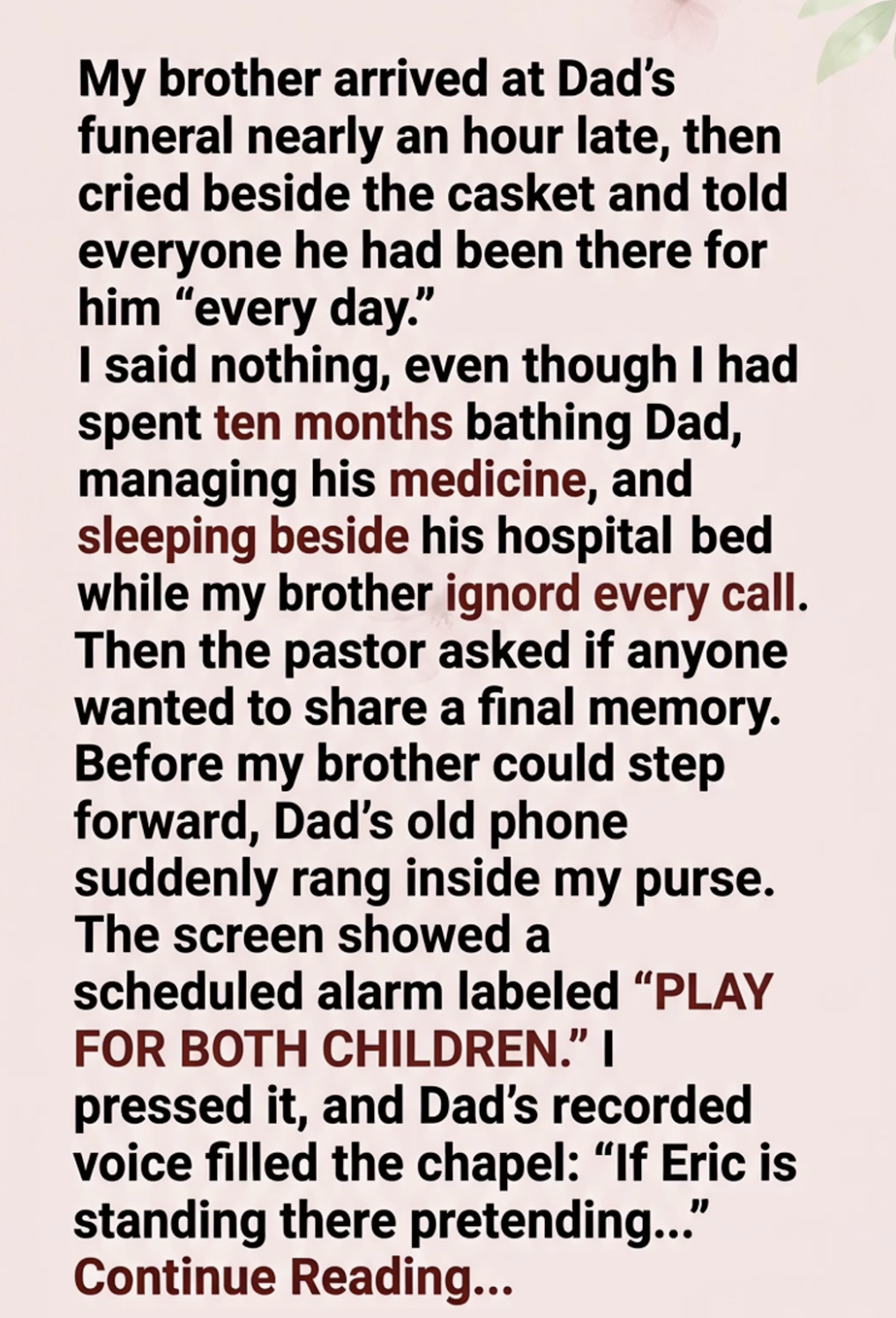
My brother arrived at Dad’s funeral fifty-three minutes late.
The chapel was already full.
Friends from Dad’s old workplace sat along one side.
Neighbors filled the back rows.
My aunt was crying quietly near the front.
And I had spent the previous ten months making sure Dad was never alone.
Eric walked through the chapel doors wearing a dark suit and carrying a bouquet of white roses.
He stopped when he saw the casket.
Then he covered his face.
“Dad…”
His voice cracked loudly enough for everyone to hear.
He walked straight to the casket and placed the flowers beside it.
“I was there for him every day,” he whispered.
I looked down.
I said nothing.
Because I knew the truth.
I had been there.
Every morning.
Every night.
Every medication.
Every appointment.
Every hospital visit.
Every fever.
Every sleepless night.
For ten months, I had been the one bathing Dad when he couldn’t stand.
I was the one who learned which medications had to be taken with food.
I was the one who slept in a chair beside his hospital bed because he became frightened when he woke up alone.
Eric knew all of this.
I had called him.
Again and again.
I had left messages.
“Dad wants to hear your voice.”
“He’s asking for you.”
“Please call.”
Most of the time, Eric never answered.
Sometimes he texted:
“I’m busy.”
“Tell him I’ll call later.”
“I’m dealing with work.”
Later never came.
But now he stood beside the casket crying as though he’d spent every day of those ten months at Dad’s side.
People hugged him.
My aunt whispered,
“He must be devastated.”
I nodded.
I couldn’t bring myself to correct her.
Not there.
Not beside Dad.
The pastor began the service.
He spoke about Dad’s kindness.
His stubbornness.
His terrible jokes.
His habit of fixing things that weren’t broken.
People laughed through their tears.
Then the pastor said,
“Before we close, I’d like to invite anyone who wishes to share a final memory.”
Eric immediately stood.
I knew what was coming.
He walked toward the microphone.
“I was blessed to be my father’s son,” he began.
Then something rang.
A phone.
Everyone looked around.
I reached into my purse.
My hand touched Dad’s old phone.
I had kept it because the hospital had called that number for months.
The screen was glowing.
There was an alarm notification.
I stared at it.
The label read:
PLAY FOR BOTH CHILDREN
I froze.
I had never seen it before.
The alarm was scheduled for that exact time.
I looked toward the pastor.
Then toward Eric.
He was staring at the phone.
His face had gone completely white.
“What is that?” he whispered.
I didn’t know.
My thumb hovered over the screen.
Then I pressed it.
Dad’s recorded voice filled the chapel.
“Hello, my children.”
Everyone became silent.
Eric sat down.
Dad continued.
“If you’re hearing this, I’m probably no longer here to explain myself.”
I covered my mouth.
His voice was weak.
But unmistakably his.
“I made this recording because there are things I don’t want either of you to misunderstand.”
He paused.
Then came the sentence that made the entire chapel go still.
“If Eric is standing there pretending he was here for me every day, please don’t let him finish the story.”
Someone gasped.
Eric stood up.
“Turn that off.”
I looked at him.
Dad’s voice continued.
“Eric, I love you.”
Eric froze.
“But love doesn’t mean pretending.”
The room was completely silent.
Dad went on.
“Your sister has been here.”
My eyes filled with tears.
“She has bathed me when I couldn’t bathe myself.”
“She has learned every medication.”
“She has slept beside my hospital bed.”
“She has held my hand when I was afraid.”
“She has answered every call.”
“She has done things no child should have to do alone.”
I couldn’t look at anyone.
Dad continued.
“And Eric…”
There was a long pause.
“I know you weren’t here.”
Eric’s face crumpled.
“I know you didn’t answer your sister’s calls.”
“I know you didn’t visit.”
“And I know you sent money sometimes.”
Eric whispered,
“I did.”
Dad’s recording continued.
“Money is helpful.”
“But money isn’t presence.”
My aunt began crying.
Dad continued.
“I don’t want my children fighting at my funeral.”
“That would break my heart.”
“So I’m not asking you to punish Eric.”
“I am asking you not to let him rewrite the truth.”
I looked at my brother.
He was staring at the floor.
Dad’s voice became softer.
“And I don’t want my daughter to believe that everything she did was invisible.”
My tears finally fell.
“I saw you.”
“I saw every night you stayed awake.”
“I saw you pretending you weren’t tired.”
“I saw you crying in the kitchen because you didn’t want me to see.”
I closed my eyes.
I had thought Dad hadn’t noticed.
He had noticed everything.
Then he said something that changed the entire room.
“There is one more thing.”
The recording continued.
“I left instructions with my attorney.”
Eric looked up.
“There are two envelopes.”
“One for each of you.”
“Mine contains something for Eric.”
“And hers contains something for her.”
I heard Eric whisper,
“What?”
Dad continued.
“Eric, I didn’t disinherit you.”
“You are my son.”
“But I have not left you control over anything.”
I looked at my brother.
His expression changed.
“The house, the investment account, and the family property are to be managed by an independent trustee.”
Eric stood.
“What?”
The pastor quietly asked him to sit.
Dad’s voice continued.
“My daughter will receive compensation for the caregiving expenses she covered personally.”
“She will also receive the small lake cottage.”
Eric stared at me.
“What?”
Dad went on.
“Eric, you may be angry.”
“You may believe this is unfair.”
“But fairness isn’t giving everyone the same thing.”
“Fairness is recognizing what each person actually contributed.”
The chapel was silent.
Then Dad said:
“I have one final request.”
His voice softened.
“After I’m gone, I want you two to stop keeping score.”
“Your mother would have hated that.”
There was a tiny pause.
Then:
“Tell your sister I’m proud of her.”
“And Eric…”
Another pause.
“Come home.”
The recording ended.
For several seconds, nobody moved.
Then the screen went dark.
I lowered the phone.
Eric was crying.
Not the loud crying he’d done when he first arrived.
This was different.
Quiet.
Broken.
He walked toward me.
“I lied.”
I didn’t answer.
“I don’t know why I did that.”
I looked at him.
“You wanted everyone to think you were a good son.”
He nodded.
“I was ashamed.”
“You should have been honest.”
“I know.”
He looked at Dad’s casket.
“I thought if everyone knew I hadn’t been there, they’d hate me.”
I swallowed.
“I didn’t want them to hate you.”
He looked at me.
“I know.”
“I wanted you to come.”
He started crying again.
“I know.”
That was the hardest part.
I hadn’t wanted Dad’s funeral to expose Eric.
I had wanted Eric to show up while Dad was alive.
He hadn’t.
After the service, Dad’s attorney, Mr. Harris, asked both of us to meet privately.
He placed two envelopes on the table.
“One for each of you.”
Eric looked at his.
Then at me.
Neither of us opened them immediately.
Finally, I opened mine.
Inside was a letter.
My dear daughter,
If you’re reading this, you probably think you did what you had to do.
You did more than that.
You gave me dignity when I was losing everything else.
I know you may feel angry with your brother.
You have every right to feel hurt.
But don’t carry his absence as another burden.
That’s not yours to carry.
Then came the sentence that broke me.
“You were my daughter before you became my caregiver. Never forget that.”
I pressed the letter against my chest.
Eric opened his envelope.
His face changed as he read.
“What did he leave you?” I asked.
He shook his head.
“Not money.”
“What?”
He handed me the letter.
Dad had written:
Eric,
I know you stayed away because you were afraid.
Maybe you were afraid of seeing me sick.
Maybe you were afraid of seeing what you had become.
Maybe you were ashamed.
Whatever the reason, you still have time.
Don’t spend the rest of your life proving you were here.
Be here now.
The letter continued.
“Your sister doesn’t need another apology.”
“She needs a brother.”
Eric covered his face.
For a long time, neither of us spoke.
Then he said,
“I don’t know how to fix this.”
“You can’t fix the past.”
“I know.”
“But you can stop making it worse.”
He nodded.
Then he asked,
“Can I come to the house?”
I hesitated.
It was the house where Dad had spent his final months.
The place where I had cared for him.
The place where every room contained a memory.
Finally, I said,
“Yes.”
He came the next morning.
For the first time in seven years, my brother walked into Dad’s house while Dad was still the subject of our conversation.
We went through photographs.
Old Christmas cards.
School pictures.
Dad’s terrible vacation shirts.
We laughed.
Then we cried.
At one point, Eric found a photograph of the two of us as children.
I was sitting on Dad’s shoulders.
Eric was beside him.
Dad was smiling.
Eric stared at it.
“I don’t remember this.”
“I do.”
“I wish I remembered more.”
“You have time.”
He looked at me.
“Do I?”
I smiled sadly.
“Yes.”
“You think we can be okay?”
“I think we can try.”
It wasn’t forgiveness.
Not yet.
But it was something.
A beginning.
Over the following months, Eric changed.
Not dramatically.
Not overnight.
He simply started showing up.
He came to family dinners.
He helped clean Dad’s house.
He visited our aunt.
He called me without needing anything.
Once, he called just to ask,
“How are you?”
I almost laughed.
Then I realized he was serious.
“I’m okay.”
“Good.”
“Why?”
“Because I finally understand how often nobody asked you that.”
I didn’t say anything.
I didn’t need to.
Months later, we returned to the cemetery together.
Eric placed flowers beside Dad’s grave.
Then he stood quietly.
“I should have come when he was alive.”
“Yes.”
“I know that doesn’t change.”
“No.”
He looked at me.
“But I’m here now.”
I nodded.
“That matters.”
He put his hand on my shoulder.
And for the first time in years, my brother didn’t try to rewrite the past.
He simply stood beside me in it.
Dad’s recording had lasted less than six minutes.
But those six minutes changed everything.
It didn’t expose Eric to humiliate him.
It exposed the truth because Dad knew that silence could become another kind of lie.
He knew his daughter might spend years wondering whether anyone had noticed what she’d sacrificed.
He wanted me to know.
He wanted Eric to know.
And most of all, he wanted us to stop confusing money with love, appearances with devotion, and guilt with responsibility.
I still think about that morning at the funeral.
Eric arrived almost an hour late.
He stood beside the casket and told everyone he’d been there every day.
Then Dad’s old phone rang.
And his voice filled the chapel.
“If Eric is standing there pretending…”
Dad never finished the sentence himself.
He didn’t need to.
The truth did the rest.
And the final lesson my father left us wasn’t about who had done more.
It was much simpler.
You don’t prove love by showing up after someone is gone.
You prove it while they’re still here.
And if you were lucky enough to be given another chance after failing someone you love, you don’t waste that chance trying to rewrite yesterday.
You show up today.